Thursday, January 31, 2019

Faces in the crowd


Here's a photo taken in just one of many moments in a busy day at Boston's South Station in mid-October 2018.  One of my lovely nieces had just escorted me through the labyrinth to connect with friends A and J for our bus trip north and our long-planned Excellent Maine Woods Adventure.

I was already filled with so much contentment and stimulation -- foremost from family and friends and unforgettably, too, from all the wonderful art I'd seen in both New York City and Boston.  You might have read my November post about the very special Pontormo exhibit I'd seen.  I was thrilled to see one of the actual paintings that had triggered my continuing enchantment with this artist and my continuing fascination with the "lesser" faces in major paintings -- the people on the sidelines or in the background; the faces in the crowd.

I still keep dipping into the internet for articles and videos about Pontormo and about that particular exhibit.  I wish I'd done so in advance -- I would have learned that the colours of his "Visitation"  (barely captured in my shot above) were so fresh and glowing because the painting had only recently been restored.  Fresh and glowing, too, was this unforgettable face in the background that has intrigued me ever since I first saw it in an art book reproduction.


 Intriguing, too, was that young woman in the crowd at the bus station.


 When I settled back home and began working regularly in my revamped studio, the two somehow came together for me:--  a painting to be called, "Art Students - The Twins."  And so I set to work.


 -- with many ups and downs, I might add.  There's a prevailing question in painting, which would be funny if it weren't so serious:  "How do you know when to stop?"  A common answer from professionals is, "When there's nothing more to be done."  In my case lately the answer has been, "When I know that if I do one more tiny thing, I will totally wreck what, for better or worse, I've achieved so far."

The ups and downs of this Excellent Adventure are shown here.  I'll blame a little bit on the not yet satisfactory lighting in my studio and my camera's tendency to go for the raw when I adjust the brightness.  I don't think I've done either of these young ladies credit, but here it is:--


I still think Pontormo's beautifully conceived face is one of the most compelling I've seen in Western Art -- even more so than Mona Lisa.  Even in my own inadequate version, I've savoured the time I spent studying her.


I've also considered what it means to copy a masterwork -- either for study or for fun -- and have come up with no hard and fast rules.   Speaking of Mona Lisa, look what some goofball on the internet came up with, called "When Mona Lisa Was a Half-Hour Late."


Tuesday, January 15, 2019

Uh-oh ---


You call this a fresh start?  Well, it's not quite The Scream, but I felt like screaming as my resolution to return to the life drawing studio on January 3rd dissolved in an eerie penetrating shriek.  Probably the model who selected this shrieking sound considered it "music," but it was more like the war-cry of deranged aliens.  I could stick it out for only an hour (of a usual 3-hour session) before I felt on the verge of a seizure. 

I packed up and left, having confirmed things I already knew: (1) that my drawing would be rusty after three months away; and (2) tomorrow is always another day.  So I returned the following Thursday and was greeted with peace and quiet, a small but focused group of compatriot artists, and a delightful model whose mop-head hairstyle just suited my kind of loose sketching.


Simultaneously, I'm committing my weekend studio hours to the new on-line course.  My cohort there, like that at the drawing studio, changes all the time since students do the lessons at their own pace (or not at all).  The curriculum starts with considerable emphasis on values in painting --  a key quality I've worked with many times since I first read the words of  Corot, one of my heroes:  "The most important things in a painting are Form and Value. Color comes last - like a friend you welcome."

The lesson called for choosing several master paintings and analyzing their value structure, assisted by a neat little trick:-- using one's computer software to translate the painting from colour to black-and-white.  For example, "The Scream" looks like this:--


and can be analyzed with this:--


Next it was time to do our own thing:-- Paint and submit a "baseline painting" (for later comparison), along with its value breakdown in black-and-white.  Here's my "Let's Talk," a recent re-do of a study I worked on a few years ago:


 And with a flip of the switch in my software, here's the black-and-white version:


Value studies are one of those things that artists return to from time to time, more or less forever.  One way to approach them intensively is to develop and use a grey scale -- most challengingly, a 9-step evenly modulated progression from white to black.


 Does this look easy?  It isn't!  I played up and down this xylophone so many times it was starting to emit sounds. (Scream, anyone?)  This final version results from some creative cutting and pasting from several different tries.

Now, for some additional strenuous exercise, I've followed the much simpler instructions to make a handy little viewfinder.  This enables one to isolate spots on 2-D surfaces or in the surroundings and selectively compare them against each other.


For example, suppose you're aiming for a fairly realistic painting of apples and oranges, and you need to get the values just right.
  

Yes, you can compare apples to oranges -- right down to the fine points in your model.   Are you confident of the lightest light?  Let's compare the light on the edge of the orange peel to the light yellow-green of the apple.


The difference in "lightness" might come as a surprise.  Then again, when value comparisons become automatic, you don't need to do this.

My biggest New Year's noise -- and it's a celebratory cheer -- consists of applause for my newly expanded studio, a major goal I'd set for the end of 2018.  Since we first moved here, I've had a dedicated room in the basement which opens like this:


 A further peek inside shows **SPACE** that used to be limited by my painting table.


My original studio is now The Drawing Room, and painting activities have spread out into the adjacent part of the basement -- where I actually have room now to stand back a bit to view my painting in progress.  Here's a not quite 180-degree view, starting at the door to The Drawing Room.


 Talk about shrieks of excitement!

I have a lot to accomplish in 2019, and I'm newly energized when I head downstairs first thing each morning.  C'mon, let's get going ---!


Monday, December 31, 2018

The view from here -- New Year's Eve 2018


December 31, 2018, about noon today.  Now it's 8:30 p.m. and I'm counting down.   Inevitably, a time for introspection and retrospection.

This time last year, I was eagerly awaiting the first week of a weekly on-line art class that would focus on the portrait.  By February, my enthusiasm was fading but I resolved to press on.  I'd decided to do my own thing with whatever Artist-of-the-Week was scheduled, and I had moved into passive LURK mode on the class's Facebook page.  I could not stand the superficiality of Like-Like-Like critiques and what, despite different instructors and media, seemed a repetitive roll-out of long-haired young female models. 

But some good things came of the experience -- and here's a quick recap via some of my output.  First, I became more committed to delving into art history through renewed acquaintance with artists such as Piero della Francesca:


and Giovanni Bellini:


Second, even though I'm immersed in painting, I remembered how much I love drawings when I chose to work with pencil in the weeks featuring Caravaggio and Anna Dorothea Therbusch.


Therbusch and several artists made for a third benefit of the course.  They were people I'd never heard of, or was only vaguely aware of, and in some cases they were *great* discoveries.  There was Henry Ossawa Tanner:--


Ferdinand Hodler:--


 Maurice Denis:--


 A fourth benefit of the course was spending more concentrated time with some familiars -- Gustav Klimt, for one:--


 And of course, Van Gogh:--


As I look through the almost fifty portraits I've accumulated in this way, I note that three are particularly striking to me.  Further acquaintance with the artists they represent is likely, in one way or other, to have an impact on my development.  They are Gwen John:--


 Alice Neel:--


 ...and, most significantly, Irma Stern -- who was formerly unknown to me.  These little punk kids, as I call them, are the genies of my studio now.  I'll feel very good if  I again do something that pleases me as much as they do:--


So....that was then.  This is now.  What's next?  Welllllll.....this is as good a time as any to announce that:  I've signed up for another on-line course!!   Do I hear a collective groan?  Do you think my brain has turned to mush from some of the last quarter's artists who were collectively kind of strange, like Afarin Sajedi?

Time will tell.  But the very structure of the course addresses the shortfalls of the just-ended On-Line 2018.
  • It was developed by a professional artist who aims to present the content of  a year of art school, with a focus on painting.
  • It operates within a highly sophisticated website with a wealth of teaching material -- reading, videos, and examples.  A brief weekly newsletter is an added friendly touch.
  • There are no hard and fast requirements for participation, but if/when you choose to participate, there are very definite guidelines about what you're expected to achieve and where and how you are expected to post your completed assignments.
In contrast to the Facebook stuff that I couldn't stand, the communications among students takes place within a secure "on-line classroom".  There are firm do's and don'ts about critiqueing others' work:
  • It's an expectation.  Before you post your own assignment, you're expected to comment on at least one other student's post.
  • It is explicitly stated that it's unacceptable to say, "I really like this, Fred."  Instead -- and there are numerous examples as guidelines -- you're expected to hone in on something specific and to recommend a remedy.
I've been enrolled for two weeks now, and I'm really impressed with the curriculum and with the calibre of the "on-line community" -- serious people (many retirees like me) who know that they have a lot to learn and are eager to work seriously to get where they want to go.

For now, I'll hopefully sign off with a favourite quote from the poet Rilke: 
"Come let us welcome the new year,
full of things that never have been."


Saturday, December 15, 2018

YES - Done, finished, fini, fertig, terminado!


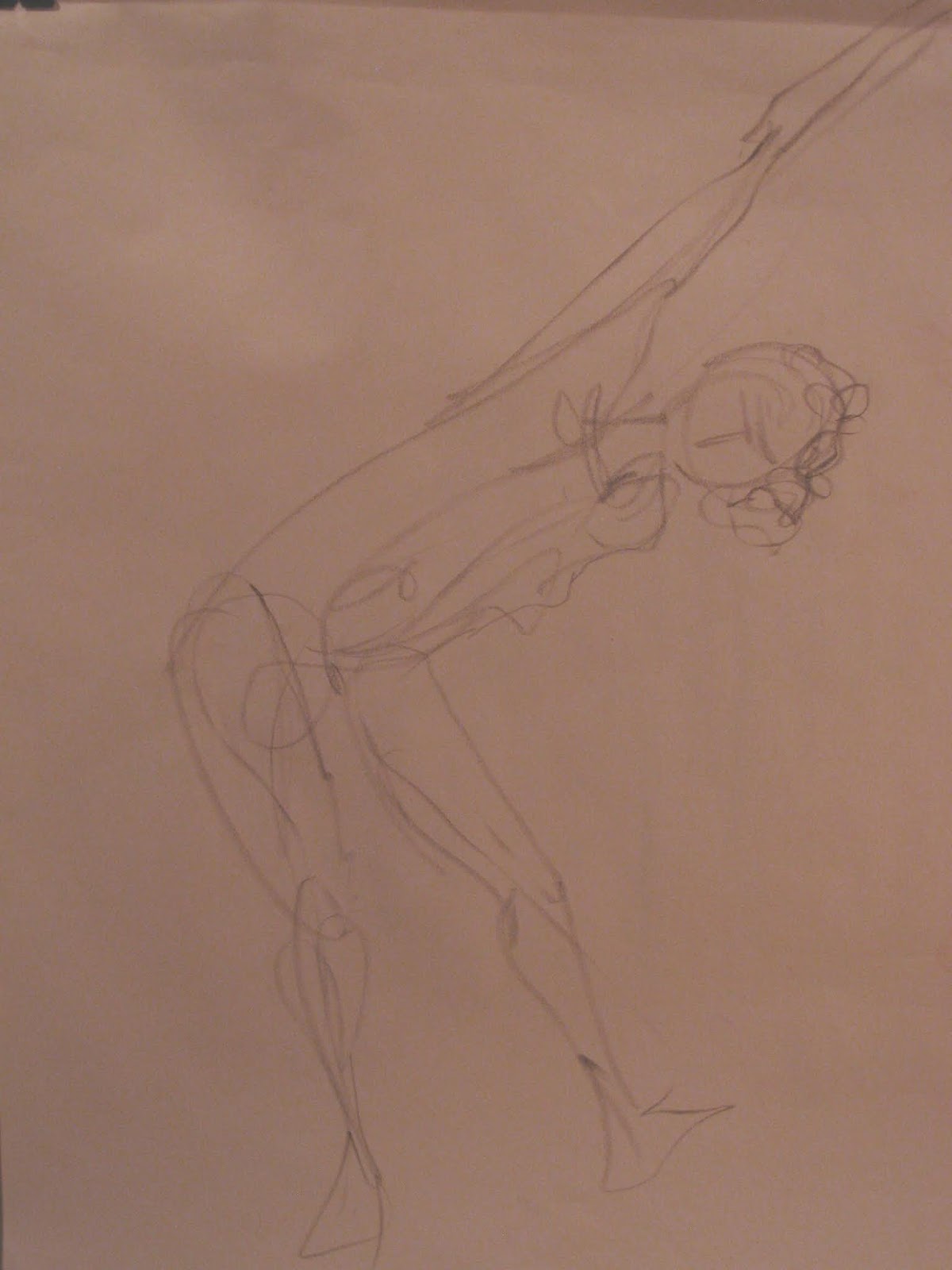
This figure is a quick study I made a few years back from a dance poster -- and I bring it out from time to time when I need a forceful reminder to "GET IT DONE!!!"  Well, I did it.  I finished the year-long on-line art course about which I've had such mixed feelings.  More about that next time, but for now....let's do a wrap with the final Artists-of-the-Week.

First, as the rain pours down here in Vancouver, I'll do a quick check out the window for bowler-hatted gentlemen holding umbrellas, drifting down from the sky.  No sign of 'em.  But you've guessed I'm summoning the spirit of Magritte.  For my lesson, I preferred his blue skies, usually with puffy clouds and occasionally with a prominent eyeball.  I put them all together for a weird riff called "Head in Hands" --


Everyone knows Dali, right?  Sagging watches.  Weird artifacts strewn about desert landscapes.  Butterflies doubling as sails on a 7-masted schooner.  Yes, that Dali.  But he also did some rather lovely women's faces, as in his mysterious "Adolescence".  The painting itself was once the subject of an art heist from a Dutch museum -- finally recovered after seven years' absence.  Here's my take on this, my favourite among all the Dalis I've seen:


After these surrealistic offerings, the course moved next into the era of so-called Contemporary Realism.  I wasn't keen on Roberta Coni whose females often wrap their heads in turbans -- and despite the protective covering, find themselves smeared with paint from the artist's hand.  My rendition:


Then we hit familiar territory again with Chuck Close, who I've known for decades for his wonderful pencil and charcoal portraits -- often reaching awesome proportions, say 15 x 20 FEET.  Lately, his giant works in colour have combined Klimt-type shapes with mosaic-type layouts.  Check this link and wait for about the fourth head to appear and you'll see what I mean.

With a self-serving strategy, I opted for small rather than large -- about 4" x 6", done in coloured pencil.  Copying an earlier class exercise, I did a close-up of Van Gogh's eye in one of his self-portraits.   Here's my version called, "Chuck and Vincent See Eye-to-Eye."


Up next were two contemporary artists I'd never heard of but whose work I found interesting.  Michael Carson often places his figures and portraits on a plain flat background, sometimes using a particular rich rusty red colour.  I used these two aspects for a painted version of an unrelated photograph I happened across on-line.  Using my favoured el-cheapo support, I painted on a piece of cardboard to produce "Corrugated Carson."


 Casey Baugh does gorgeous charcoal portraits -- sometimes smeared or speckled, sometimes on the large size -- maybe 5' across.  My spin-off from another on-line vintage photo was not very satisfactory but...hey, I was wanting this course to end!!


 -- and it did for me, finally, with artist Tony Scherman -- another whose style involves blurring and smearing.  I hadn't much interest in emulating this so opted for a simple pastel-like treatment.


 And now:  A new year is waiting in the wings, and what that will mean for my art goals will become clear before very long. 

Right now, things aren't quite "terminado" with my household and studio reorganization , but I'm getting it done!