Tuesday, October 31, 2023

Nothing old hat about these centuries-old traditions


These witchy gals keep showing up in my searches for vintage photos – sans identification.  Well, what would one expect?  And who would want to learn that one of them was your grandmother?


Even in their day, they were youngsters in the witchly family tree.  The first known written manual on How To Be A Witch dates to 1584, but the practice evidently goes back to the Stone Age in different cultures.


This group of pointy-hatted Victorians would be right at home having tea in the garden.  Oops!! That's a Starbuck's cup, and someone who is decidedly eerie has already snagged the last table.


Coincidentally with this season when costumes rule, I've been thinking about my next series – after my tronie-induced art fail recorded last time.  Looking at old lists I'd made of possible "Series and Singulars," as I call them, I came across a recurring enticement – Commedia dell'Arte.   Like the witches' grimoire, there are various recorded fragments of Commedia performances going back to the 1500s.


This ample compendium from the 1960s collected working scripts for no fewer than 50 plotlines.


Thanks to traveling Italian players, the Commedia's stock characters in stock situations will show up throughout the history of European theatre -- in Shakespeare, in Moliere, and even in the lower-brow Punch and Judy puppet shows.


Well!  Before my book request came through from the Vancouver Public Library, I'd remembered my early infatuation with the Commedia characters.  When we moved in 2012, I'd tried weeding out old paintings but hadn't been able to give up this brief series from 1988.  (I look at some of my early paintings and wonder if I wasn't better then than now).


Here's my Harlequin (Arlecchino in the Italian), whose deep purple-violet garments seem to have become even darker over time – while the surface of the glued collage elements has made it almost impossible to get a proper glare-free shot.  It's just as well that my original plan, to place our Siamese cat in his arms, didn't pan out. 


Next up:  "The White Clown," modeled on the Commedia's Pierrot.


I must offer a tip of someone's hat (pointy or otherwise) to Watteau, from whom I borrowed the bow on the shoe.


I was in a very experimental phase then.  The White Clown peeks from beneath that drapery because the panel I was painting on had a big corner chip that I had to cover up.  And the final piece in the series is perhaps the most successful – except for my timid treatment of the flesh and faces.


Here, Columbina (left) and Arlecchina share a dramatic element of their dresses with the single piece of old lace that unites them.


Well, one thing leads to another when your thoughts are leaping around.


 As a result, I've decided to revisit the Commedia characters and costumes.  After all, if the subject is good enough for Picasso, it's good enough for me.  No way!!!  I've just gone looking for a link to Picasso's harlequins and found a link to "Picasso Clown Fish."   A pricey little number, too.


So – gather your theatre attire…or popcorn?...and get ready for more behind-the-scene glimpses of a zany collection of characters.  But first, they have to audition!


Saturday, October 14, 2023

What next?


When I first saw this face as a poster in a long-ago co-worker's office, I thought it was a cartoon joke.  But no.  It's a Rembrandt self-portrait, in popular form.  Not only did Rembrandt make over 80 surviving self-portraits through his lifetime, but he had an unsuspected sense of humour, too.


This one is in the tradition of Golden Age Dutch tronies.  The term applies not only to faces that are exaggerations or caricatures, but also to "types"  -- Vermeer's well-known "Girl With A Pearl Earring" is considered a tronie, as the type of an innocent young woman.  And how about this real-life example – the "type" of a Canadian political figure?


Confidential to ardent investigators:  If you want to pursue the weird aspect of tronies, just skim down this page for the heads created by Franz Xaver Messerschmidt, an 18th-century German-Austrian sculptor.


Where is all this leading?  Returning from summer camp, with fewer than 11 hours of daylight now, I'm eager to return to my own favourite themes – people's figures and faces.  I remember how much fun it was to frolic and detour!


I decided it was time to start working on a series I've had in mind that would kick off with an image of the sun.


Just at this time, it happened that via my friend L and the circles she moves in, I went with her on a tour of artists' studios in Gibsons and Sechelt on the Sunshine Coast.  What an amazing trip!  Probably my favourite of the artists we met was this architect-turned-painter -- click here on "Meet the Artist" and you'll see him in action – creating the random slicks of paper that in themselves are gorgeous.


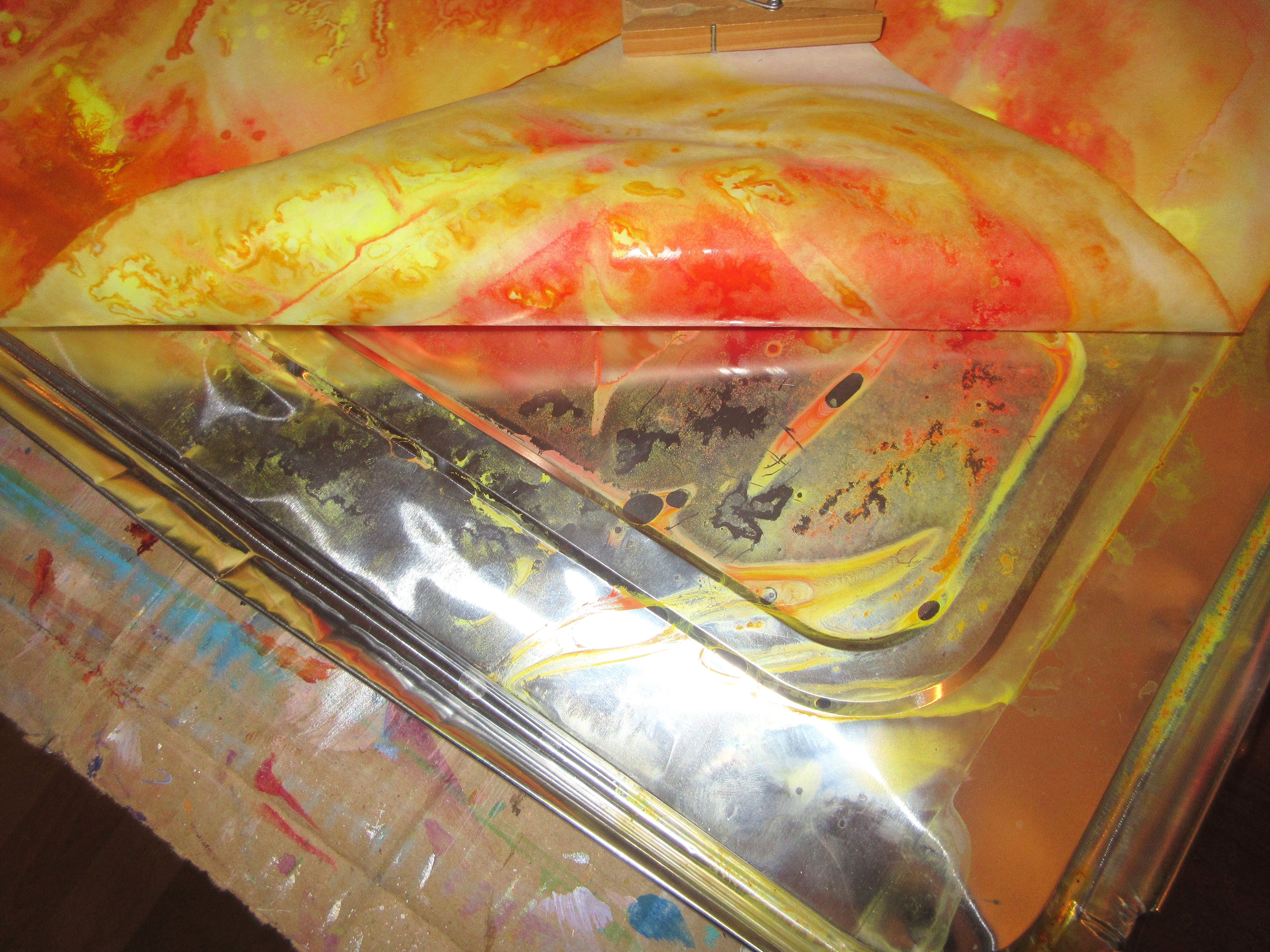
So – on a much smaller scale and with different materials, I headed for the sun as I emulated his intuitive approach.  Here, on my basement floor, acrylic paints are drying on paper placed on a dollar-store aluminum tray.


Already, this is not at all in the spirit of the wall-length paintings we saw in Tyrel's studio.  The circle from the aluminum tray has already suggested the head – and his method makes no assumptions, gives no directions, just lets things flow as they will.  Then he cuts and pastes, also without any goal in mind. AND he said nothing about the possibility of his dried paper sticking to its base….as mine did.


After cutting my random strips of paper, I glued them together in a Sun God motif.


Hmmm.  This is nothing like the creations I sought to emulate.  What would my admired artist have done with my strips of paper, assuming they were the large size he works with?  Something like these?


What do you think?


Me, too.  In fact, as I look at a sketchbook cover I collaged about 40 years ago in my Edward Betts phase, I think my work was more in touch with his then.


So where to go from here?  I'm not going to re-do the Sun face; I'm not going to try another Sunshine Coast emulation.  Where will I head next?


Only the tronie knows…


Saturday, September 30, 2023

Wasn't that the best summer camp?


This congenial little group, gently shepherded by Dr. Woods (the "grown-up" with the glasses), is hoping you had as great a time at this year's summer camp as they did.  And maybe you'll come back for more next year?  I certainly met some new people and made at least one lasting friendship. I know that Harold Weston and I will stay in touch.


The seasons have changed now, and in times past, the Adirondacks summer vacationers would be heading back by train to Eastern seaboard cities – a phenomenon that took off in a frenzy in 1869 when a young preacher published the first guidebook to a wilderness area.


I caught this group of early 20th century vacationers and imagined them grabbing their last sketching session before it was time to catch the train.  Don't worry – bags are packed, bills are paid, and now they have a few hours before they say goodbye.


Thinking about how memories inevitably fade, I decided to catch that phenomenon in paint.  The people in the photo, existing originally in "living colour," would fade to grey.  To fit them all into that creek-side setting, I started with a formal grid.


Here's an early lay-in stage – do you notice anything missing?


What seemed to be missing was someone to occupy the space on the left.  I had to look further in Adirondack archives and found a group that's perhaps native to the region, taking a break from farm work….while the city slickers pack up their easels.


Let's morph two of these guys together and fill in that space.


Moving along, I realized that I would have done better to start out differently.  Maybe I should have proceeded as if tinting an old black-and-white photo.


Ah, well – we're getting there – or somewhere, at least.


And here's the finale:  "Fading to Grey – Summer's End," copyright 2023.


Oh, what's that whistle?!   The train is leaving the station!   Destination?  I'm not sure -- it was just a blur on the "Departures" sign.  We'll know when we get there.


Friday, September 15, 2023

Coming to a close


Just one week now till the official change of seasons, and my summer camp experience is coming to a close.  Back in June, I'd researched and selected the late 19th – early 20th century Adirondack artists who I was counting on to help me fill "the Empty Frame."   I knew as soon as I discovered him that I'd be saving the best until last – Harold Weston, who some critics of the time had nicknamed "the Thoreau of the Adirondacks."


I have a particular soft spot for him, for all the reasons noted in this very readable short article  -- his strong response to nature, the improbable love story, his perseverance despite medical challenges, and most of all – for his part-time hermit's life in a remote cabin.  There's another reason, too.  In the past year and across the expanse of time, I've "met" the father of a NY state school friend via his unpublished memoir that she's bringing together for her grandchildren.  He was a near contemporary of Weston's and – curiouser and curiouser – from an entirely different background, he embraced the Adirondacks at first sight and spent a similar remote existence in a makeshift cabin in the very years and the very region where the young Weston was first living there solo.  They might have criss-crossed snowshoe tracks!


At first sight, I was so taken with Weston that I sought out the book he wrote – he was as fine a writer as he was an artist.  Thank you, Vancouver Public Library and inter-library loan services – eventually, the book reached me for a firm 3-week loan (no renewals!) from the University of Alberta library.


In this 2-minute video, you can see his granddaughter introducing the book and some of its photos, along with the more "futuristic" paintings that marked his late career.


I was – and am – so taken with Weston that I decided not to try any funny business this time.  Here's one of his self-portraits, and of course, the firm use of line and outline is always a draw for me. 


I decided my best lesson would come from trying to copy it.  Here's an early stage.


And the finale:  "Framed: Harold Weston."


Now, to a landscape – Weston's "Adirondacks in Autumn."   Again, his use of line intrigues me.


I paired this with a photo I took from Grouse Mountain...


...and set to work over an old painting.


And here's the final:  "Midsummer - Looking Southeast from Grouse Mountain" – Empty Frame series, copyright 2023.


It's by no means flawless – rather, it's at that stage where it's best to just down the brushes.  But – as with Weston and his superlative results, it's been something of a labour of love.


It sounds silly – but inevitable – that as I worked to finish this over the past two weeks, I couldn't help but think of "September Song."


Thursday, August 31, 2023

Closer to home


Of all the early artists who painted in the Adirondacks, most came to the area in their adulthood, loved the wilderness places and landscape enticements, and stayed on for a while and/or came back seasonally. 


I've come across only one so far who was born and raised there – maybe not quite "there" but in the foothills area of my little paper mill town; just 20 miles away, in fact, and 100 years before my time.  He was Levi Wells Prentice, a farm boy with little formal training whose works garnered notice only decades after his death.  I was so intrigued by this Nearby Unknown that I found a book about him on-line and, Dear Reader, I bought it.


As suggested in this cover painting and the selections here, Prentice had a distinctive style in both his still life paintings and his landscapes.  In many cases, they are hyper-realistic in a sense, with strong dark/light contrasts and fiddly attention to little shapes that he has painted more distinctly than the eye would see them in nature.


"Nature Staged" had little to offer about the man himself, and there's not much about him on-line, not even a photo.  I could find only a portrait of him painted by an unidentified artist.


Well, that was enough to play around with – and play I did, starting with some quick prototypes and then trying some printing, stamping, collage techniques.


None of this was the least satisfactory so I decided…what the heck.  I would try something I'd recently seen in its end stage at a gallery my friend L had whisked me to.  I placed two versions of Experimental Prentice on a plastic sheet in the back yard…


 …and set a big chunk of ice on top.  I expected that when I came back later that day, I'd find some magnificent swirling features – beyond Jackson Pollock's wildest dreams.


No such luck!  No magic transitions.  Not even a "Framed" version to show for this.  Time to move on to Prentice's landscape and my own.


From among his on-line landscapes, I was hopelessly smitten with his "Moose River, Adirondacks" -- for reasons that might be apparent to historians of this blog.


You've seen the Moose River before, where it joins the Black River at the long-ago hometown that marked me for life.


I paired Prentice's painting – which must have been done considerably upstream – with my recent photo of Palisade Creek, at the northern edge of the Capilano Watershed.  


I planned to mimic Prentice's style – with the characteristic outlining and details.  Determined to "hold the lights" – not get too dark, too soon (my mistake last time), I made a very tentative start.


I thought I was on top of things, but before long (actually, very long; several hours worth of long),  I heard myself saying, "What was I thinking??!?!?"


Was I really going to try delineating every branch and leaf in all that expanse of greenery?  Nope.  Not gonna do it.  Instead, I cropped away about 90 square inches, removing strips on either side of the creek.


Pressing on regardless, I finally dubbed this The Finale:-- "Palisade Creek, Capilano Watershed" (copyright 2023)


With all the Adirondack landscapes in my view this summer, I can't help but think of a young boy I once knew – fervent and accomplished angler of freshwater creeks and lakes from the age of 10.  I remember him in his mid-50s, delighted when I happened to say, "No fish has ever tasted as good as the rainbow trout you used to catch in the North Country."  He might well have fished these very spots along the Moose River.