Saturday, July 15, 2023

Busting Out of the Frame


Continuing the Empty Frame Series, we're hooking up in this post with Thomas Worthington ("Worth") Whittredge.  He's another of those 19th century American artists who lived out the stereotypical story of the rural, semi-educated kid who was driven to draw and paint and managed to do so despite family discouragement.  And paint he did – becoming a pal of Sanford Gifford, who kicked off this series, and earning fame in East Coast artists' circles.


How could I resist choosing this framed photo as the basis for my Worth Whittredge portrait?


Continuing my exploration of various artists' materials, I chose to work with fine-tipped art markers, as did this artist in "Portrait Revolution."


 I set to work, realizing I'd need to carefully scale up this framed portrait.


On the slick paper I'd intended just for a draft, these markers were a tricky medium – slick on the one hand, indelible on the other, and the merest accidental touch-down would leave a definite mark.  I sensed that "Worth" was finding it all a little boring, too, as he tried to refrain from squirming.


Here's the final portrait, "Framed (For the most part) – Worthington Whittredge".


Now, on to the Whittredge painting I selected – "The Woods", a close view quite unlike his better known expansive landscapes.


From my photo files, I found a somewhat comparable scene, taken along a trail in the woodlands just south of Deep Cove.


I'd been browsing through some of my cherished art books and decided that for summer camp fun, I'd work in a semi-abstract style reminiscent of one of my original heroes in paint, 20th century American artist and teacher Edward Betts.


As I looked at the 1982 inscription inside the cover, I remembered feeling a pang then – that if I'd stayed in Illinois (though dying to bust out of it at the age of 18), I might have had him as a teacher.  He also had a great connection to Maine, and his book is full of his paintings and drawings (and other artists') of rocky shorelines and granite quarries.


I made a start and found it uninspiring.


Searching on-line, I came across this more relevant example of Betts' work – just some of it shown in part of  a frame!!  Was it meant to be?


Using acrylic medium, I papered over the Bad Betts with swirling rice paper.   I then cut up an old membership card to use, instead of a brush, to pull small puddles of paint across the heavily textured surface.


Here's the finale:  "Catching the Moonlight on Deep Cove Trail" – Empty Frame Series, copyright 2023.


I've always kept in mind the gist of Betts' answer to the question, "How do you know when a painting is finished?"  He wrote:


(It is important that you) "keep yourself attuned to what is happening on the painting surface.  You must always be ready to act in answer to what arises there, to recognize and grasp those elements that suggest the route to order and structure in the painting.  Once the control image has been found, the act of painting becomes more purposeful.  Finally, a point is reached when you find yourself fussing over unimportant little things, when you have said all you wanted to say, when nothing can be added or subtracted without upsetting the picture's overall organization.  At that point, your painting is finished."


Friday, June 30, 2023

Just add water


Officially into summer now, I'm sticking with the Adirondacks for the next little while.  With the "Empty Frame Series" introduced last time, I'll be exploring little known artists of the 19th/early 20th century who painted there – and at the same time, I'll have some summer camp fun by experimenting with different media.


This post's subject is Homer Dodge Martin, looking like a successful businessman here.


He died not only in obscurity, but in poverty, ill heath and blindness – yet his mellow landscape paintings are in the collections of many prominent American museums, including the Met, the Smithsonian and the Boston Museum of Fine Arts.


With a nod to Martin's 4-year sojourn in France, and a nudge from "Portrait Revolution",  I decided to do his portrait in intensely coloured pastel chalks.  It's about time I put a dent in my 35-year-old supply of these legendary art tools, most of them handpicked by me from huge trays at Sennelier Paris.


An important health protocol has evolved around the use of soft pastels.  Because they're essentially powdered pigment plus water, it can be harmful to work indoors without plenty of ventilation and even to directly contact some colours with bare hands.


My euphoria about reuniting with my colour trays led to a quick session outdoors in the cool air of morning – and a quick take on the subject, with an irresistible polka-dot tie. Here's "Framed – Homer Dodge Martin."


Now, on to his own painting, "Adirondack Landscape."   Was the "some old thing" that my mother discarded from the carved frame something like this?


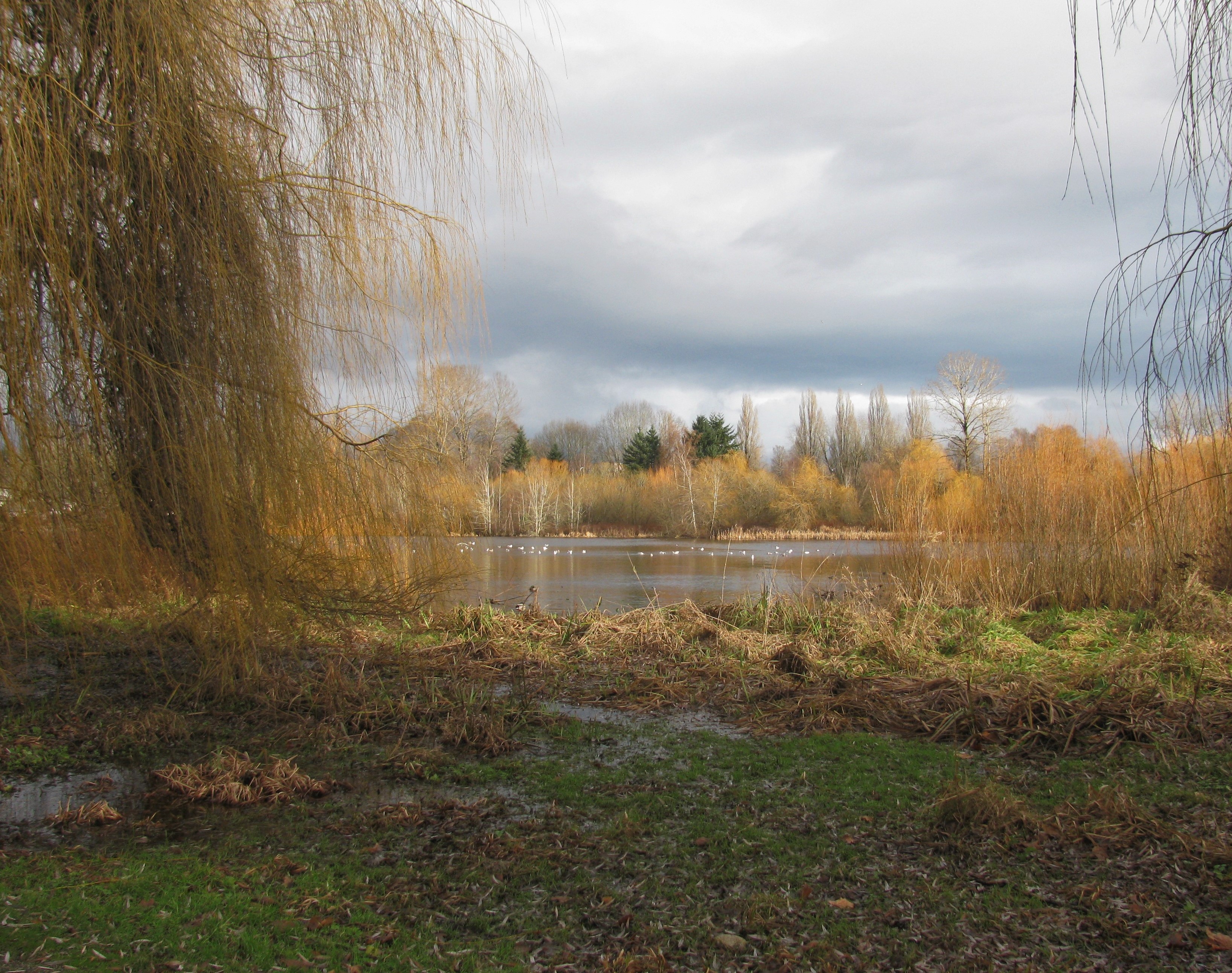
From my photo archives, I found a suitable companion piece – the creek below Shannon Falls, just off the Sea to Sky Highway.


Thinking about landscape artists I like, I suddenly thought of Canadian artist David Milne, who has his own Adirondack connection.  I'd first fallen for him via a 2nd-hand book purchase, and my enthusiasm was confirmed by a huge 2017 retrospective at the Vancouver Art Gallery.  Now I had the idea to try to replicate my mountain stream in his style.  As I browsed his paintings, I found…was it possible, this similar subject? -- "Black Waterfall."


What fascinates me about Milne's style is his use of pronounced line and blocks of colour – this looked oh-so-easy and self-evident, but it was not.  It's a very different manner of working, and I felt stumped at almost every turn, constantly asking, "What would David Milne do?"  It took me hours to get to this point, and then I stalled for three weeks. 


I was about to call it quits and then decided….what the heck, I'll plug in a dark background.  So here's the finale of "Milne Creek" – the Empty Frame Series, copyright 2023.


There is so much wrong with this finished piece, and it is so quirky, that I've actually become rather fond of it.  The challenge itself certainly gave me plenty of scope for reflection.


Thursday, June 15, 2023

Summer in the Mountains


Since I first saw it decades ago, I've loved this painting – "Kindred Spirits" by 19th century American landscape artist Asher B. DurandWithout knowing its whole story, I felt that it extended a vast invitation – to explore a beautiful new world, in company with simpatico companions.


I've rarely painted landscapes although I regularly sketched outdoors in our old days of hiking, camping, paddling – and I have dozens of old sketchbooks to show for it.  As I begin to weed them out, I find memory fragments like this:


The note reads: "Hwy 99 – N. of Horseshoe Bay – waiting for the tow truck – COLD! – Jan 25/97"


These old sketches contributed to a convergence that sets my program for Summer 2023.  As I was working on my personal Remembrance of Things Past, I happened to pull out of a cluttered corner the lovely old mirror my mother bought as a framed painting in those olden days.  The mirror that then replaced the painting in the frame has gone ghostly with age so I papered it over for this shot:


Simultaneously, I'm receiving almost daily promotions for pricey art workshops at popular summer destinations -- sponsored by organizations that are busily reinventing themselves post-COVID.  


There's a long history to artists working in the Adirondacks – many of them, like Asher B. Durand, were formal or informal members of the Hudson River School.  As I followed internet trails, I came across dozens from the 19th and early 20th centuries – some of them well known, some almost forgotten.


Reflecting (ahem!) on my mother's mirror, I once asked her what the lovely frame held when she bought it from the antique dealer.  "Oh, some old thing," she said dismissively, "but I saw the frame would be perfect for a mirror."   Even then, as an inexperienced teenager, I wished I might have seen its original state.  Just imagine!


Well, this led me to my summer project called Filling the Empty Frame.  Are you ready?  Here's the plan:  Every two weeks, I'll choose a "vintage" artist and one of the paintings he made in the Adirondacks.  (Sorry.  They are all "he/him" – because Georgia O'Keeffe is just too spectacular for my purposes).  First, to continue my fascination with portraits, I'll produce that artist's portrait with a method chosen from this wild and wonderful book.  (You can read here about the book's origin in the author-artist's international project)


Next, I'll match the artist's painting to a photo or drawing I've previously made of a similar landscape. Then, maybe or maybe not in a similar style, I'll produce a landscape to the frame's size.  Ready?


Our first subject is Sanford Robinson Gifford.  "Never heard of him" – but he was an admired artist in his day and was among the group of New York City notables who founded the Metropolitan Museum of Art in 1870.


His connection to The Met suggests a conservative selection from "Portrait Revolution"...nothing too wacky yet.  I tried to loosen up a bit as in this sample from the book (on the right side, the largest of the lot) but otherwise played it pretty straight.


Moving right along with the work-in-progress.


And here's the final, "Framed – Sanford Robinson Gifford, 2023."


Now, here's Gifford's painting with a title confirming its connection to our theme, "A Twilight in the Adirondacks."


 A photo from Vancouver's nearby Trout Lake has a vague similarity.


But this view faces east – so I decided to borrow a radiant sunrise captured at the end of my block.


Here's an early stage.


And the grand finale, "A Trout Lake Sunrise" – Empty Frame series, copyright 2023.


On the basis of colour alone, I don't think my mother would have described this as "some old thing."  Maybe a better candidate for her description would be my scraped-back palette, awaiting the next go.


As I kick off this series, let Georgia O'Keeffe's words be the guide:--

"Whether you succeed or not is irrelevant; there is no such thing.  Making your unknown known is the important thing -- and keeping the unknown always before you."


Wednesday, May 31, 2023

There’s always a chance to begin again


Look closely within the circles and you'll see healthy growth on the small rose bush I acquired in 2018.  It flourished nicely on my porch for several summers, and then this past winter's extreme cold seemed to knock it out. A month ago, I clipped off the obvious deadwood and crossed my fingers.  Two days ago, those healthy green leaves greeted me one morning.  The 19th century author Mary Wollstonecraft Shelley wrote, "The beginning is always today."   And she should know – surely her Frankenstein wasn't built in a day!


I was still mulling over the business of cool and warm colours when my friend Y sent a photo of the magnificently garbed European Firebug spotted (ouch!) at her son's property not far from Budapest.  Here's a stock photo of His Eminence in all his glory.


That's all I needed!  I began working on small studies, playing on various tones of red, including one that showed a museum visitor assessing paintings of beetles!


I'd been recalling the lovely young woman I'd once surreptitiously photographed doing the same thing – with a view to one day painting her.


Then it happened that I picked up on Y's comment that she really didn't like these beetles, and I decided that producing another in the Beetlemania series would be no thanks for all the inspirations she's shared.


I was carried away, though, with the figure of the young woman and splashed onward chaotically.  For one thing, I'd decided to paint over and "re-purpose" a 2022 painting called "Chortle."


My friend G has noted the times I've painted over old stuff.  Hard to tell if she's serious (with that subtle gleam in her eye), but she's convinced that some day a famous (?!) painting of mine will be scraped back and beneath – voila! – there will be found something even more astonishing.  Maybe like the recent find of a small dog in the corner of a Picasso painting?


The fact is that at this point I was deep into chaos.  Not even organized chaos.  I thought of a new-to-me saying I'd learned from my neighbour pal, something that I might have known from childhood if I, too, had been born and raised in  Canada:  "Begin as you mean to go on."   This intrigues me as a more purposeful statement than, "getting off to a good start" or "putting your best foot forward" – instead, it offers real guidance on the process of planning ahead and moving forward.


Instead, with no preliminary studies, no colour experiments, I was splashing to the beat of the familiar (and perhaps contradictory) artist's observation, "The painting tends to take on a life of its own."


Somewhere along the way, I'd decided that the museum wall would feature, instead of the Firebug, the fabulous self-portrait by 20th century Canadian artist Myfanwy Pavelic.  Thanks to a pamphlet shared with me by friend M, I'd met and explored her works late last year.


Initially, I'd assumed my painting would replicate the colours the young viewer was wearing in my photo of her:-- dark skirt and top against light museum wall. 
But as things began to shape up, I saw that it only made sense to put her in the same grey-white clothing as Myfanwy's -- and to darken the museum wall.


And then -- when I began to work on copying Myfanwy's self-portrait, I found a whole art school education in trying to master the changes in tone from white to multi-greys to near-back.  Eventually, aside from this greyscale,  there would be little more than a slice of red wall, some yellow in the hair of both subject and viewer, and some grey-blue.


By now, I had a title for this painting -- "In Another Lifetime" – and something of a story line.  I imagined the young viewer speculating on whether she might wish to travel back in time to Myfanwy's artists' circle, The Limners -- or whether in today's world, she might want to travel cross-country to hang out with the Toronto teenager who was offered $4.1 million in art scholarships.  (For that matter, what if Myfanwy's own time machine took her forward to Now – what would that mean?)


Here's the final version (copyright 2023), which I'll be keeping for a good long while – because I learned so much from working with the range of white-grey-black. 


As I wrapped this up, I recalled a line from a poem by Stephen Spender --  "One more new botched beginning".  But I can't find the whole poem, so who knows?  Meanwhile, my reborn rose has no intention of botching the season.  Here's how it looked on May 30, 2018, with buds about to open -- and this year it can only be better!


Monday, May 15, 2023

The Handy Little House That Goes With You


You guessed it, didn't you?  That with a stretch, I'm using this mosaic snail and his house to signal a return to the Maison d'Etre series, first introduced here.


This time, I decided to focus on the verb tomber which means "to fall" or "to drop" – or to do a whole bunch of other things, when combined with other phrases.  By the way, if you've studied French and never heard of "la Maison d'Etre" you're not alone.  The three best French speakers I know, one of them speaking her native tongue, have never heard of it.  It seems to be a pedagogical tool that caught on in some quarters after its introduction in the 1960s.


I collected my source material – for which photos of dancers and drawings from my life classes were so useful -- and then did some small studies.


I started with one of those earnest ideas I'd picked up from a class – to begin each gesture with indications of the stresses or weights on the figure.


Typically, my earnest ideas don't last long once I begin splashing with colour.


Funnily enough, at this early stage I remembered my "Frolick and Detour" painting – and  how that wild scene might be hard to shake off.


But "Frolick and Detour" isn't solely to blame.  Back in the early 1980s, I'd produced this entanglement – from a collection of swim goggles.


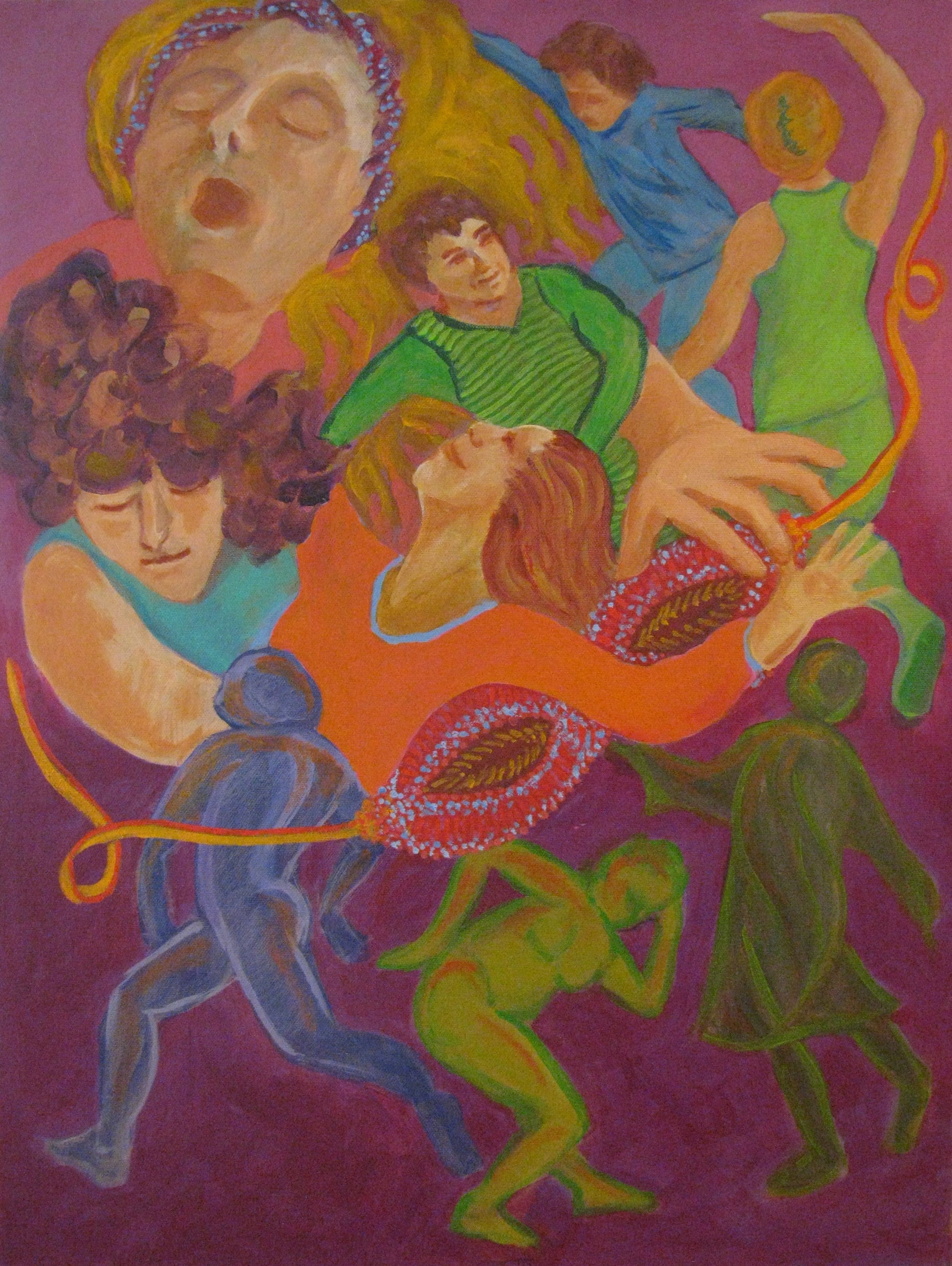
Hmm.  Something of a resemblance.  Well, let's move right along to the final version of "Free Fall – Tomber - House of Etre Series" (copyright 2023).


What do you think of the outcome?  Is this a case of bien tomber (to be lucky) or mal tomber (to be unlucky)?  Check here to see if any of a dozen or more other possibilities apply.  (I'd looked for "to fall asleep" but that's a different verb entirely).


Back to "Frolick and Detour" for a minute.   I've realized that my mania for lively interacting figures goes way back.  A long way back – to my first artistic choice!  I hadn't reached kindergarten when my mother entrusted me for a day to a rural neighbour who had kids a little older than I was.   It was a weekday so I trotted off with them to their one-room schoolhouse.  There, the teacher kindly gave me crayons and suggested that I choose and copy a picture from one of their storybooks.  YES!! What better way to spend a day?


I can still visualize the view out that schoolhouse window as I earnestly settled to my task.  And then -- My first show!  My first review!  The teacher was blown away (okay – I know; good teachers are the ones who make you feel good about yourself) by my copies of the six poses in a sequence that showed a pig falling down a flight of stairs!  And what do you think I've always remembered when I see Marcel Duchamp's "Nude Descending a Staircase"?


This is getting rather silly, isn't it? And who's laughing loudest?  The sleek fellow who drops and falls fearlessly and makes a soaring recovery every time.  (Hmmm….if pigs could fly??)