Friday, October 14, 2022

Feeling bamboozled?


Back from summer camp, I'm getting reacquainted with studio routines – like doing a quick spin-off in emulation of my current hero Hashim Akib.  And I've been thinking that it's time for an end-of-season status report on Bamboo 2022.


To recap, here's my backyard starting point on August 1st.


Even the resident panda here at The Yellow House found this a daunting scene.


By August 16th, at the rate of 1-2 hours/day, I'd met my goal-- clearing virtually all the bamboo inside my yard.  Of course, this happened with a little help from my friends, the smallest ones shown here surveying the empty raised bed by the fence and a pile of bamboo clippings. 


Friends farther afield helped in many ways.  There was applause (the best part!), the panda suggestions, of course, and a neighbour's recollection from a trip to Thailand that elephants also love to romp in and devour bamboo.


Another friend was the first to suggest what led to the title of today's post.  I was blown away when this professional librarian (ret.) sent me "the well-known 10 C. haiku attributed to the Emperor's 4th gardener":--   

Begone foul bamboo roots

The heron sits in lotus position

Will I be paid on Friday?

When I cyber-exclaimed with amazement, "How? What!! Really?!" she replied, "I think you've been bamboozled" – and made a sly reference to her own trusty "haiku machine".


There's still plenty of bamboo in my future, and I had planned to attack the two long planters on the laneway (the source of the invading roots) next year.  Here's one of them:


But another friend said: "Consider this.  If you keep clipping away the green parts, the plants won't be able to produce chlorophyll, and eventually they'll die off."  Well – this was a strategy worth trying for the coming winter.  But not surprisingly, I got carried away.


I clipped all of that bamboo to about a foot in height.  And then.  Well, it's, er, addictive.  I couldn't resist exploring the roots below.  I didn't commit to doing this on a daily basis, but as of mid-October, I've dug up almost a third of the box's contents.


In the process, I followed THE longest root ever, from the eastern edge of the box into my neighbour's section of laneway, almost four feet, as displayed here:  (An unfailingly supportive friend remarked, "You should hang this trophy on your wall!")


Scarily, I also found a half-dried clump of black bamboo and breathed a sigh of relief that there was no more.  The biggest cane here is larger than any of the green-gold canes.


Despite all that awaits me in 2023, I've tried not to be bamboozled.  I know there's a chance something will pop up from presumably cleared ground – but I also know it's been fun and satisfying to persist…and sometimes exhausting, too.  The gardener shown here needs a nap – before she inspects that back left corner…and a tiny shoot of green emerging through the cracks.  ("Bamboozled," copyright 2022)


As for me, I think I'll settle in this bamboo chair (another friend's contribution) for my one weekly cocktail and survey a job well done.


And that brings a revelation!!  Bam-BOOZE…?!!  Well, just about anything organic can be rendered alcoholic and it so happens that: 

"Ingenious villagers in China's Zhejiang province have come up with a way of using bamboo to make liquor. Primary liquid of liquor or rice wine is injected into each bamboo shoot with the wine brewed and purified with the growth of the bamboo."

And for the real deal – bamboo wine -- check this link for full instructions.  I'm just grateful that the roots at The Yellow House are nowhere the size of these massive tree roots from a nearby construction site.  (I think the "STOP" sign in the background is a message that I've gone on long enough)


Friday, September 30, 2022

Something I didn't learn in law school


And there's a very good reason why.  I wasn't even shortlisted for law school.  (Who me?  I'm the one in the back of the room, flipping through the art books, with Daumier's lawyers as close as I came.)


Those papers on the floor have nothing to do with the familiar spread of scattered documents we've been seeing in the news for months now.   Instead, they're from a planning session for the first painting I've done since I frolicked off to summer camp.


The inspiration?  Early in the summer, I received an invitation to a milestone birthday dinner on the East Coast.  It was too far away for me to accept, but I was so intrigued by the party's location that I had to check further -- a restaurant called "Frolic and Detour."  When I searched on-line, I bumped into a dozen websites explaining the legal concept of "Frolic and Detour."  Quick!  I needed a consultation with my personal Lawyer-in-a-Pocket, who runs her own exclusive 5-star restaurant in Upper Manhattan…right out of her own kitchen!!


She confirmed, from her days practicing and teaching law, that this is indeed a legal concept.  I received a personal mini-seminar, but I'm making it easy for you -- just skim down to Paragraph 9 here which explains it very simply. 


Well! I really didn't need much more to get started as I envisioned a throng of folks, partly frolicking and partly detouring.


Carried away, I kept slapping on shapes and colours.


At about this stage, I remembered some of my old useful planning practices, but it was too late for anything but abandon.


Here's the final version, which would have benefited from a more considered approach.  For the record, it's titled "Frolic and Detour" (of course).  I first considered "Sublime to Ridiculous", but it was hard to spot anything "sublime."


Get it?


Oh, and I almost forgot.  The Lawyer-in-my-Pocket suggested that if I'm really keen on legal terminology, there are plenty of oddities to tackle. How about "incorporeal hereditaments"  -- Not to be confused with the corporeal ones.  Is Halloween in the offing?


I rest my case with this:  It always takes a while to get back in the swing of things after summer vacation.  At least this gave me practice in remembering how to mix paint colours.


Thursday, September 15, 2022

A soft spot for bricks


The hugely influential 20th-century architect Mies van der Rohe summed it up: "L'architecture commence quand vous mettez en relation deux briques. C'est là que tout commence."  ("Architecture begins when you connect two bricks.  It's there that it all begins.")


Well, with that kind of accolade, I have a clear conscience about introducing the topic to my friends – who, it turns out, are bricks themselves!  Take a quick glean at the previous post, and you'll see why I was so excited when, after its publication, reports began arriving almost immediately from all parts of the world.  Well, my own world, anyway.


First, on the subject of the more-or-less local Clayburn bricks, I heard from friend P from a stone's (or brick's) throw away:-- As a schoolgirl in the 1950s, she'd lived in Abbotsford, BC, for a time – had classmates whose dads worked at the brick plant, the local industry on which the town depended in those days – much like my own childhood memories of the paper mill town along an upper New York State river.


Next I heard from my lifelong friend A – she of those early paper mill days.  She said simply, "I've always loved bricks!"  What a good thing – since for most of her adulthood she's lived in a brick building in New York City.


Here on the West Coast, friend M is conscientiously looking for old bricks as she rambles about Victoria, BC.  No Victorian bricks have crossed her path yet – but there was a thriving Victoria Brick Company once upon a time.   Meanwhile, she sends exciting reports about the deer that roam freely, even in residential neighbourhoods, and occasional new-to-both-of-us plants or flowers.


From the U.S. Midwest, friend G snapped a photo as we talked on the phone – and sent me a view of the beautiful wall in her basement, constructed by husband, son, and father-in-law.  What’s more, when her daughter was in school, she shared a ballet class with the daughter of the owner of – ta tum!  Belden Bricks, the largest brick manufacturer in Ohio. 


G's wall arrived within a week of another gift from Budapest – a photo of the brick wall-in-progress being reconstructed from 18th/19th century bricks by friend Y's son in the basement of his old building.  I'm counting on an unveiling when that wall is complete – and meanwhile, here's just one of the prized bricks that will be embedded in it:


And then – oh, my goodness – I received a photo tour of almost a dozen old buildings in Ottawa, of both brick and cut stone.  Thank you, friend J – I'll choose just one of them for now…but such beauties!


Meanwhile -- as I've revelled in brickworks and bamboo roots, I've also been attending Summer Camp.  Every summer, I like to take a month's break from usual studio routines and PLAY.  This year, I was eager again to get hands-on with modelling clay – and I had a vision of a whole bunch of small figures climbing around The Brick Factory garden plot.


Well.  It didn't exactly happen.  You saw my messy brick experiments in my previous post – NOT the kind of clay I needed for my figures.  So I tried another brand which was much too hard. Then I tried a third brand, which was way too dry.  (Perhaps all three were just old stock….?)


Nonetheless, I borrowed a concept from an innovative young Japanese artist whose exhibit I was able to see, thanks to P, at the Nikkei Cultural Centre.  From the thinnest possible slips of washi paper, Alexa Hatanaka creates things like – no, it's not a kimono – it's a hazmat suit!!  Take a look.


With hats off to Alexa (actually, she prefers to craft baseball caps), I've positioned my two Summer Campers in an assemblage titled:  "Sleepover at The Brick Factory – Wear Your Hazmat Suit."


Tuesday, August 30, 2022

Puzzled (again)? Blame it on Budapest


Well, doesn't everyone recognize this as a finely wrought mold for shaping the elegant brick shown on the left?  And it isn't blame that's in order – but rather cheers of appreciation for my friend Y, who moved to Budapest two years ago.  Periodically, she sends a new image or expedition report that sets off an enthusiastic resonance. (You might remember the "Anonymus" statue – and the ladybug poster.)


Early in her explorations of Budapest's streets and buildings, Y noticed intriguing historic bricks and tracked down the Brick Museum.  I'm not sure this is the very place, but scroll down for some photos and a brief English paragraph – or read onward in the text if your Hungarian is up to it!  Y's photos, like this one, set the stage for my current obsession with bricks.  (I'm sure Y would grant me permission to reproduce…but I want to surprise her with a "You've done it again!" moment).


Suddenly, I had a revelation:-- that among the old bricks I'd snagged from a neighbour's renovation project, I also had "trademarked" bricks – among them, some local heroes such as the "Clayburn – Made in Canada" variety (actually made near Abbotsford, BC) –


… and the "Dominion," likely made in Nanaimo, BC, -- or Saskatchewan!


On my walks, I started peering at random bricks in people's yards or at demolition sites.  And voila!  My best find so far (though not one I could bring home) is the elegant "Gartcraig" – a high-quality Scots-made brick that was imported to BC and elsewhere in Canada for the construction of significant buildings.


As I researched the internet, I became more and more wrapped up in the historic lore that swirls around rivers and mud and sand in the form of old-time trades and manufacturing.  Consider, for example, that the same conditions that led to brickworks along rivers also led to the production of products like pottery and glass.


Here's a game you can play with unending satisfaction (well, for brick nerds).  Do a Google search for "__(NAME)__ River Historic Brickworks" – plugging in any river's name you can think of in the mid-latitudes of North America or Europe.  And there you are 95% sure to find accounts and photos of once-thriving brick manufacturers.  I scored with Mississippi, Cooper, Delaware, Hudson, Missouri, Columbus, St. Lawrence, Thames, Shannon, Danube.  Just as a whimsical test, I tried the river name I loved from my childhood in the East: Monongahela.  Wow!!  What a find! View the photo story here.


By this time, I'd decided to use my few old bricks in one small part of my back garden – and refer to it as The Brick Factory.  Not so long ago, I would have disdained any bricks that were not, well, brick-RED – but I've become fond of the pale gold of Clayburn, which appears everywhere in the soil and stones of my yard.


Then, in the carefree mood of Summer Camp, I decided to try making a moldable melange with my clay-ish earth and an equal amount of clay mix from the craft store.  Hmmm.  Too much water maybe?  So instead of the small figure I'd hoped to make, I slapped down a messy "brick" with the Yellow House trademark. 


What a mess, but things were going better at The Brick Factory garden, and here you see its final state .


Those brick-red bricks and reddish stones were allotted their own corner.


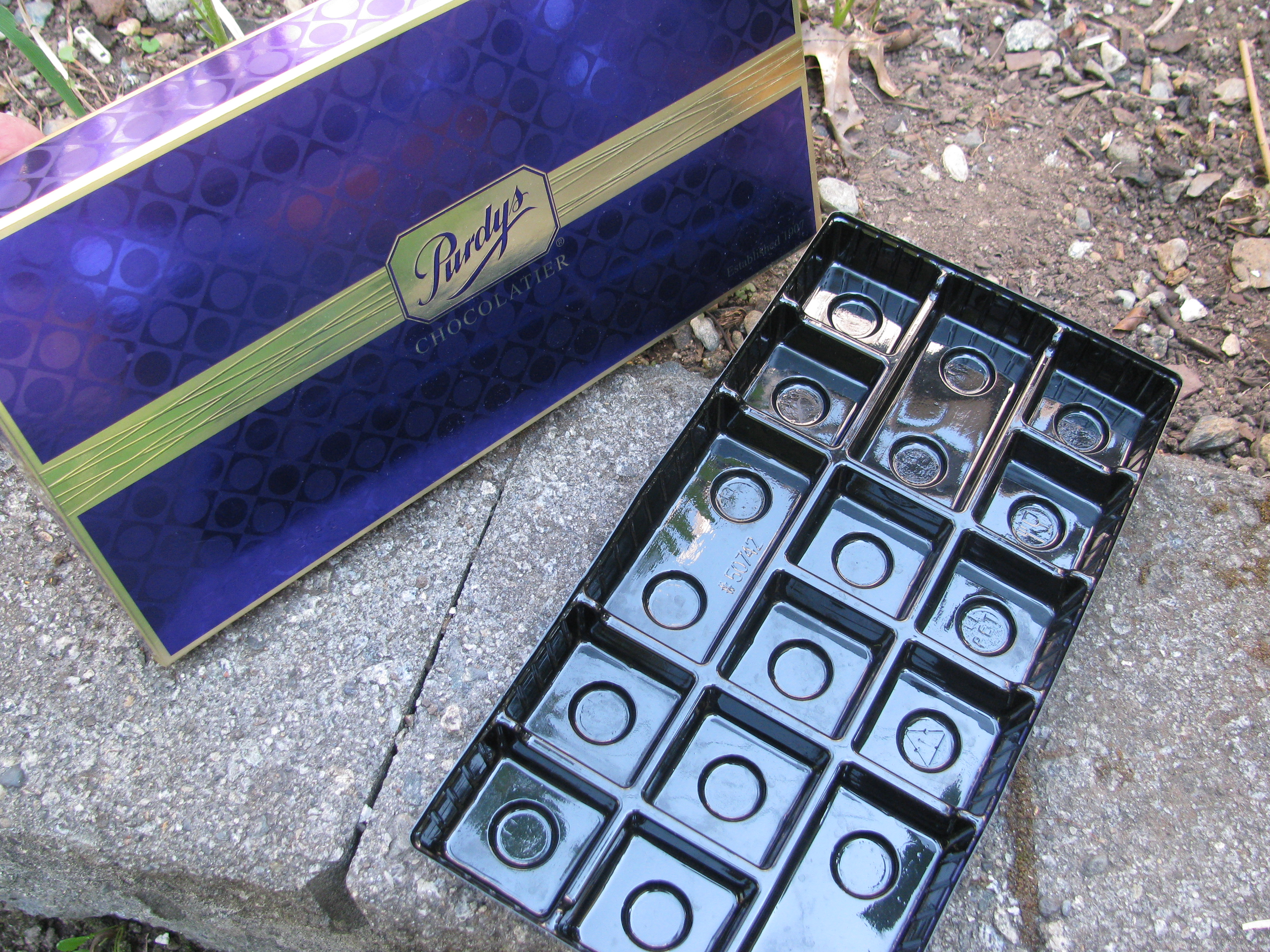
About then, recycling day came along and, sorting papers and plastics, I came across the packaging from Purdys, Vancouver's famous chocolatier.  How could I resist using this as……..a mold for mini-bricks? 


Judging solely on appearance, the finished products wouldn't satisfy the quality control test – no need to move on to the taste test.


 – but the universe gave me a gentle smile with an article about Purdys in the very next day's paper. (Among other things, it explains that Purdys deliberately dropped their hyphen)


Well, making bricks is no easy matter.  Here's just part of the process as described in Ross King's "Brunelleschi's Dome" on the creation of Florence's cathedral Santa Maria del Fiore – a fantastic read, by the way.


It's a weighty subject, all right, and you haven't heard the last of it.  (This photo is by the 20th c. photographer August Sander – more of his sometimes eeerie photos can be seen here.)


Monday, August 15, 2022

'Boo times two - Hokusai meets Renoir


Here's the scene on August 1st, the official starting point for the Great Deracination of Summer 2022.  I'd been trying to hold the spirit of Hokusai and Aoi Yamaguchi as described last time – "to draw bamboo, become bamboo," and thus, the idea came to me to do a painting titled, "Becoming Bamboo."


I started by making a couple reference drawings – "en plein air" as they say, with the actual models before me at 8 am one cool morning.


Then I made a start on a figure in a bamboo thicket, on the verge of morphing into the surroundings.


Meanwhile, The Dig was under way.


The physical labour took place in the shade of early mornings.  The studio work took place in the afternoon in my coolish basement.


My figure was striving up as my trusty trowel was striving down.  Photos really cannot capture the impressive convolutions of bamboo roots – over, under, around and through various obstacles, sometimes twinned side-by-side, sometimes overladen at different depths.


But I was happier with the root progress than with the painting progress – until Renoir offered a fresh approach. Long ago, I read and have tried to observe Renoir's counsel on drawing from nature, "Do not draw a leaf.  Draw the leaf."   I went to my art notebooks and found a fuller explication as quoted in "My Life and My Films", the autobiography of his famed filmmaker son Jean Renoir:-- 

"If you paint the leaf on a tree without using a model, you risk becoming stereotyped because your imagination will only supply you with a few leaves – whereas Nature offers millions, all on the same tree.  No two leaves are exactly the same.  The artist who paints only what is in his mind must very soon repeat himself."

I decided to make a very deliberate drawing, leaf by leaf, and then use this as the basis for a stencil of leaves that would further envelop the becoming figure in the painting.


It was fun to begin cutting out the shapes for the stencil – especially as colours from the cutting board showed through and offered something entirely different.


It was fun to bring the painting to its pre-stencil stage.


 And it was fun to apply intense lime-green paint through the spaces of the stencil.


But, it was absolutely not fun to view the result.


Rather than becoming bamboo, this figure is becoming fodder for the recycle collection…another of those bright ideas that wasn't so bright after all.  Still, my feelings were salvaged by the work of a master who showed how it's to be done.


Coincidentally, I'd just snagged this book from the "Staff Picks" shelf at the local branch library. 


William Morris is an enduring hero of mine for, among other things, his gorgeous fabric designs which are usually based on botanical themes. Was it just possible that he might once have tackled bamboo?  YES!!!!!!


Maybe there's a doctoral thesis in arguing Morris' repeated stencil designs against Renoir's counsel – but why argue, when we can just savour it all? 


Renoir himself was as enthusiastic a gardener as Monet.  In a favourite story of mine, Renoir scolded his gardeners who were, they told him, busily pulling up weeds.  "There is no such thing as a weed," he said.  And as someone else added, "They're just plants in the wrong places."  As further testament to Renoir's wisdom, I'll add, "No two roots are exactly the same… Nature offers millions of variations, all along the same underground stem."


Here's my progress report on Day 15, after about 26 hours of digging and clipping.  Whew!