Thursday, October 31, 2019

Acrobatic outcomes


I've been doing studio gymnastics for a long time now, and there's no way to predict when I'll land on my feet.  It was 2016 when I painted "Clowns Take a Tumble" and considered it then to be a kind of breakthrough.   I haven't painted over it yet, but not every attempt of mine has survived that long -- or even reached that stage.

Remember "Young Fil"


It seemed to start out so well, and then at a late stage, it became clear that too much was wrong with it.  Quite disappointed, I stowed it in a dark corner until just recently -- when the time was ripe to turn it upside down, paint it over, and start with something else.


I decided I'd work from a drawing I'd done several months ago at the life drawing studio.

I worked away and began to wonder if this particular canvas had a curse on it.  The placement of the shoulders wasn't right. The slope of the head was wrong.  And even as I made adjustments, I decided that as a drawing it had been one of my great successes -- but as a painting….it was boring.


Enough!  I reached the stage of what I dramatically call "The Point of Abandonment."  But as if on cue, almost that very day, my niece N sent me a fabulous photo of her (and my) friend H, who lives in Bellingham.  I knew I had to give him a try and started with a quick familiarization study on cardboard.


Then I took the troublesome canvas, painted over the model's head, turned it upside-down, and began to lay in H's portrait.  He's one of the kindest men I know and in his quiet way draws people to him.  Notably, he's also a fabric artist, and I decided to place an imitation dyed fabric behind his head.


It's taken some juggling, but two tumbles later, this canvas turned out to be magic for me.  Here's the final version of "Artist, Friend, People Magnet," (copyright 2019).  


This is truly the best painting I've ever done. (Not that I intend to give up my pursuit of surrealism).   And here's the real work of art -- a close-up of one of H's tie-dyed scarves that he and N gave me, a cherished essential in my summer wardrobe.


Tuesday, October 15, 2019

Out of the shadows


It's that time of year when the low sun works mysteries in The Yellow House.  At its long seasonal slant, it bounces off windshields of cars parked out front and creates enticing shadows as the reflection passes through outdoor foliage onto my living room walls.  Continuing my Denizens series, I pulled two more candidates out of shadows of their own.

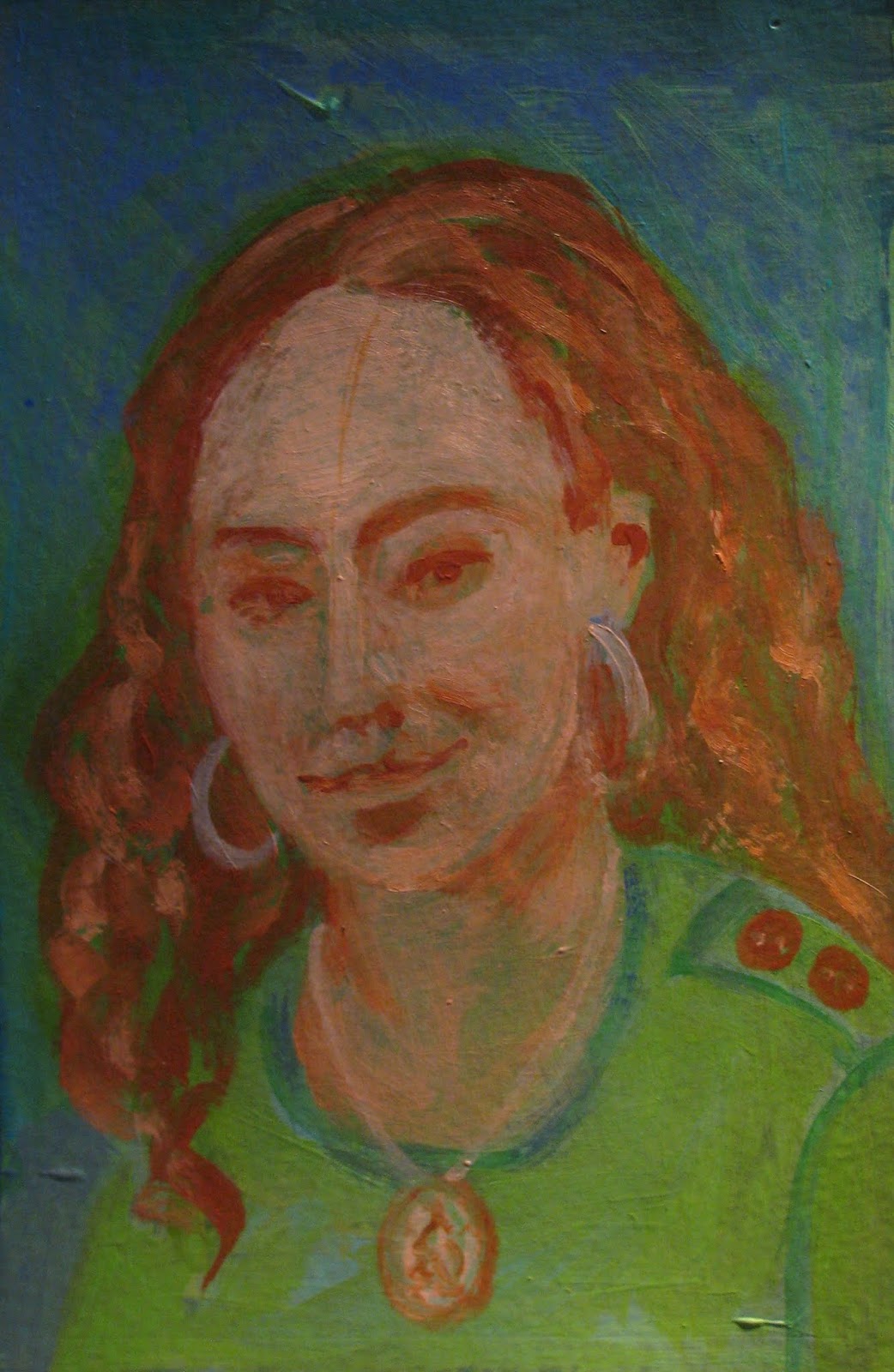
First up was an unusual young elfin woman I spotted on the bus.


As I laid in her features, which brought to mind a woodland sprite, it occurred to me that she might be at home in camouflage.


If you want to be dazzled by pattern, google "camouflage" or take a look at this page of a gazillion variations.  After studying many examples, I was almost seeing double by the time I'd narrowed my choices and placed the nymph among them for Denizens Series - "Camo" (copyright 2019).


 Just as my vision needed a rest, another bus rider caught my eye.  (I've perfected a technique of not being noticed as I constantly scan people's appearance -- their posture, their costume, the lift of their eyebrows, the ridge of their noses, the shape of their chins...)


Compared to the dazzle of the "Camo" elf, this young man was almost all uniformly dark -- his cap, his hair, his beard, his skin, his T-shirt, his sunglasses, his earphones.  Here's the final version:-- Denizens Series - "Shades" (copyright 2019).


Right now, there's a possibility that Metro Vancouver bus drivers might go on strike.  Luckily, I have years of stored images in my sketchbooks based on memories of fellow transit riders.  And when you look around you, Denizens can be seen anywhere -- as on the shadow side of this building.


Sunday, September 29, 2019

Denizens of the deep -- and elsewhere


I thought I'd have to explain the word "denizens"  but the Collins on-line dictionary says it's among the top 30% of popular English words.  Can this really be?!  Well, maybe it's one of those 21st century words that climbed out of 20th century semi-obscurity -- like "ubiquitous," "decry," "egregious" -- and is now used "fulsomely" (ack!! - check this and know that I'm on the side of traditional usage) all over the airwaves.

The title "Denizens of the Deep" has been on my mind as, I thought, a vintage science-fiction movie.  But I guess I was confusing it with "Twenty Thousand Leagues Under the Sea" and that humungous submarine-swallowing squid.

In fact, it's a perfectly respectable natural history publication (1907) by one of those cool guys you've never heard of:--  F. Martin Duncan aka Francis Duncan Smith, a natural historian and a pioneer in micro-photography and filmmaking.  Wikipedia describes his 1903 films:
 "Among the films shown were Circulation of Blood in a Frog's Foot, Red Sludge Worms and the notorious The Cheese Mites, the views of which were preceded by a scene of a man (played by Duncan himself) horrified by what he sees when he views a piece of Stilton through a magnifying glass."
Well, we're neither in a Stilton cheese nor 20,000 leagues under the sea -- but here in the studio, where "Denizens" is the title for a series I've begun.  I want to become  more adept at capturing faces and features, working from sketches and remembered glimpses of "denizens" in my community.

Starting point:-- a quick cardboard study for the first in the series, "Ringlets."


Sometimes, as in this one, the face and the outfit are not necessarily from the same person I've surreptitiously studied on bus trips or in coffee shops.  Here's the final version of "Denizens Series - Ringlets" (copyright 2019).  Can you count the rings?  -- include her hair in the head-count, too.


My next subject was a strongly featured older man, who I watched using his laptop in a coffee shop.  He seemed so like a veteran European filmmaker, but my first quick cardboard sketch took a few years off his age.


If truth be told from the snippets of conversation I heard when an earnest young woman joined him, I think the guy was actually a real estate agent -- maybe in a European film?  Here he is in "Denizens Series  - Filmmaker." (copyright 2019)


Something else I'm working on with this series is learning to paint on canvas -- a quite different support from the fine arts paper I usually paint on.   I'll still work on paper for my larger pieces. (Art students, are you listening?)

Now, inspired by the Denizens just off the dock of my Pender Island friends' home, I'm diving deeper to meet my goal of 10 denizens in this new series.


Monday, September 16, 2019

Haven't I seen you somewhere before?


As I was finishing my recent painting starring Dr. Menzies,  I thought.... "Hmmm.  Where I have I seen something like this before?  A painting of a sculpture in the open air.  An onlooker...."   

Suddenly it came to me -- the artist Georgio deChirico.  He did plenty of plaza scenes like this "Piazza d'Italia" where sculptures and onlookers play a role:


 And when I checked further online, I found one of the sculpted heads I'd been thinking of in "Song of Love":-- (and if you want to know more about this curious painting, check here.)


This lesser known surrealist has stuck in my mind because of a wonderful story I once read about him.  A young couple who admired deChirico sought him out on their travels through Greece.  When they found his studio at the end of a dusty hot road, he invited them inside -- along with their cat, who couldn't be left in the car. 

This is not necessarily a reflection on deChirico's art, but the cat totally freaked out -- roared around the studio, tipping over easels and paints, making a complete mess of both finished works and works in progress.  The young admirers were of course mortified -- but the artist was totally undisturbed as he helped them corner their cat and ensure it was soothed.  As they tried desperately to apologize, he said, "It doesn't matter at all.  What is important is that no living creature should be afraid."  That's my kind of guy!

And perhaps it was this incident that led to his "Surrealist Scene with a Cat."


Well, cats are one good reason to hang out with this artist, and maybe there are other bonds between us.  Remember my egghead armature for what became the mini-sculpture Gaia?

  
Take a look at deChirico's "Face of Metaphysics."


Am I a surrealist at heart?  Well, consider how much fun I had with an assignment in last year's on-line course -- doing a fishy emulation of the contemporary surrealist Afarin Sajedi.


 And here's something more -- a fascinating treasure found in my back yard garden, a 3" rusty nail:

I carefully wiped it off and saved it, even before I knew the Vancouver Art Gallery would be hosting a Giacometti exhibit this year.  See any resemblance?


Maybe the surrealists can explain some of the wacky digressions my art is inclined to take.  As deChirico said:
"One must picture everything in the world as an enigma, and live in the world as if in a vast museum of strangeness."
 Or maybe it's a whole lot simpler than that.  In the words of that old rogue Henry Miller:
"Paint what you love and die happy."
And doesn't that shine through in deChirico's "Sun on the Easel"?


Friday, August 30, 2019

Remember the park?


 This time it's Vancouver's VanDusen Botanical Garden.

Remember the art students?


They've thronged into VanDusen and are particularly taken with the sculptures of famous botanists along the margins of a small rose garden.  And who could resist a particular "favourite son" of West Coast botanical legend, Archibald Menzies.


Distinguished looking dude, isn't he?  -- with a distinguished track record:

 
Just think:-- He identified and recorded our cherished Arbutus tree.


AND one of my all-time favourite BC wildflowers, Youth-on-Age, growing here in the spring just inside my front gate.


It's said that Menzies and Captain Vancouver became shipboard enemies -- maybe because of the 10x12 foot greenhouse the Royal Horticultural Society sent along for Menzies to fill.  Or maybe because Captain Vancouver was prone to be as irascible as Captain Ahab and wasn't amused at losing some of his deck space to a greenhouse.  Nonetheless, when the ship's official doctor became ill himself, Doctor Menzies saved the day and brought the crew home safely -- though it's said that all the greenhouse plants died en route.

But never mind.  Menzies' noble features were worth recording in a quick cardboard study done with one day's leftover paints.


 And then an art student edged into a preliminary sketch.


Add some plants for Dr. Menzies and a sketchbook for the art student, and away things went:


As always, lots to learn, and the distinguished physician/botanist can take a bow with "Dr. Menzies Holds the Pose." (copyright 2019)


Before leaving Dr. M. to the peace and quiet of this corner of the gardens, it should be noted that he was also the first to catalog the giant, thick-barked Pseudotsuga menziesii  -- commonly known as the Douglas fir.   Misnomer times two -- since it's not a fir but a pine; and it's named for the slightly later botanist-explorer David Douglas solely because he identified its commercial value!!!


Friday, August 16, 2019

Summer camp is almost over


For the past two months I've been in Summer Camp Mode -- straying freely when the spirit called from my to-do lists and curriculum and goal-setting.   My mother, like all the best ones, carefully saved all my school reports and one of them I remember her showing me years later said, "She gets along well with other children, and she is also happy playing independently, especially with crayons and clay."  

Hey! - that's the spirit of Summer Camp which led to my buying some modelling clay in a package that gave me about three handfuls, in a quality just a step up from the kids' brightly coloured variety.  Two weeks ago, I had the idea I might make a small model of "The Dreamer" -- the very romanticized statue of Christopher Columbus in "Il Giardino," a beautiful sculpture garden created by Vancouver's Italian community.


I started at Cristoforo's waist and worked downward to establish a base.  Messy fingers and all, the first half-hour was exciting.  I thought I might need to prop up his swinging leg but otherwise things went well.  But then...when I added the weight of the torso and the head -- oh, dear.... he looked like a shocking example from an orthopedic textbook.


Too bad, Colombo.  Maybe you'll make it to the New World next time.  I rolled him into a ball and decided to work flat -- a relief sculpture of, um, maybe one of the other personae at Il Giardino.


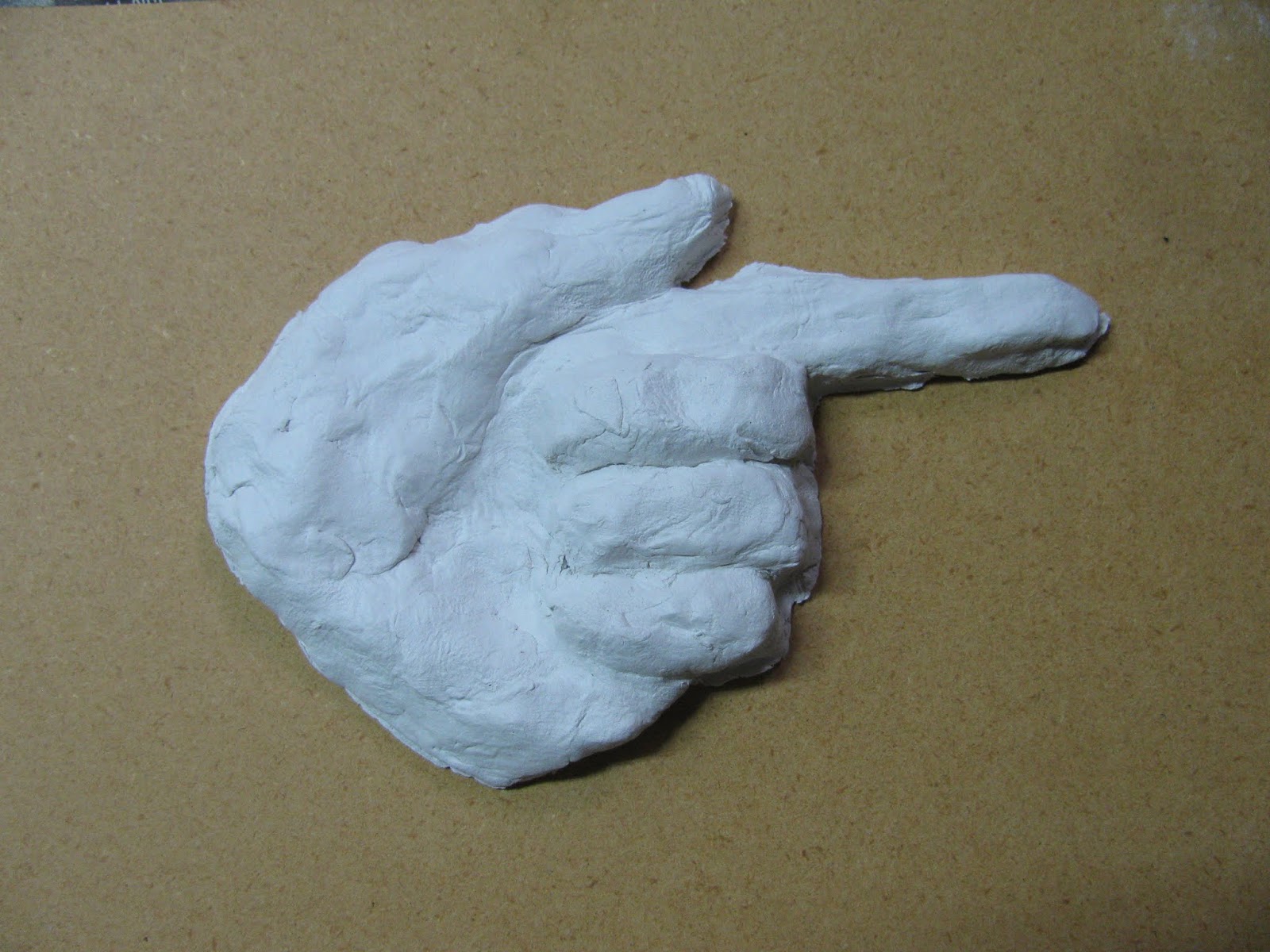
Even though this plastic clay requires working with wet hands, it still air-dries fairly quickly.  Now I had almost a handful of clay that wouldn't last much longer.  So what else could I do?  How about making my own almost-life-sized "manicule" or "index." 


Okay.  I left these two productions to dry and planned a comeback a few days later -- about the length of time I thought I could leave the remainder of the clay in its resealed package.

On Day 2 in the Summer Camp Sculpture Studio, I thought I'd work free-form on the kind of head you might see in the Uffizi Gallery  -- maybe a Dionysus with wild hair.  And this time, I made a sort of armature which is what the big kids use -- an internal support for the weight of the clay, something like a skeleton...except mine was a super-simple assemblage of newspaper and masking tape.


So I was off to a fresh start,  with plastic sheeting (and stones to hold it down as a breeze blew pleasantly through my campsite), carton of water, my fist-sized armature, and half of the opened package of clay. 


Everything I needed except...........enough clay.  Once I covered the armature, I barely had enough left for the face's nose, let alone its ears.  So this is what I was left with:--


I felt slightly cheered when I read an article about the recent discovery of a head of Alexander the Great -- long-lost in the store room of a Greek museum.  (Maybe I should tuck mine away in a corner, and some day it might be considered an archaeological find)


But seriously, wasn't the best option to cover this bald ear-less head with a cap?  The internet abounds with instructions for sewing, knitting, gluing, folding, felting a simple 3-pointed jester's cap.  And I was certainly feeling the fool at this point -- but not foolish enough to spend another two hours making a head covering.

Instead, I gathered some of the Chinese lanterns my neighbour gave me along with some small dried flowers from my garden for an extravagant garland.  Let's imagine this as "Gaia,"  -- perhaps as seen in the Uffizi Gallery!


Within a few days of finishing Gaia, I was walking along Stanley Park's sea wall and found that Mother Nature had carved a perfect stone face, apparently without effort.  And if you wonder how this caught my eye, check out this week's BBC video on "Why We See Faces in Clouds."