Friday, August 30, 2019

Remember the park?


 This time it's Vancouver's VanDusen Botanical Garden.

Remember the art students?


They've thronged into VanDusen and are particularly taken with the sculptures of famous botanists along the margins of a small rose garden.  And who could resist a particular "favourite son" of West Coast botanical legend, Archibald Menzies.


Distinguished looking dude, isn't he?  -- with a distinguished track record:

 
Just think:-- He identified and recorded our cherished Arbutus tree.


AND one of my all-time favourite BC wildflowers, Youth-on-Age, growing here in the spring just inside my front gate.


It's said that Menzies and Captain Vancouver became shipboard enemies -- maybe because of the 10x12 foot greenhouse the Royal Horticultural Society sent along for Menzies to fill.  Or maybe because Captain Vancouver was prone to be as irascible as Captain Ahab and wasn't amused at losing some of his deck space to a greenhouse.  Nonetheless, when the ship's official doctor became ill himself, Doctor Menzies saved the day and brought the crew home safely -- though it's said that all the greenhouse plants died en route.

But never mind.  Menzies' noble features were worth recording in a quick cardboard study done with one day's leftover paints.


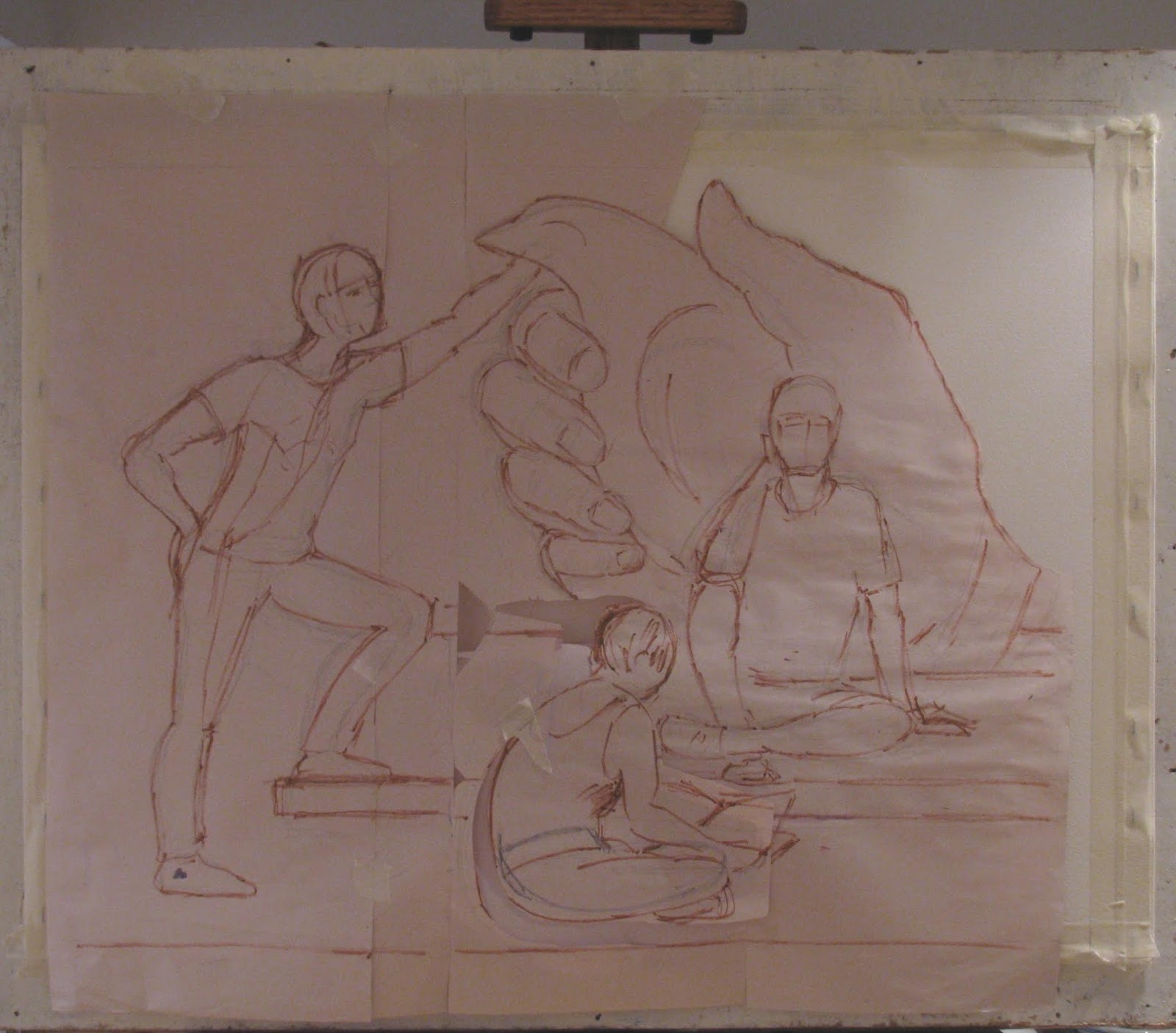
 And then an art student edged into a preliminary sketch.


Add some plants for Dr. Menzies and a sketchbook for the art student, and away things went:


As always, lots to learn, and the distinguished physician/botanist can take a bow with "Dr. Menzies Holds the Pose." (copyright 2019)


Before leaving Dr. M. to the peace and quiet of this corner of the gardens, it should be noted that he was also the first to catalog the giant, thick-barked Pseudotsuga menziesii  -- commonly known as the Douglas fir.   Misnomer times two -- since it's not a fir but a pine; and it's named for the slightly later botanist-explorer David Douglas solely because he identified its commercial value!!!


Friday, August 16, 2019

Summer camp is almost over


For the past two months I've been in Summer Camp Mode -- straying freely when the spirit called from my to-do lists and curriculum and goal-setting.   My mother, like all the best ones, carefully saved all my school reports and one of them I remember her showing me years later said, "She gets along well with other children, and she is also happy playing independently, especially with crayons and clay."  

Hey! - that's the spirit of Summer Camp which led to my buying some modelling clay in a package that gave me about three handfuls, in a quality just a step up from the kids' brightly coloured variety.  Two weeks ago, I had the idea I might make a small model of "The Dreamer" -- the very romanticized statue of Christopher Columbus in "Il Giardino," a beautiful sculpture garden created by Vancouver's Italian community.


I started at Cristoforo's waist and worked downward to establish a base.  Messy fingers and all, the first half-hour was exciting.  I thought I might need to prop up his swinging leg but otherwise things went well.  But then...when I added the weight of the torso and the head -- oh, dear.... he looked like a shocking example from an orthopedic textbook.


Too bad, Colombo.  Maybe you'll make it to the New World next time.  I rolled him into a ball and decided to work flat -- a relief sculpture of, um, maybe one of the other personae at Il Giardino.


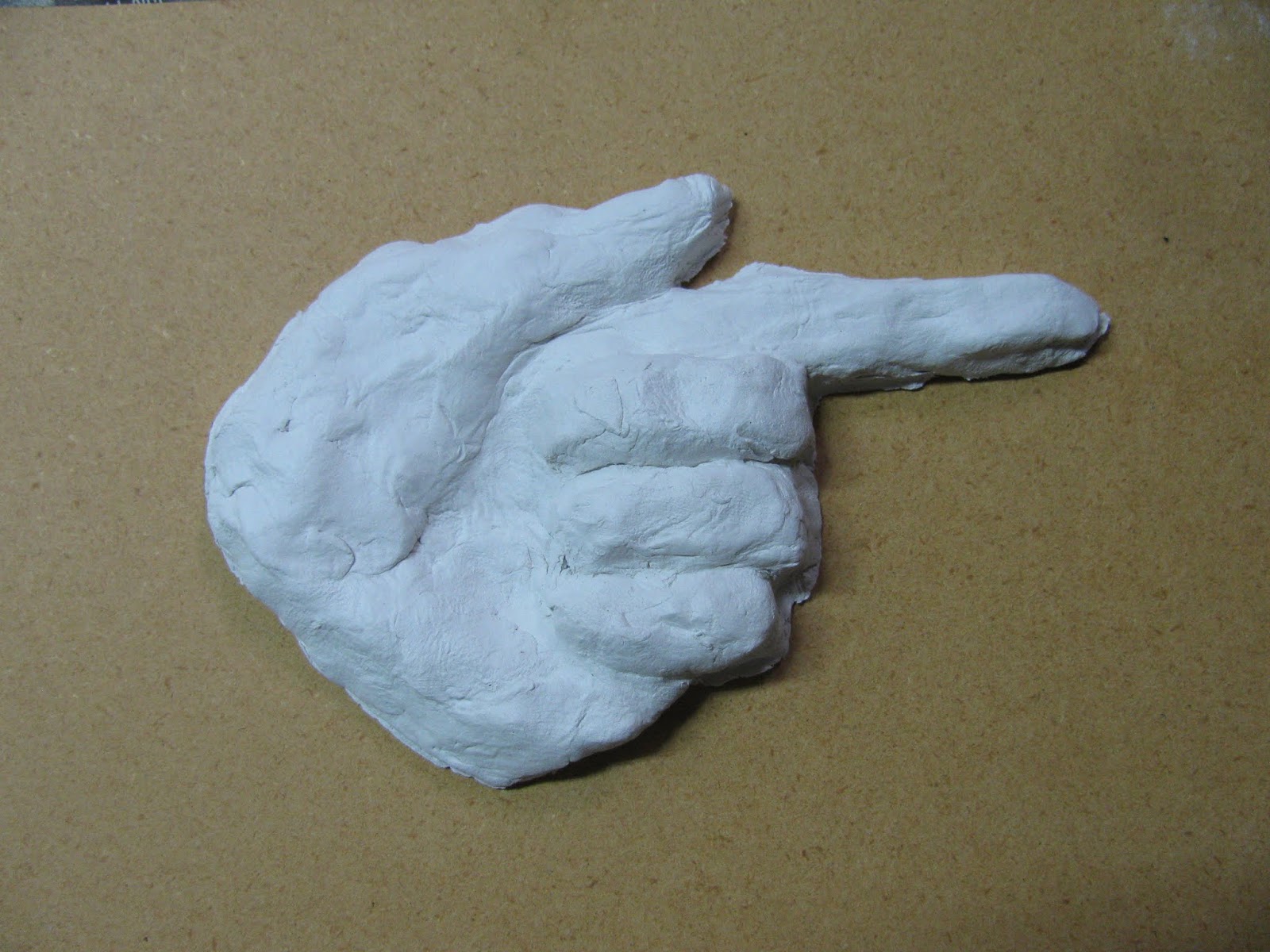
Even though this plastic clay requires working with wet hands, it still air-dries fairly quickly.  Now I had almost a handful of clay that wouldn't last much longer.  So what else could I do?  How about making my own almost-life-sized "manicule" or "index." 


Okay.  I left these two productions to dry and planned a comeback a few days later -- about the length of time I thought I could leave the remainder of the clay in its resealed package.

On Day 2 in the Summer Camp Sculpture Studio, I thought I'd work free-form on the kind of head you might see in the Uffizi Gallery  -- maybe a Dionysus with wild hair.  And this time, I made a sort of armature which is what the big kids use -- an internal support for the weight of the clay, something like a skeleton...except mine was a super-simple assemblage of newspaper and masking tape.


So I was off to a fresh start,  with plastic sheeting (and stones to hold it down as a breeze blew pleasantly through my campsite), carton of water, my fist-sized armature, and half of the opened package of clay. 


Everything I needed except...........enough clay.  Once I covered the armature, I barely had enough left for the face's nose, let alone its ears.  So this is what I was left with:--


I felt slightly cheered when I read an article about the recent discovery of a head of Alexander the Great -- long-lost in the store room of a Greek museum.  (Maybe I should tuck mine away in a corner, and some day it might be considered an archaeological find)


But seriously, wasn't the best option to cover this bald ear-less head with a cap?  The internet abounds with instructions for sewing, knitting, gluing, folding, felting a simple 3-pointed jester's cap.  And I was certainly feeling the fool at this point -- but not foolish enough to spend another two hours making a head covering.

Instead, I gathered some of the Chinese lanterns my neighbour gave me along with some small dried flowers from my garden for an extravagant garland.  Let's imagine this as "Gaia,"  -- perhaps as seen in the Uffizi Gallery!


Within a few days of finishing Gaia, I was walking along Stanley Park's sea wall and found that Mother Nature had carved a perfect stone face, apparently without effort.  And if you wonder how this caught my eye, check out this week's BBC video on "Why We See Faces in Clouds."


Tuesday, July 30, 2019

It's not easy


No, it's  not easy to haul in a heavy net's load of fish, like this larger-than-life sized fisherman at VanDusen Gardens.  Nor is it easy to land a good catch from recurrent images and fleeting ideas, to get down in paint what's swimming around in my head.

A few months ago, I mentioned a work-in-progress called "Art Students at the Sculpture Park."   In the interest of keeping the records straight, I'll show it here -- finished in June -- but I think it must be considered one of the ones that got away.


What can I say, except that I still like the colours....?   It started with an imaginary world - imaginary students, imaginary sculpture, a little world in my head, not even as fully evolved as this little world along the seawall in Stanley Park.


I made a preliminary sketch, which later morphed quite a bit, and somewhere along the way, it lost its initial oomph.


Not at all as convincing as someone else's imaginary world of two lovers, seated not far from the fisherman at VanDusen.

My students and bird-in-hand sculpture reminded me of my own "Flash Mob" series -- but far less successful than what is still one of my favourites in that group, "Sit Tight."


Ah, well.   As Winston Churchill said, "Success is stumbling from failure to failure with no loss of enthusiasm."

There are other gardens, other students, other sculptures....all floating around in my head... and I will be back another day.


Tuesday, July 16, 2019

A world in two words


A few years ago, my wise friend A alerted me to a favourite quote of hers by the writer Henry James:--    
"Summer afternoon, summer afternoon; to me those have always been the two most beautiful words in the English language."
How could these words not remind me of a summer romance that stays with me after all these years?  It's just a slight jump from "summer afternoon" to "Sunday afternoon" and to my first introduction as a young teenager to Real Art.  Our family had moved to a suburb of Chicago, and I had the immense good fortune to begin to learn and love at one of North America's great museums, the Art Institute of Chicago.


No wonder my heart beats faster when I see the lions at the gate (back door, actually) of the Vancouver Art Gallery.


But back to the Art Institute and my first and enduring love:-- Georges Seurat's great painting, "A Sunday Afternoon on the Island of La Grande Jatte."


I might almost have been in this 1963 crowd -- note the bouffant hairstyles and vintage (!) coats.  Except then, as now, I always travelled solo or with a trusted friend or two. 

This painting inevitably brings back the whole world of my high school years in that suburb.  My first boyfriend knew how I loved it and made a special trip in to Chicago to buy a reproduction as a gift for my birthday.  My mother helped me select a frame (such a grown-up thing to be doing!), and it hung in my lavender-blue bedroom from then until decades later when the parental house was sold.

It has struck chords elsewhere, too -- maybe too many elsewheres since it's been endlessly reproduced in whole or in part on everything from fridge magnets to Broadway musicals.

But I couldn't help it.  Once it resurfaced in my life via Henry James' quote, I longed to capture the major female figure in contemporary dress.  Not an original idea -- but irresistibly enticing.  So when a model at my drawing session struck a pose slightly resembling her stance, I started to strategize.


But what to do about that monkey?


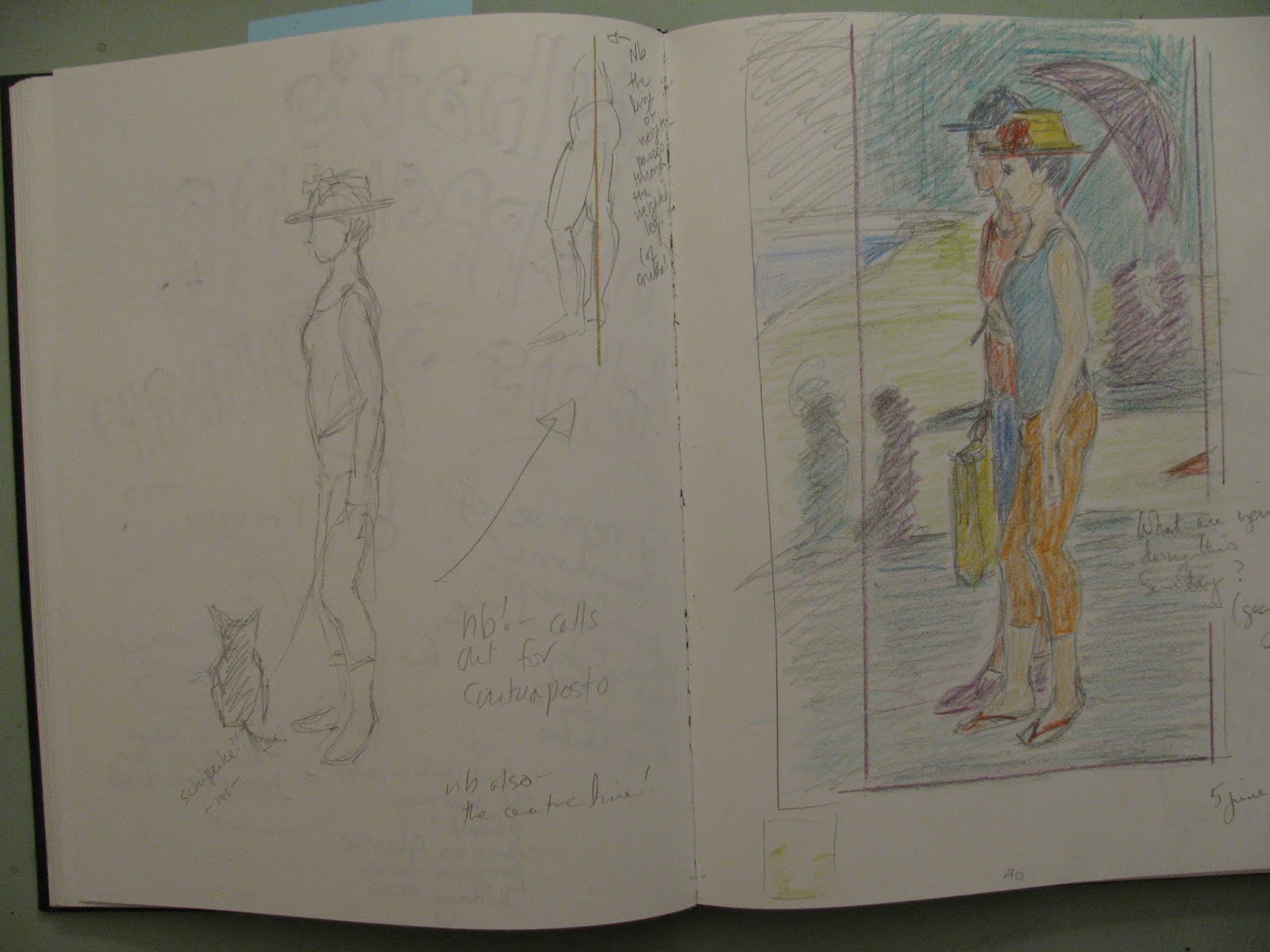
Its funny little canine companion gave me a hint, and I set to work on a preliminary study, inspired by two very special little critters of my acquaintance.


My original plan was simply to have the couple and the dogs against a background that would barely suggest La Grande Jatte.  As I began to lay in my painting, though, I saw that their background needed to be beefed up a fair bit, and so I added a few more figures (but not all of them!) and the tree in the distance.


Still, I saw that against the dominant placement of my figures, I'd need to do more.  There was nothing for it but to call in the pointillist brigade and emulate....very slightly...Seurat's own approach.  Everyone has learned about this, right?  Seurat's idea was to reject colour mixing on the palette and to develop colour with adjacent dots that the viewer's eyes would mix optically.


I was glad that I wasn't working on Seurat's scale -- the final version at the Art Institute of  Chicago is ten feet wide.  For that matter, I was glad I wasn't working on the scale of a preliminary cardboard face I'd painted as a warm-up (size 8" x 11").


Those dots took a fair bit of time although they're not nearly as varied in colour as Seurat's.   But the whole exercise was fantastically instructive -- how to get the tan of the tree trunks; how to vary the darkness in the shadows on the grass.  Wow.


So here's the outcome:  "What Are You Doing This Sunday?" (copyright 2019)  It still gives me a mild guffaw (do I enjoy my own sense of humour too much?), but it was *seriously* worth doing.

And as for those two special dogs who inspired me at an early stage:--  I think I overheard them saying, "We're NOT purple -- and with our own perfect summer afternoon drawing to a close and the sun rising again tomorrow, why would we ever want to spend Sunday in the park with George?"


Sunday, June 30, 2019

Unfamiliar territory


When my childhood friend K and her husband R invited me to their home in Edmonton, Alberta, she spiced the invitation with, "And we'll spend a few days in the Rockies."  I had no idea what would unfold when we set out on the 4-hour drive west to Jasper National Park.  My jaw began to drop even before the first peaks came into view.

I'd given no thought beforehand to artist Lawren Harris's paintings in the Rockies until I saw a reproduction of his "Spirit Island - Maligne Lake" hanging over the fireplace in a teahouse we visited.


And we had just come from Maligne Lake!!! -- still mostly under ice and waaaay too cold for us to walk to the distant point on this shoreline to catch a glimpse of Spirit Island.


Years ago, back in our hiking and camping days,  I experimented with landscape painting.   Inspired originally by the Eastern coastal paintings of American artist/teacher Edward Betts,  I tried to take on West Coast vistas in a somewhat similar vein.   When we left our old house,  I couldn't quite leave behind one of my duds, "Above Furry Creek" -- impressive in its 5' x 5' scale, as illustrated in this quick walk-through by one of our then-resident furry ones.


As we drove in and around Jasper for 2 1/2 days, following the course of the Athabasca River, I became as enchanted with the river bottom as with the almost unbelievable majesty and variety of the surrounding mountains.  


I had the feeling I could have spent days, just sitting in one spot, never running out of subjects to draw or paint.  How was it possible that these almost flat expanses, so monochrome in colour, so lacking in contrasts, could be so compelling?

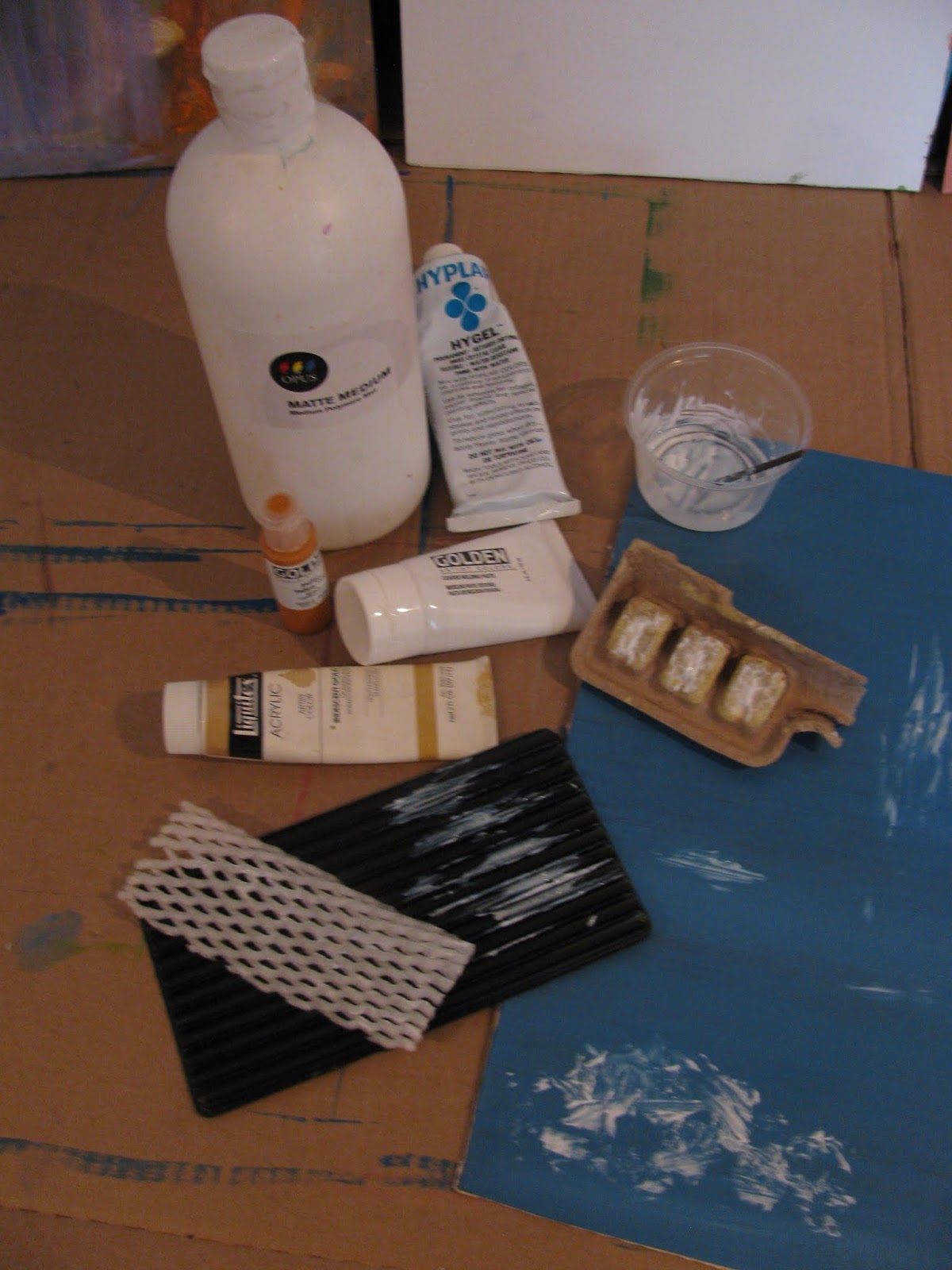
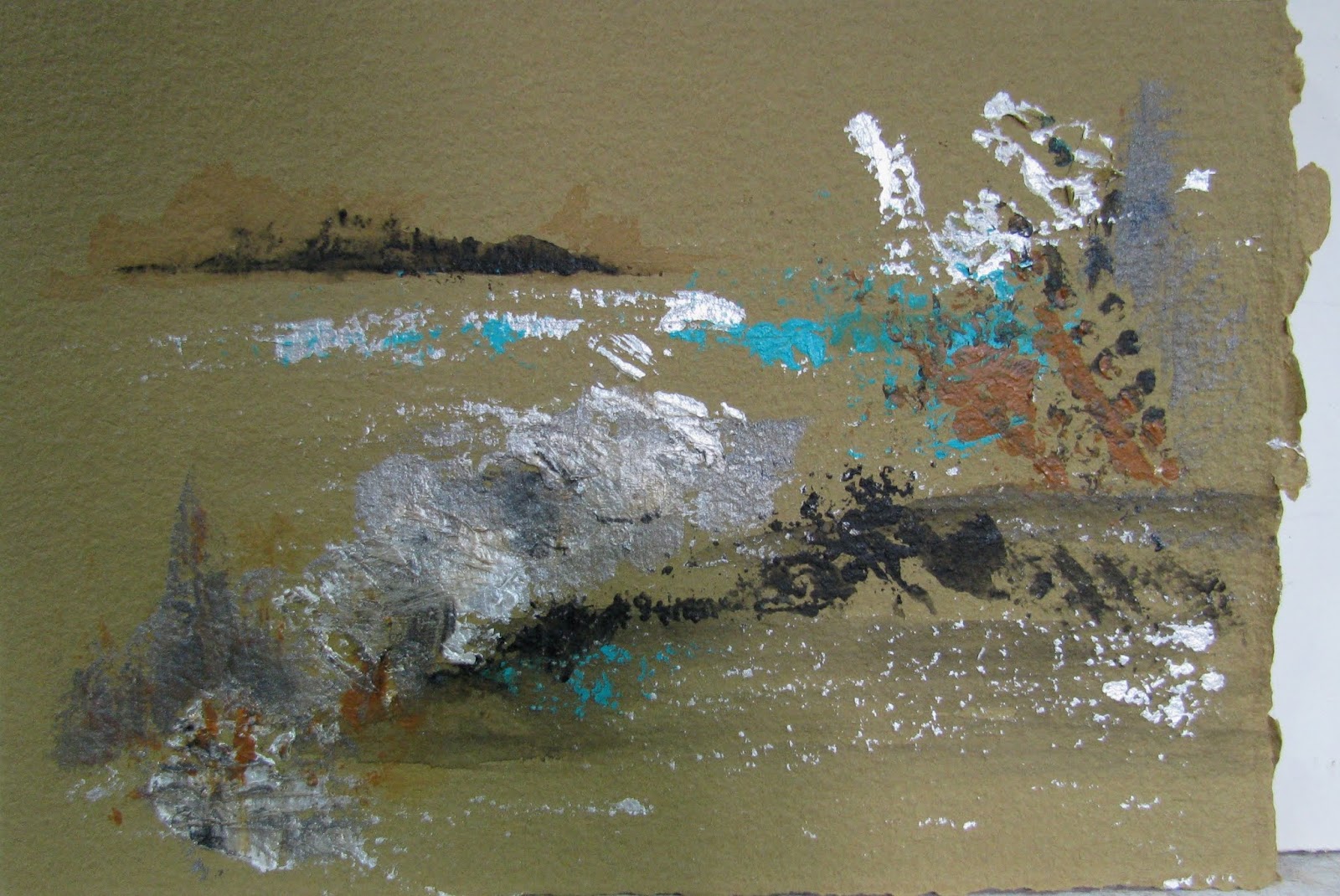
By the time I came home, with so many visual memories locked in my system, I wanted to work with them in paint.  But how?  There seemed little point in trying for realism when what would best communicate their power, I felt, was near abstraction.  Certainly texture was called for so I got out a bunch of texture-making stuff, as well as some rarely used Iridescent Pearl White paint...


 ....and went to town, or rather to the river bank.


I even got caught up in trying to capture a forest pool that we would pass each morning -- still dark against the shadowed cliffs and evergreens, with the rising sun just catching the tree tops on its far bank and some rocks and weeds in the foreground.


Frankly:  None of this was at all what I had in mind.  In fact, I realized that what was left on my palette at the end of one session was probably more successful than my three sketches.


My grandiose plans for a magnificent landscape series entitled "Terrain" were obviously coming to nought.  But:  I gave myself two more tries.


Just not my thing.  Unless maybe I settled down for several days along the river and drew and drew and painted and painted and -- chewed my cud, like these two elk we were astonished to see chilling out on the sand banks.