Saturday, March 14, 2020

Do you hear what I hear?


School bells!   And unless fate intervenes,  I'll be continuing with my ten days of art workshops -- all-day sessions for ten consecutive Mondays, each session taught by a different artist-teacher.  It's a "foundations" course in the basics, some of which I practice consciously, some of which I know in theory but haven't before focused on, some entirely new tricks of the trade.

Our first session touched on elements of design -- line, shape, form, space, texture, colour.  There was some confusion and last-minute-itis about what we were to prepare in advance.  Like several others, I understood we were to bring a simple line drawing on a small canvas.  I brought out some of my favourite artifacts (from among my 500 or so favourite artifacts) and prepared this:--


During the course of the day, we had about two hours here and there to work on developing our example -- presumably giving thought to those six design elements.  At the end, we were invited to finish our paintings at home and send the image to the instructor.  My work-in-progress looked like this:


When I looked at it the next day, I could barely begin to deal with it.  Soooo BORING!  So I pinned up a vibrant fabric (once a cherished skirt) behind my set-up and began to have some fun:--


What the heck.  It was an assignment.  I couldn't start over again.  So I just plain let loose and produced something that I'm not crazy about -- like Matisse on steroids?  I suppose it deserves a title.  I call it "The Pitcher Picture."


I took a photo of the setup for my records, remembering that Picasso had once said something like, "I never met a photograph I didn't like" ....as he counselled moving on from the world of photographic exactitude.  I couldn't find that quote but found another, perhaps more useful:

"I am always doing that which I cannot do, in order that I may learn how to do it."

Saturday, February 29, 2020

Heads must roll


When I did a recent glean of sketches from my life drawing sessions, I was pleased to salvage some rather nice head studies I'd achieved.  One of my virtual teachers (as I call those whose books I've learned from), Mary Beth McKenzie  wrote: "You must constantly challenge yourself.  Set ambitious goals and push your limits."

So I decided I'd try assembling four of them for a friendly coffee meet-up -- bodies included.
  
 
For several days, I was pretty pumped as I went downstairs to the studio each morning -- thinking that this foursome might really hit it off together.  As I pressed on, though, things started to get a little weird.


This image doesn't begin to describe how every stroke I made seemed to be the wrong one.  What to do???  Consult another virtual teacher -- wonderful BC artist Robert Genn (1936-2014), whose artist daughter Sara carries on with his  biweekly "Painter's Keys" newsletters.  It happened I'd recently read a post that she'd republished from her father's archives on a learning experience he called "The 37 Club."

The objective? Push yourself to do a painting with only 37 strokes of the brush.  OR, do a painting in 37 minutes.  OR, do 37 paintings in a day.  Whatever.

Okay.  Why not?  I could devote 37 strokes to each face.   And I did that.  Four faces x 37 + an extra 37 for the times I lost count x 2 cycles through the four faces.  Any way you add it up, it was not a magic answer.


 The spacey blonde looked more spacey than ever.


The successful drawing that I'd tried once before to transform into a painting continued to elude me.


The right-hand figure, although looking a little more congenial for a coffee companion, was hopelessly muddled in strokes of paint, pastel, and water-soluble crayon.


And the once-promising female on the left was clearly no Vermeer.


Help!  What to do, Virtual Teachers?   Richard Schmid replied immediately with this stern admonition:  "Never leave a mistake on the canvas."  In fact, this mistake was so pervasive........it was time for it to hit the cutting room floor.  For that matter, I've discovered that there's a whole world of possibilities in painting faces ON the floor -- check out "The Face on the Barroom Floor."


Saturday, February 15, 2020

Things are getting surreal


This funny winter, with its record-breaking precipitation, has made me a little unfocussed -- not quite ready to try to break my personal "best yet" record.  That doesn't mean that I've been idle; in fact, I seized on another two bus-riders (favourite subjects for surveillance) and have been helping them bring home their great finds from the local farmers' market.

Our trip began in November when two young women climbed on the bus, one of them verging on ecstasy with the fair-sized white pumpkin she'd found  to match her white hair and contrast with the black coats that she and her white-haired sister wore.  I tried a memory drawing when I reached home:--


The two of them sat on the sidelines as I finished up my 2019 paintings and occasionally played around with a composition.  How's this for surreal?


After a bit, I was ready to start putting paint to paper:


Having spent time with Raphael Soyer's marvellous self -portrait, I was thoroughly disenchanted with the direction these faces seemed to be going.  At one point, I even painted one of them on a 4" x 4" canvas and tried it on for size.


At this point, I faced the decision:-- to finish or to paint over?  For better or worse, I decided I'd see it through and see what happened.  Here's the final version, "Heading Home from the Farmers' Market" (copyright 2020).


Well.  Is this any better than "Dressed for Winter," a similarly inspired painting I did in March 2019? --


The verdict is out.  But this latest painting does at least meet my personal criteria of being Weird and Wonderful -- that surrealist thread that snagged me, courtesy of deChirico.   Also, I've shared with you my sighting of the contented young white-haired woman with her oh-so-cherished white pumpkin. 

Artist David Hockney wrote: 
"What an artist is trying to do for people is bring them closer to something, because of course art is about sharing. You wouldn't be an artist unless you wanted to share an experience, a thought."
I have mixed feelings about Hockney.  Some of his stuff I like, but you have to wonder: Is his frequently reproduced "Pool With Two Figures" really worth the $90.3M paid at auction in 2018?

In any case, looking for a Hockney link, I found reference to his book "Secret Knowledge:  Rediscovering the Lost Techniques of the Old Masters."  Our library has a copy, and it's apparently controversial -- so that should be weird and wonderful indeed.  Surreal, even.


Friday, January 31, 2020

Where do I wannabe?


Torrential rain again, raging in against the screen in my front window.  "But at least it's not snow," we Vancouverites say to each other, as we huddle under umbrellas at bus stops and storefronts.  Would I rather be somewhere else?  Noooooo.  But the thought balloons react spontaneously.


In fact, I *do* want to be right here, doing my own thing -- only constantly doing better.  That's the goal.  One plan, presented by those spontaneous thought balloons, is to return to a practice that proved useful in the on-line course I did in 2018:-- Choose my own subject and emulate the style of an artist I admire.  And so, every few paintings, I'm going to add to my "Wannabe Series".

One of the artists I discovered for myself  in the 2018 course was Ferdinand Hodler.  My Swiss-born friend "Y" tells me, "Hodler's a bit of a joke in Switzerland," but I couldn't pin her down to a reason.  She replied, "Oh, he's just so..." and then shrugged.

No matter.  I really, really like him for his people paintings with the clearly stated outlines and simple background, such as this self-portrait:


In the on-line  course, I modelled Hodler's style for a take-off on 20th-century photographer Richard Avedon.


And with Hodler on my mind as the first in the Wannabe Series, I came across a publicity photo of the perfect subject -- Otto Tausk, the music director of the Vancouver Symphony Orchestra.


The painted outcome?


I have a theory that if I keep working, doing my own thing, studying artists I admire, the skies will begin to clear.  There might be snow on the ground, it might be late in the day, but there will be mountains just visible in the distance, and I'll know I'm headed in the right direction.


Wednesday, January 15, 2020

Direct to you from Lincoln Centre


Yes!  I was there -- New York City's Lincoln Centre for the Performing Arts.  It was a year and a half ago now, but so unforgettable.  I took a gazillion photos that I'll probably never get into albums to share because when I view them, I get lost in a wonderful reverie of memories. 

When I sought out this photo, I found plenty of "denizens" like these loungers on the 14-acre grounds of Lincoln Centre -- just waiting to be immortalized in one of my paintings?


But...it isn't this Lincoln Centre that led to today's post.  It's this one:--


Hmmmm.  What  IS this?  Let's take a peek inside.


Okay.  It's a well-travelled book, at some time discarded from the Lincoln, Maine, Public Library -- and then wending its way through several second-hand stores until it came into the hands of my niece's mother's cousin in Massachusetts.  She grabbed it with a bunch of others, intending it for the free book exchange in my niece's little town and passed it on to niece's mother -- my lovely simpatico "new" sister-in-law, discovered on that same memorable trip.  Sister-in-law promptly snagged it, read it, and decided it was meant for me.  I opened my mailbox one day to find:--


Now, it happens that I'd long ago seen a book of  paintings by Raphael Soyer, an American artist who's little known today.  They hadn't then appealed to me, but his self-portrait on this cover enthralled me, as did the writings in his diary.  It only made sense, then, to give it a shot -- to try to emulate this marvellous painting.  And so I set to work:


Such an instructive process -- looking every day at the shapes, the tones, the edges, the brushstrokes.  I don't work in oils, as Soyer did, but I still learned a ton.  The outcome, though far from an exact copy, thrills me -- because I can look at it, propped against a shelf in my living room, and be continually challenged:  How did he do it?


My version, up close:


His diary and the further reading I've done about his colleagues -- so many of them known to me -- have made me very fond of this man, who wrote: 
 "From all that I have seen, I am more than ever convinced that art must communicate, and it must represent, describe and express people, their lives and times."
I realized, too, that on my unforgettable trip, I must have seen Soyer at the Whitney Museum of American Art.  Back to my photo collection.  YES!


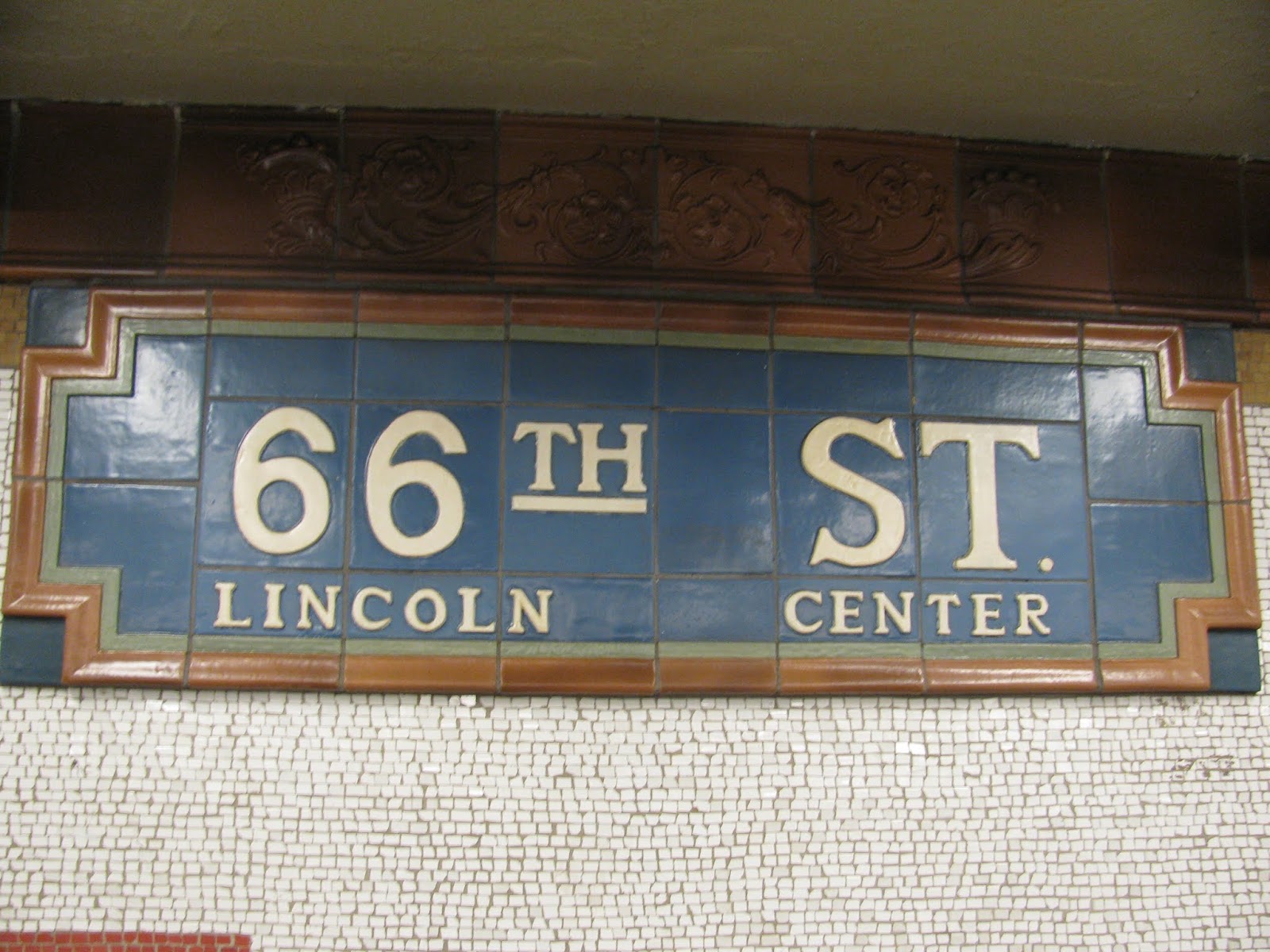
Huge sigh!  -- I saw so much fantastic art.  Now let's come full circle with New York's Lincoln Centre.  In planning my trip, I knew that I'd be watching for the famous tile art in NYC's subway stations -- a commonplace, I suppose, to New Yorkers but a revelation to me when I first saw the paintings of  Daniel E. Greene.  He was a handsome young artist/teacher when I met him 40 years ago in the pages of the now-defunct magazine "American Artist."  You *have* to see what he did with people and tile art in his Subway Paintings.

This has been a circuitous trip.  Now, as we hop back on board, you might feel inclined to ask, "What's our next stop?"


Tuesday, December 31, 2019

New Year’s Eve 2019 - What’s out there?


Wow.  What's coming?  A new year.  A new decade.  And who knows what, on all fronts.  To say the words "twenty years ago", to reflect on all that has happened in that time...  rather astonishing.

Well, twenty years ago at this time of year, I'd been recently hired for a full-time job at a place I loved, we were celebrating the season at our snowy cabin, and among the gifts I was cherishing from JT was this beautiful half-size sketchbook:--


Just recently, when my Chinese-Canadian neighbours brought their friends to my house, I realized my chance had come to learn the meaning of the symbol on the cover.  When I brought it out, their eyes lit up, "Good luck!  Good fortune! -- and the red, too, so lucky!"  Well, what more could I have asked, for the special purpose to which I eventually put this lovely little book? 

Twenty years ago, the year 2000 was a special time for my art.  I had come to accept that evening art classes were no longer feasible but that, by golly,  I wasn't a half-bad student.  I had continued my enduring practice of drawing every day -- thank you, revered teacher Kimon Nicolaides via your book THE NATURAL WAY TO DRAW.  I see by this link, which explains the Daily Composition exercise I've followed for more than 20 years, that his teachings continue to inspire others.

I also recalled then the advice of my other revered teacher RJS, from whom I'd taken several semesters of life drawing classes in the early 80's.   Nicolaides had said, "The student who learns to draw is the one who draws." (Meaning:  You have to work at it, not just think about it.)  RJS had said, in answer to another student's question about how to learn to paint, "Just do it.  Start painting."

By August of that year (the season that I consider my personal "new year" in terms of major goal-setting), I had decided to take myself to Art School at home -- to set goals, to devise a curriculum from all the resources I had available, to keep working. 

Year One in my art school was based on an exercise suggested by Robert Kaupelis, artist-author of two great books, LEARNING TO DRAW and EXPERIMENTAL DRAWING.  He proposed:  "Draw every day for a year.  Draw on a roll of paper.  Do not unroll and do not look back until the end of the year." 

And I did it! - missing maybe 3 days out of the 365.  The Daily Composition continues (most days!), as does my annual goal-setting in the beautiful red sketchbook.  To cheer myself on, I "graduated" from Art School about five years ago and began to call my studies "The Homegrown MFA." (Master of Fine Arts).

This past fall, I again carefully set my goals for Year 20 - Homegrown MFA.  And I decided that I'd paint a self-portrait for my launch into the year 2020 -- when (gulp!) I will be 75 years old.  The self-portrait was a good opportunity to try working in the style of an enthralling artist I'd only recently discovered -- Julien Lévy-Dhurmer.  My eye was caught by a library book cover using his painting, La Femme à la Médaille ou Mystére  ("Woman with Medallion -- or Mystery."):--

As much as I've always loved Art Nouveau, I'd never come across this French artist of the late 19th/early 20th century.  When I checked on-line and found some of his other eerie images -- like "Le Silence" -- I was smitten.

Here's my take, in the manner of  Lévy-Dhurmer, on my own personal "Mystére":--  "Looking Toward 75" (copyright 2019).


Although I'm excited about the unknown adventures ahead, the view hasn't yet come into focus.  I'm confident, though, that if I just keep moving, one step after another, the path will become clear.  From another old sketchbook that I came across just the other day, here's how things appeared as I looked out my studio window at our old house -- one dark evening, almost exactly 20 years ago.


Sunday, December 15, 2019

Denizens Series -- It's a wrap!


I aimed to produce ten paintings in the "Denizens" series by year-end, and with mixed results, I'll announce that it's a wrap.  Did I learn a lot?  Yes.  Did I make progress?  Well…let's come back to that in a minute.

First, I'll introduce Number 9 in the series.  She's a lovely young woman who's a receptionist at the clinic I go to.  Almost every time I show up for a volunteer stint, her hair is a different colour, and I ooh and aah.  She told me her sister is a hair stylist, and she gets the benefit of her sister's experimentation.

Here's the first drawing I made from memory and my first quick painted study.


She was so excited about the drawing -- though we both agreed it doesn't really capture her beautiful young face.  (My words, not hers)  And I don't even plan to show her the final painting, Denizens Series - "The Stylist's Sister," copyright 2019.


Number Ten in the series is truly a denizen -- a neighbour down the block until two years ago.  Evidently, he worked from home and would go out for a daily coffee.  He seemed at first to be grim and vaguely hostile.  Then I began taking my sweet cat Nik for walks on his leash -- and that led to cordial sidewalk exchanges.  Here's my memory drawing and very slapdash painted study (gotta use up the excess paint on my palette).


The last time I saw him, Thanksgiving 2017, he and his 10-year-old son (who I'd never previously laid eyes on) were taking a big box of food to a homeless shelter -- quite a different person behind the forbidding features that had first caught my eye!  Two weeks later, I learned the family had moved out, unable to afford a hefty rent increase.  So here he is -- reminding me that you can't judge a book by its cover, Denizens Series - "Neighbour," copyright 2019.


Back to the opener:  Did I make progress through this exercise?  I'm not aiming to paint classical portraits but just want to become more….well, plausible, I guess.  Let's take a look.  Here's Number One, "Ringlets," compared to Number Nine, "The Stylist's Sister."


And here's Number Two, "Filmmaker", compared to Number Ten, "Neighbour."


Hmmmm.   Progress?  Not sure.  What I remember as a uniting feature of all four is that I knew something more needed to be done, but I wasn't sure what.  And I was afraid to go further and wreck the whole thing.

Did I say "feature"?  I'm sure I've read somewhere that it doesn't take an artist to instantly recognize the errors in the features of a painted face -- like those eyes in "Ringlets"?!  Looking for this reference on-line, I found an abundance of articles on facial recognition -- some of it rather scary.  The Smithsonian offers the simplest (and least sinister) summary of findings to date.

With the Denizens Series a wrap, what's next?  Well, there are always people off on the sidelines, and their figures and features are just waiting to show up in my studio.