Friday, May 31, 2019

Strange happenings in the park


Where did it all begin?  I guess it all started last October when my newly discovered sister-in-law (newly discovered as a real sister-friend) took me on a golden day's trek around her part of almost-rural Massachusetts -- Concord Bridge, Walden Pond, and a favourite place of hers, the DeCordova Sculpture Park and Museum.  Of course, this over-sized head drew me like a magnet.

And then there was my 100 Hands project.

 
-- and my own unfinished "Bird in the Hand" cedar sculpture, about 25 years old and weathering gracefully in the back yard.  (Unfinished because I'd decided early in the game that clay would be an easier medium).


And how about those art student friends of Pontormo's -- and then a giant-sized hand sculpture that I read about in an art newsletter -- maybe one of these.

Picking up the vibes, I decided to let some art students loose in a sculpture garden.


I'd previously enjoyed the process of "carving" a painting out of a dark background so I thought I'd try it again.


I should have remembered that strange things can happen in a park after dark.  So far, there's a wise bird's head shaping up in Massachusetts marble:


....a pair of eerie hands...


 ...a funky student haircut...


...and other miscellanies that aren't yet ready to see the light of day.

I plan to keep nurturing this painting:


 -- and maybe next post, I'll be able to announce thumbs up.


Wednesday, May 15, 2019

Time for a new wardrobe


Seriously:  It's time to put winter away.  My winter doldrums paintings lingered on past the equinox but, just in time for some warm weather, I wrapped them up at the end of April.

Both of these were started in January,  inspired by strong contrasts in colours against the (psychological?) surroundings of winter darkness.  And in the tiny quick studies I made, they looked promising.


The idea for the first one hit me one day as I stepped into the commuter train.  Everyone was wearing black and almost-black garments -- a wall of blackness, with the exception of the female in the foreground with knock-out blue coat and red scarf, along with her magenta hair, and the guy with the black-white plaid scarf.  When I came to plan the painting, I added some more colour with the female on the right, another commuter I'd sketched on another day.  My crowd scene is called inevitably "Rush Hour."
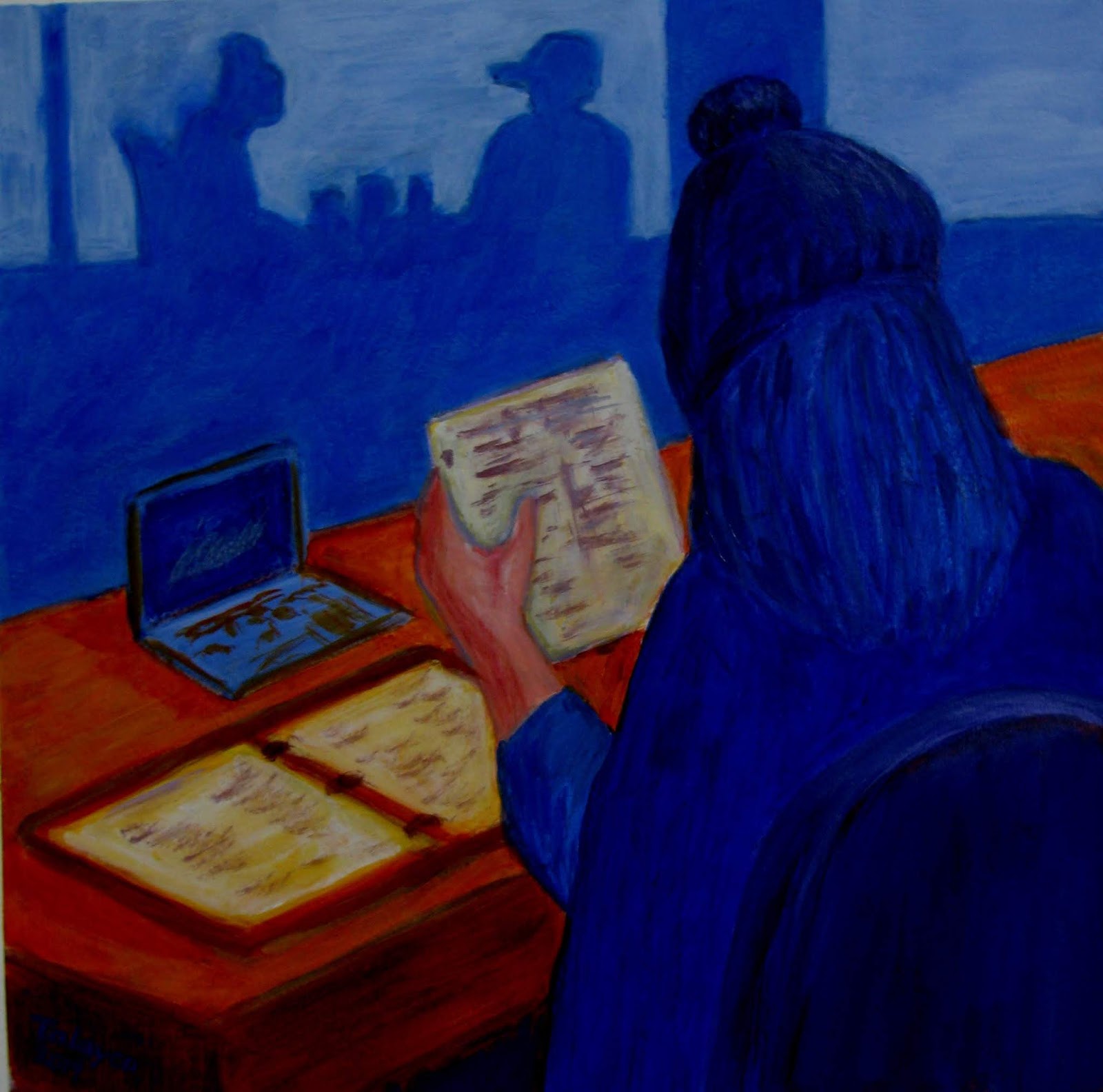
The second originated with another strong contrast.  Looking into a coffee shop window near a bus stop, I was struck by  the warm golden wood table contrasting with the young woman's all-black garments and hair.  It also amused me that with all the hype about offices (and coffee shop offices!) becoming "paperless" she was still dealing with a lot of paper.  And so emerged "The Not Quite Paperless Office."

I'm not crazy about either of these, but they presented some learning opportunities -- that overworked phrase!  (Could we somehow blend Learning Opportunities with LOL !?)  And despite the winter of my discontent that I'm leaving behind, they at least confirm my continued interest in working with faces and figures.
Now let's head for the garden!


Monday, April 29, 2019

Lost in the crowd


I know you'll remember my fascination with the wide-eyed young woman on the left in Pontormo's "Visitation" -- and the painting that evolved as I paired her with another young woman spotted in a Boston crowd last fall. 

Well, it happened again, thanks to my current project of browsing through art history for poses for my One Hundred Hands project.   I opened up Google Images for Filippino Lippi, son of the only vaguely familiar (to me) Renaissance painter Fra Filippo Lippi. 

And there he was -- in a presumed self-portrait on the sidelines of his "Dispute with Simon Magus."


That gaze!  I had to give it a try -- not to copy exactly, but just to spend time getting to know that face.  Also, I thought,  I could try working on one of the small canvases I bought recently as an alternative to the fine arts paper I usually work on.

And so I set to work on "Young Fil," as I called him -- restraining myself, though, from putting him into a backward baseball cap.


Things developed quickly and easily, and I was quite pleased and excited.
  

But it was at about this point that I allowed myself to think something that had been nudging at me over the course of a week:-- his nose was too long.  I hemmed and hawed and decided to belatedly accept the counsel of artist/teacher Richard Schmidt:  "Never leave a mistake on the easel."

Okay.  So I painted over the middle of  Young Fil's  face and re-did his nose:


This looked quite promising, especially when viewed from across the room -- a familiar painter's technique for assessing progress.


Up close, though, it was a different story.  I had to admit that the placements I'd made in relation to the too-long nose were now off-kilter. (I should have listened to Richard Schmidt's whisper earlier in the week).   The mouth should go a little more to the right, and the subject's left eye should move a little more toward the centre.


So many ups and downs.  Should I try to correct, feature by feature?  Or should I just paint the whole thing over and start again?  Maybe give him a baseball cap after all?  I didn't have the heart to deal with it.

For now, he's been consigned to sit out a few games (maybe a season) in la panchina -- that's Italian for the dugout. 

You didn't know they played baseball in Italy?  I'm not talking about the feats of Italian-Americans Yogi Berra or Joe DiMaggio -- but actual on-the-ground baseball in Italy, a gift from the New World to the Old.

And maybe the last word on my Young Fil experiment belongs with baseball legend Satchel Paige:
"You win a few, you lose a few. Some get rained out. But you got to dress for all of them."

Tuesday, April 16, 2019

What a handful!


When I was in Junior High, I created a personal logo -- my own version of the symbol known as an index.  I used it to mark my school notes, where it even attracted the attention of a boy I admired.  His dad was a printer and he himself had a liking for typefaces. He'd created his own whimsical version of, oh, let's see, maybe Times Roman -- and I've combined the two in the image above.

It was the traditional printer's index that I emulated -- knowing even then that my finger lengths were inaccurate, but that was part of its charm.

No wonder I stopped in my tracks in mid-gallop around the Metropolitan Museum of Art when I saw a beautifully drawn historic hand -- though not, as it turned out, the pointing variety.
  

Fairly recently, I learned that the pointing hand symbol is also called a manicule, and it has a much longer history than I'd imagined.  View this charming short video from BBC and you'll learn all about it.

Hands in themselves are of course of great interest to artists -- and to scholars and practitioners in dozens of fields.   Not long ago, I came across the work of archaeologist Dean Snow who's been studying handprints in prehistoric caves.  He started by looking at research on gender differences in hand formation as collated in the Manning Index.  According to Manning, there's a consistent difference in finger length between male and female hands:  In a female hand, the ring finger is often shorter or the same length as the index finger.  In a male hand, the ring finger is often longer than the index finger. 

And guess what?  Viewing lots of prehistoric handprints, Snow concludes that an abundance of these are distinctly female hands.  Whoo hoo! -- So much for "Prehistoric Man."   You go, girl!   And if you need more substantiation for the female role in prehistory, check out poet Ansel Elkins' stunning account in her "Autobiography of Eve".


You'll have noticed that I continue my fascination with hands in my life drawing sessions.


Sometimes they risk confusion with my Junior High logo, and I'm really trying to move beyond that.  Hands are acknowledged as being difficult to draw, and tons of teaching material is devoted to analysis and various techniques.


 One thing that's consistent across methods:-- as with almost everything, it's practice and more practice that makes the difference.  And so I decided in mid-February that, in addition to my other art routines, I'd draw 100 hands -- one a day.  At first, I started out with a small sketchbook, thinking a little "Hand Book" would be fun to do.


Rather quickly, I found that the small format was limiting -- and meanwhile, there was also a limit to the poses I could do with my own left hand.  The thought then occurred to combine my readings in art history with hand poses based on the work of individual artists. 


Reviewing paintings and selecting poses from Google Images (which I've loved since we were first  introduced in about 2003 !!), I've become more familiar with artists who I'd known before -- and I've made some entirely new acquaintances.  When I pick up my pencil tonight, I'll be looking for hand pose #66 -- from Rembrandt, no less.

It's been fun, too, to recall my long-ago logo and the interest in typeface and calligraphy that eventually emerged from my crush on the printer's son.  I used to say that in another lifetime, I'd been a monk in an Irish monastery, happily applying pigment to illuminated manuscripts.  Learning that "my" index has medieval origins suggests I might have picked it up way back when.  Well.  Seriously....  But why be serious?


Sunday, March 31, 2019

Maybe this is not your style?


I first spotted these twin Lawrence of Siberia lions with snow on their heads in early February.  By the time I'd returned with my camera, the snow was gone, perhaps just as well.  They're one of the wittiest treatments I've seen of the stereotypical gate on the stereotypical fence in front of the stereotypical Vancouver Special-style house. 

It's time for T-shirts to replace the thawbs (okay, I just looked that up, and you can, too) but I still have winter-clothed figures on the easel and for artistic purposes, I'm going to miss those winter garments.  The piece I just finished is based on a young woman I saw on the bus --white-blonde hair, light cream coat with black sleeves, rich golden-orange scarf and headband, and red boots!!!


Challenging myself to make an interesting painting of the prominent cream and black, I set to work.


But something had happened by the time I started laying in the colours.
  
 
I got bored.  Even though I'd planned ahead, I hadn't planned enough.  I had really wanted to do those red boots, but the figure's placement....yawn.   Decision:  Forget the boots and enlarge the figure.


Deep sigh.  Still boring.  But I *still* wanted to do this figure.  Decision:  White-out the whole thing and begin again.


Okay -- I liked the size now.  Will I be able to I pull this off?  (One of the questions I often ask myself mid-stream)
 
All right -- the placement of the darks seemed promising, and away I went.

 
And as I reached the final version of "Dressed for Winter",  I found myself really liking my big flat colour splashes:


It's almost a given that a painter's style evolves of itself as the artist keeps working -- trying new things, pushing boundaries, making experiments.  Best not to give too much thought to it except I can't help but notice an irrepressible impulse towards big shapes, definite edges, and vibrant colours. 

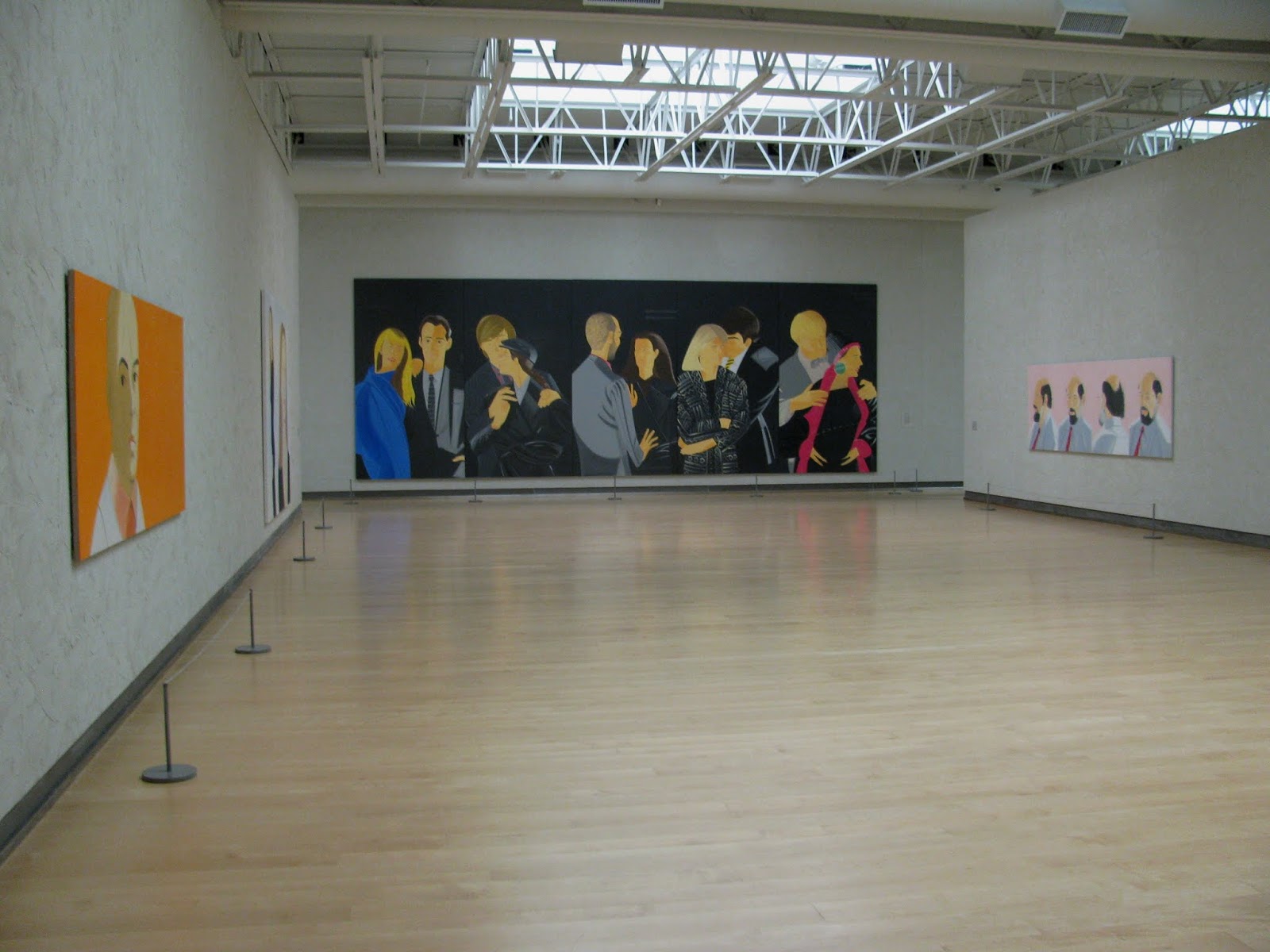
When my esteemed teacher Thomas came for coffee at The Yellow House, he said, "Just keep doing your thing."  And as he talked randomly, deliberately not wanting to give specific advice, he said, "Alex Katz is a painter you might like." 

I'd only vaguely heard of Alex Katz but when I checked him out (scroll down on the page to see the paintings),...yeah, I did like him a lot.  My beloved friend A. did better than that -- she confessed to *loving* Alex Katz and last fall in Maine took me to the Colby College Museum.  Katz donated about 400 of his works to Colby College, where they can be seen in rotation in a specially-built wing -- and there I saw the real thing, very much larger than life!


Katz, by the way, is still going strong at age 90, and he describes his own style this way:
"I like to make an image that is so simple you can't avoid it, and so complicated you can't figure it out."
Now, about those Lawrence-Lions that kicked off this discussion of style:--  They win a prize, but only second place.  The major award for "Most Distinctive Ornaments on a Vancouver- Special Fence" goes to a house several more blocks away, with the Seven Dwarfs each perched on its own brick pedestal.  Modestly accepting the prize is Bashful.

Friday, March 15, 2019

The black and white of it


Back at it!  Pictured here are two of the regulars who often show up at the same life drawing session I prefer:-- Thursdays, 10 am to 1 pm.  When these sessions are at their best, the model is inventive and steady, the room is silent, and we're all so focussed we're almost breathing in unison.  I love these kind of days -- so do my compatriots and it shows in our happy anticipation beforehand and good moods afterwards, whether or not it's been a "good day" or a "bad day". 

I've referred before to my bible -- Kimon Nicolaides' "The Natural Way to Draw."   A close runner-up is "The Art Spirit" by Robert Henri.  Nicolaides and Henri were hugely influential early 20th-century teachers at New York City's Art Students League; Henri, the elder by a generation, an accomplished artist.  Their books are still read and revered now, almost 100 years later.  Some timeless excerpts: 
   
"There is no such thing as starting where Cezanne left off. You have to start where he started... at the beginning." -  Kimon Nicolaides
  
"All real works of art look as though they were done in joy."  - Robert Henri

Maybe in some other lifetime, I'll be able to hit the Art Students League when one or the other is there teaching.  For now, I'll dip into my recent drawing sessions...just for the joy of it:


I've found it worthwhile to focus on just a part of the model if I'm not quite in synch with the pose.  Can you interpret this one? --


Just coincidentally, I hadn't worked with a male model in months so I was glad to see this guy show up -- someone with meat on his bones!


You might have noticed that I'm working on hands.


Now, in the coming two weeks, I'll be able to again attend the noontime drawing sessions that are offered free at the performance site of Vancouver's International Dance Festival.  It seemed like a good omen when one of last year's wonderful models returned for the first session I attended this year.


 When I got home, I took a couple inches off her head!  But this one, one of the last, was just about right:


I don't know if she's a dancer (often they are),  but she certainly models with joy.  These free sessions are only an hour long.  As our time came to a close and I began to dismantle my drawing board she said, "Okay -- there's one more minute.  How about this?" -- and  went instantly into a kind of yoga pose, balanced on one leg, arms outstretched.  I slapped my paper back in place, grabbed my charcoal, and captured this impression by the time the minute was up.   Forget the oversized head -- it was an exhilarating conclusion!