Monday, April 30, 2018

Youth and age - the timeless theme


There's a BC wildflower called Youth-on-Age, so named for its characteristic growth pattern.  The ones  blooming in my garden now derive from a tiny plant judiciously collected from a vast growth at the base of UBC's Point Grey cliffs -- forty years ago this month!  As my enduring and unequalled identification guide explains it:
"...examine the leaves in the late summer and you will see that the reason for the odd name is that small leaves are growing from the base of the old leaf blades.  As the old leaves wither they slowly drop to the ground, giving the new leaves a chance to root."
                  - C. P. Lyons, Trees, Shrubs and Flowers to Know in British Columbia
 A sort of phoenix plant, you might conclude.

In mid-March when it scarcely seemed likely we'd see ANY abundant spring growth this year (so cold! so rainy!), the timeless theme was on my mind as I developed a "Youth and Age" diptych for Degas Week in my on-line course.  (True confessions:  I started a week early and spent two weeks in total).

Degas, one of my all-time favourites, began painting self-portraits at an early age -- always with eyes like deep pools which apparently characterized the Degas clan.  I chose to emulate this one for the simplicity of its tones:


 By happy accident,  my internet image search turned up a "Portrait of the Painter Degas" by Maurice Denis.  He's another early 20th century artist whose name I knew -- but with whom I had no resonance.  Now I do!  I fell in love with his austerely toned picture of an elderly Degas.


I worked on the two in parallel under the heading "Youth and Age"...


...with a somewhat successful outcome.  (You can view the brief sequence of development here).

Here's my version of Degas' "Self-portrait in a Soft Hat":


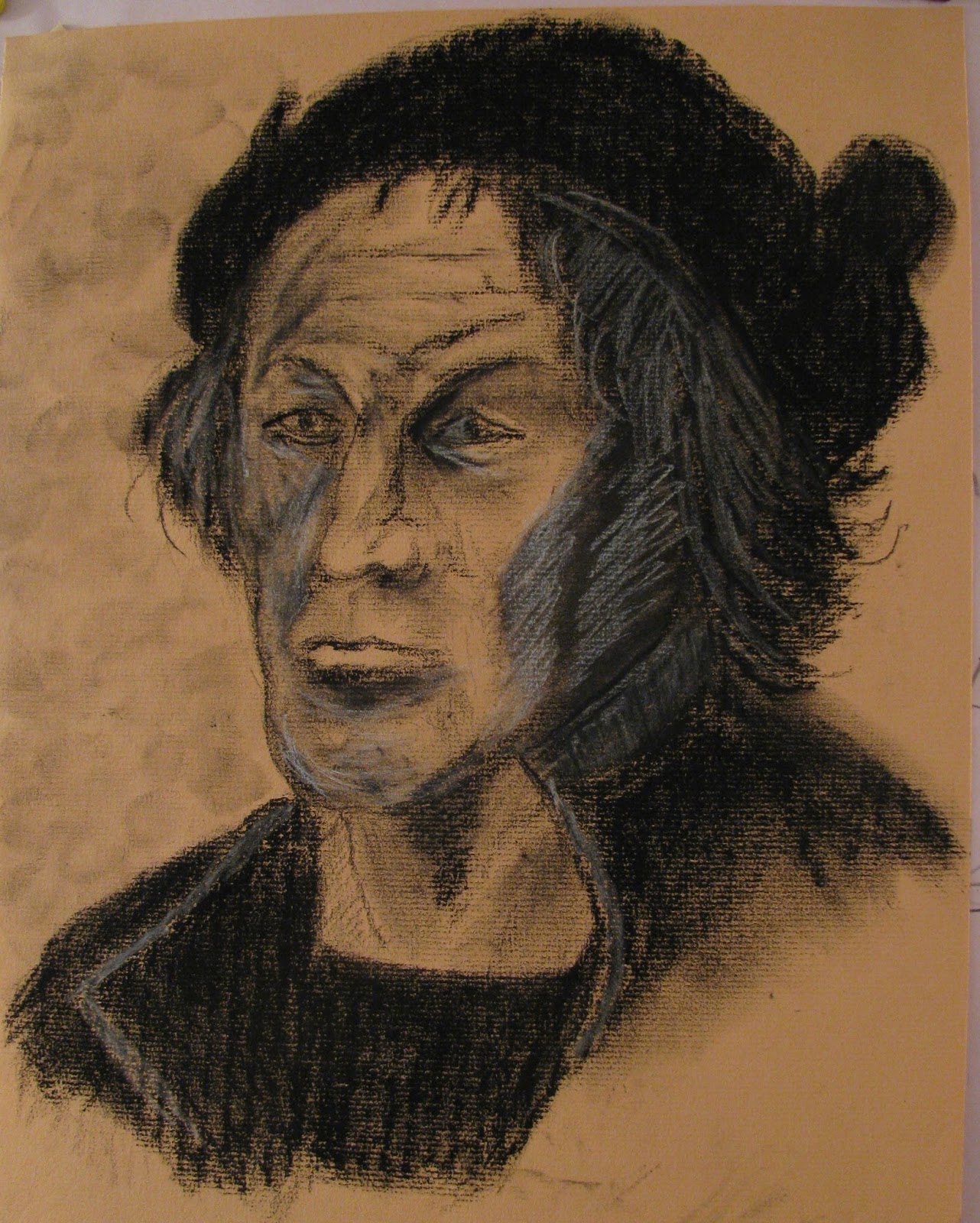
My version of Denis' portrait of Degas:


Let's think of the new spring plants that emerged from young leaves growing at the base of the old ones -- 


-- how life keeps putting down new growth; how the old nourishes the young; how after decades -- even across centuries, even across cultures -- art students are still inspired by the thrilling vitality conveyed in a masterwork of art.


Saturday, April 14, 2018

Brand new gallery wing: The docent’s tour


I'm still lurking around the edges of my on-line art course, doing my own thing to the tune of artist-of-the-week.  Now it's time for a catch-up so I thought I'd line you up with a docent's tour.

You know the drill.   You tend to hear things you already knew, things you might or might not have known, and surprising things you'd never have guessed.  Ready?  Cell phones turned off,  please.

Let's start BIG -- with Rembrandt. 

You knew:  Any gallery worth its salt must have a Rembrandt!
You might or might not know:  Rembrandt was a prolific painter of self-portraits and left a virtual painted autobiography spanning youth to old age.
You might be surprised to learn:  Your docent fell in love with Rembrandt's drawings decades ago, long before she warmed up to his paintings.

For Rembrandt week, I chose to do a simple very-black-and-white copy of his pencilled self-portrait as a young man.


You knew:  In any gallery, you're sure to encounter artists you've never heard of.
You might or might not know:  Tanner was the first Afro-American artist to achieve international acclaim -- which he was able to develop after moving to France.
You might be surprised to learn:  His wife was a Swedish soprano, Jessie Ollsson, and I chose his beautiful "Portrait of the Artist's Wife" to  emulate.


You knew:  There's a female artist who is forever painting mothers and their children.  You're sure to see her work on Mother's Day cards.
You might or might not know:  Mary Cassatt was a great friend of the artist Degas and shared his interest in experimental techniques with pastel.
You might be surprised to learn:   Your docent thought she'd discovered a close family connection to Cassatt and Degas, as described here.  (Okay, so maybe it wasn't so close after all.)

I decided to work in pastel and modify a typical Cassatt theme/pose -- borrowing a friend's husband and granddaughters for "Grandpa and the Girls."  (and obscuring them from being "borrowed" by Facebook!)


You knew:  There was a sole female among the original Impressionists but she's often overlooked.
You might or might not know:  She was married to Eugène Manet, the brother of the famous painter.  Their daughter Julie wrote a charming and insightful book, "Growing Up with the Impressionists."
You might be surprised to learn:  Morisot was greatly esteemed by her Impressionist colleagues, Renoir and Degas in particular, but otherwise had to fight the good fight of 19th century females for professional recognition.

I chose her "Jeune Fille au Manteau Vert" as my model for a quick, loose sketch of a local felt artist in her shop.


You knew:  The waterlily guy!
You might or might not know:  The great love of his life, his first wife Camille, died young of tuberculosis before he'd even settled in what became the famous hamlet of Giverny.
You might be surprised to learn:  Stephanie Cowell's "Claude and Camille:  A Novel of Monet" is sooo not worth it.

I emulated Monet's "Portrait of Camille," using my memory of one of my young neighbours for a somewhat updated version.   But why does she look so worried?  It's incredible how subtle the features can be.  I fiddled with eyes and eyebrows for days and finally left her to worry about what people would think.


You knew:  His first name is the same as my cat's.
You might or might not know:  He could draw like a dream and paint like a madman.
You might be surprised to learn:  Born and educated in Russia, he came to the States in his early 40s and eventually became part of the Taos Art Colony.

I was enchanted by the energy and splash of his "Portrait of the Artist's Father":


I decided to let loose and re-do an uninspiring portrait I'd attempted months ago of an elegant aging woman I saw in the lobby of a medical building.   She's now taken on a new life as "Wise Woman" -- and it's kind of fun to look at the progression of her facelift here.


This gallery is still under construction.  We'll dip into the paint pots from time to time with a progress report.


Saturday, March 31, 2018

Forever Matisse


Yes, Matisse is my FAF -- Favourite Artist Forever.  Whenever I see a Matisse or occasionally catch a glimpse of  something suggesting Matisse in my own work (quick sketches above) or in others', it brings me a deep sense of satisfaction -- of  joy, in fact.

He took a lot of flak in his lifetime for his words suggesting "armchair art" -- but then, you either resonate with Matisse or you don't.
 "What I dream of is an art of balance, of purity and serenity, devoid of troubling or depressing subject matter, an art which could be for every mental worker, for the businessman as well as the man of letters, for example, a soothing, calming influence on the mind, something like a good armchair which provides relaxation from physical fatigue."
There's just one among his most famous paintings that I used to dislike intensely:-- "Decorative Figure on an Ornamental Background."


Three years ago, I used this painting as the base for an exercise suggested by one of my art books:  "See what you can learn by studying a work of art you really don't like."  My experiment is explained here -- what I learned about Matisse's sources that made the stiff figure and ugly fabric more comprehensible to me, as well as the adjustments I made to make this my own.  Here's the outcome, "Channelling Matisse," copyright 2015.


I channelled Matisse again a few months after that when I included a postcard reproduction in the background of "Another Vintage Year" (copyright 2015).


Even the voyeuristic poppy pods couldn't stop looking!


Recently, Matisse came up as the "artist of the week" in my on-line art class.  It happened that I'd just finished one of the International Dance Festival's drawing sessions, and the dancer in mime costume/make-up was constantly on my mind.


I started wondering, "Hmmm....with all his facility with lavish colours, what would Matisse have done with a figure in white?"   I found a few on-line examples of Matisse figures in white clothing and then suddenly thought, "Why not just plunk my white mime figure right in the middle of........the Ornamental Background?!??"

I worked with great excitement and am still excited by the outcome -- "Mime in a Matisse Setting."  (copyright 2018)


The work-in-progress sequence can be viewed here, and it's kind of fun.   I worked over an old painting of wine and liqueur bottles, and in the initial phase the mime looks like a ghostly elf tucked in behind a brandy snifter.

Well, why not?  I'm having fun.  I'm learning lots.  Cheers!  Salut!  Happy Days!


Saturday, March 17, 2018

Shall we dance -- ?


Sunshine!  Blue skies!  Energy!!!  I don't know whether that's why the Vancouver International Dance Festival is held at this time of year, but it makes for an exciting March.  The community centre that hosts the festival on its professional stage always sponsors free one-hour drawing sessions during the festival weeks, and this is the third year I've attended a few.

But wait!  I'm getting ahead of myself.  Last month and this week, I've again been drawing in the dark at the Dance Centre, where professional dance troupes preview their works-in-progress in one-hour noontime sessions.  It's an exercise I invented for myself and although it yields few recognizable results, it's so much fun.

I've seen some astonishing young dancers there, and the latest -- the OURO Collective (named for Ouroboros) -- were truly jaw-dropping.  Try this link and click on "TANGENT - Trailer" for a sample.  Then imagine trying to capture this action, drawing quickly in the dark, virtually sight unseen.


The blob in this one  should be read as a cascade of the five interlocked dancers:


Plenty of people would view my personal Drawing in the Dark (not to be confused with Dancing in the Dark)  as a quirky idea.  What a delight for me, then, to have seated next to me a young woman who, I could see, could barely refrain from looking at what I was doing.  When the hour ended and the lights came up she said, "I couldn't help but watch you.  Could I see your drawings?  It's so cool that you're doing this."  We flipped through the blobs together, and she was so excited:  "Oh my god, you've nailed it!!!"  Talk about kindred spirits.

Now, on to the Roundhouse Community Centre for the VIDF offerings -- featuring clothed models, most often dancers themselves who are modelling on a volunteer basis. 


First up, a young woman in mime's costume, white-face, and an incredible wasp-nest kind of turban.


Her modelling was terrific but oddly enough, all this white against the black was hard to draw.  Still, I'm fascinated by this costumed pose -- you haven't seen the last of it.


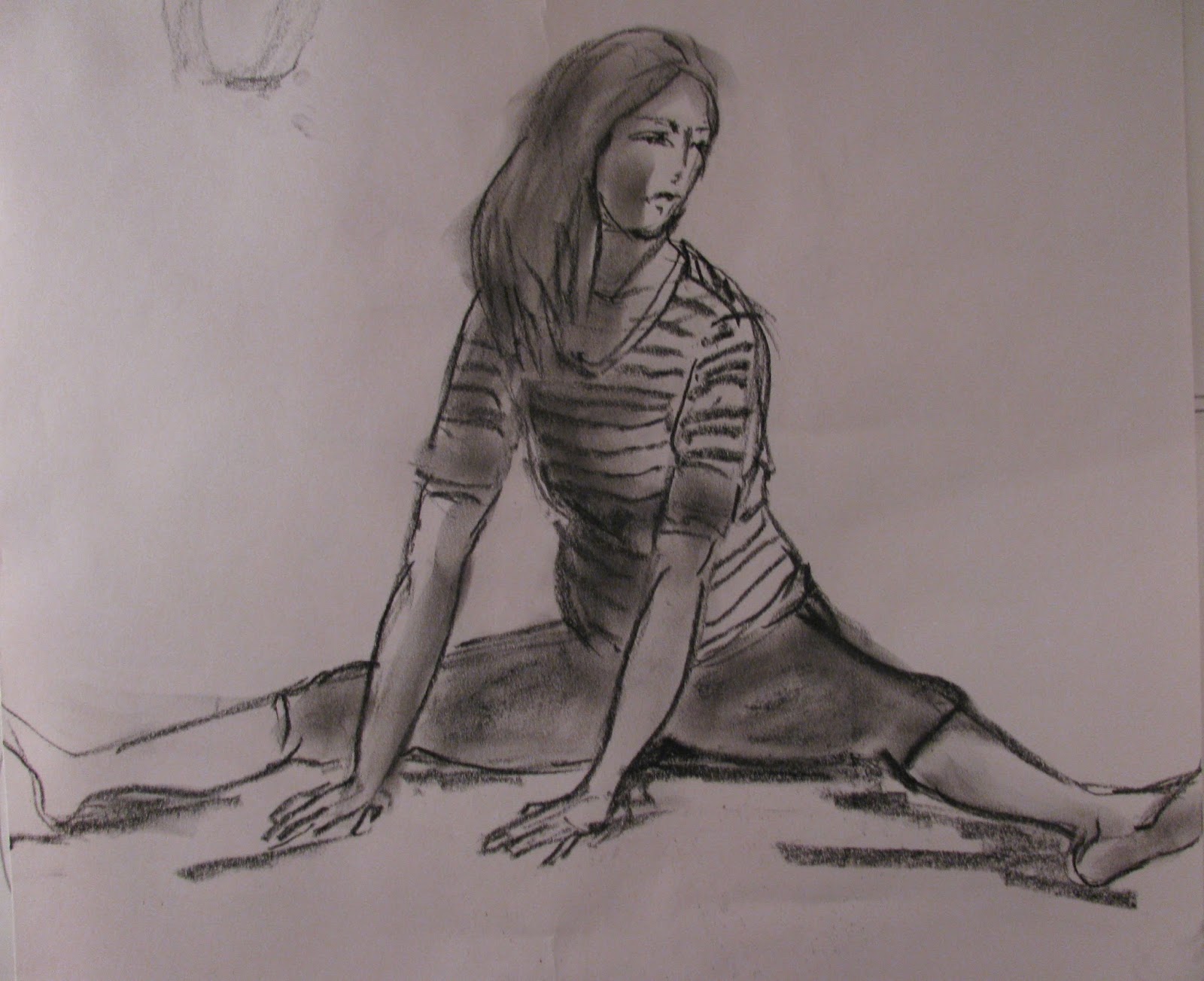
Next session, another terrific model whose stripey top created some positional landmarks.


In my third Roundhouse session, another young dancer offered some interesting twists and turns in her poses -- not always easy to fine-tune considering her all-black costume.


Finally, the Ides of March brought an astonishing finale to these weeks of dance drawings.  The midday performance at the Dance Centre featured a type of classical Indian dance known as bharata natyam, in this case performed by three female dancers of Mandala Arts & Culture.


I had expected something slow and formalized but was blown away by this contemporary approach to forms that were once practiced as devotional dances in Hindu temples.  These had become almost extinct until about 100 years ago when the dances were revived as a theatre art.  Their renaissance in Canada and internationally has been greatly aided by the passion of a renowned male Caucasian dancer, now artistic director of this troupe, named Jai Govinda.

The young women were all students of his, two of them since the age of six.  The first danced an incredibly intricate Chant to Buddha, featuring in part an invocation to the four corners of the earth.  I have never before seen such an embodiment of pure joy as in this young woman's movements, gestures, expressions.

The second danced an homage to Krishna -- the speed and positioning of her feet, hands, fingers were almost beyond capturing!


Finally, in a storytelling mode, the third dancer embodied Radha, the most beautiful of Krishna’s consorts.  She has waited for him all night and then, when he finally arrives at dawn, she enumerates all the evidence for his having been with another woman.  Teacher Govinda explained that he had choreographed this in the traditional way in which Radha feels very hard done by.  “But then came the #MeToo movement,” he said, “and I realized the story needed a revision.”  No more self-pitying Radha!  Now she stomps her foot and gives Krishna the brush-off, telling him “No more lies!”  
  

We were assured that there is a follow-up story, not danced that day, called “Krishna repents.”

And so the dance continues -- those who dance, those who are enthralled with dancers, those who inspire it all, like Shiva, The Lord of the Dance.   Shown here -- and above, as a mandala --  he has been quickly drawn from the metal statue that stood at the side of the stage.


Wednesday, February 28, 2018

Master artists -- then and now, here and there


The bright colours!  The repeated geometric elements -- like cuddly mojis!  The all-over design!  It's big news here this month with the Vancouver Art Gallery's exhibit of famed Japanese artist Takashi Murikami.  But no, the image above -- although strikingly suggestive -- is not an original Murikami.  It's the collected scrapings and splotches from my palette.

So it's not surprising that I'm far less interested (very far; very very far) in this current VAG exhibit than in my on-line art class, as we wend our way through Western art history.  The overall plan is to focus in one way or another on a different artist a week for every week of 2018.  It's an ambitious pace, but not as frantic as what you'll see here.  Do click on the link -- it's an amusing must-see.

"Wending our way" is short form for a rather meandering chronology and a pleasantly unstructured curriculum in which everyone does what they please with each week's lesson, using -- or not using -- the week's demonstrated medium.  Here's what I did in the four weeks of February.

First week, the subject was Botticelli and his familiar "Birth of Venus" and the suggested medium, encaustic -- a wax process in which I have no interest.  I decided to opt for "A Neighbourhood Botticelli" -- a painting of Sara, the local pub's lovely young waitress who cheerily dispenses coffee to our small group of retirees.  I made a quick memory drawing:


-- and then started to paint, continually correcting my tones and placements.  OMG!  Then the week was ending, and I was lost in the dark world of The Night of the Living Dead.


What the heck.  I submitted it as my homework -- there are no rules, no deadlines,  no grades, but I'm pressing myself to stick with the weekly schedule.  After posting, I continued to fiddle some more, achieving this slightly more respectable version:


At last sighting (this morning), "Zombie Sara" has been completely obliterated with a layer of grey paint, awaiting a future rebirth -- like Venus maybe.

On to Week 2, with Albrecht DĂĽrer as the subject artist and charcoal as the suggested medium.  I'd found a fabulous painting of  DĂĽrer's austere father as my model:


 I worked quite conservatively with charcoal pencil:--


...and then let loose with a little more drama, achieving a very un-DĂĽrerish result. 


I was still then posting to the class Facebook site and put up my final version with the message:  "Drawing after 'Portrait of the Artist's Father'.   But which artist?!?   Looks more like Caravaggio."

Moving right along to Week 3 on 18th century German artist Anna Dorothea Therbusch.  No, I'd never heard of her either, and she's worth reading about.  The lesson touched on her self-portraits, and we were invited to do our own -- about which I had mixed feelings.

To acquaint myself with some of  Therbusch's challenging head and neck angles, I did a quick sketch of her "Dionysus."


And then a more carefully drawn self-portrait -- which told me I needed either a haircut or leaves in my hair, Ă  la Dionysus:


For my final careful drawing, I worked from this gorgeous Therbusch painting, "Magdalena."


I'm still intrigued by the painting -- Is she counting on her fingers?  Who's inviting her to look in the mirror? -- and I'm pretty satisfied with my four days' meticulous work.


Then to the last week of the month and the 19th century painter John William Waterhouse.  You might not know his name but you'll surely recognize some of his paintings, one of which -- "The Lady of Shalott" -- was the lesson piece.  My contribution to the class was this link to Loreena McKennitt's lovely song based on Tennyson's poem, and then I jolly well went off on my own tangent.

Remember my fascination with the carved female faces atop the viola da gamba instruments I heard last October?  Some of the same musicians, members of The Vancouver Viols consortium, gave a concert two weeks ago, and I showed up like a groupie, sketchbook in hand.


-- and then I put down my pen to be enchanted by the music.  The instruments were beautiful, but this time only one had a carved head at its top.  And it was magical!!  Right in the middle of Chinese New Year:-- a Chinese-Finnish creation with a dragon's head! 


I couldn't leave that dragon alone and spent my class time in the days that followed using the photo to paint "Playing with the Dragon" (copyright 2018)


I don't even care that only six people "liked" it on the class site.  I stand strong in my resolution to do my own thing in whatever way I please.  Meow.