Tuesday, July 22, 2014
Trying to get a grip
Celebrating two years in The Yellow House, we're determined to get a grip on all these unpacked book boxes that still surround us. First step: Assemble an el-cheapo bookcase that has also been living in a box. It's the kind of task that would have taken JT about fifteen minutes in the old days when his hands were predictable. But now, for such a task, he needs an apprentice to carry out instructions -- ideally, one who's handy with tools, but you just can't get good help these days.
Yes, I'm the apprentice who is...let's not say klutzy; let's just say inexperienced. My apprentice sessions in the six years since JT came home from the hospital have taught me, among other things: (1) Pounding a nail with a hammer is not as easy as it looks. (2) Holding a pair of pliers requires more than a pair of hands. (3) At first, it's intimidating to use what's called a vise grip -- pictured above -- but with courage and fortitude, you can learn it's the nifty tool it was designed to be.
Using the vise grip again in the past week took me back to some old sketchbooks.
In my first day in Vise Grip 101 in 2009, the little gizmo snapped unpredictably, pinched my fingers, and wouldn't let go of things when I wanted it to. It was almost scary and afterwards, I had to unwind by making a therapeutic drawing:--
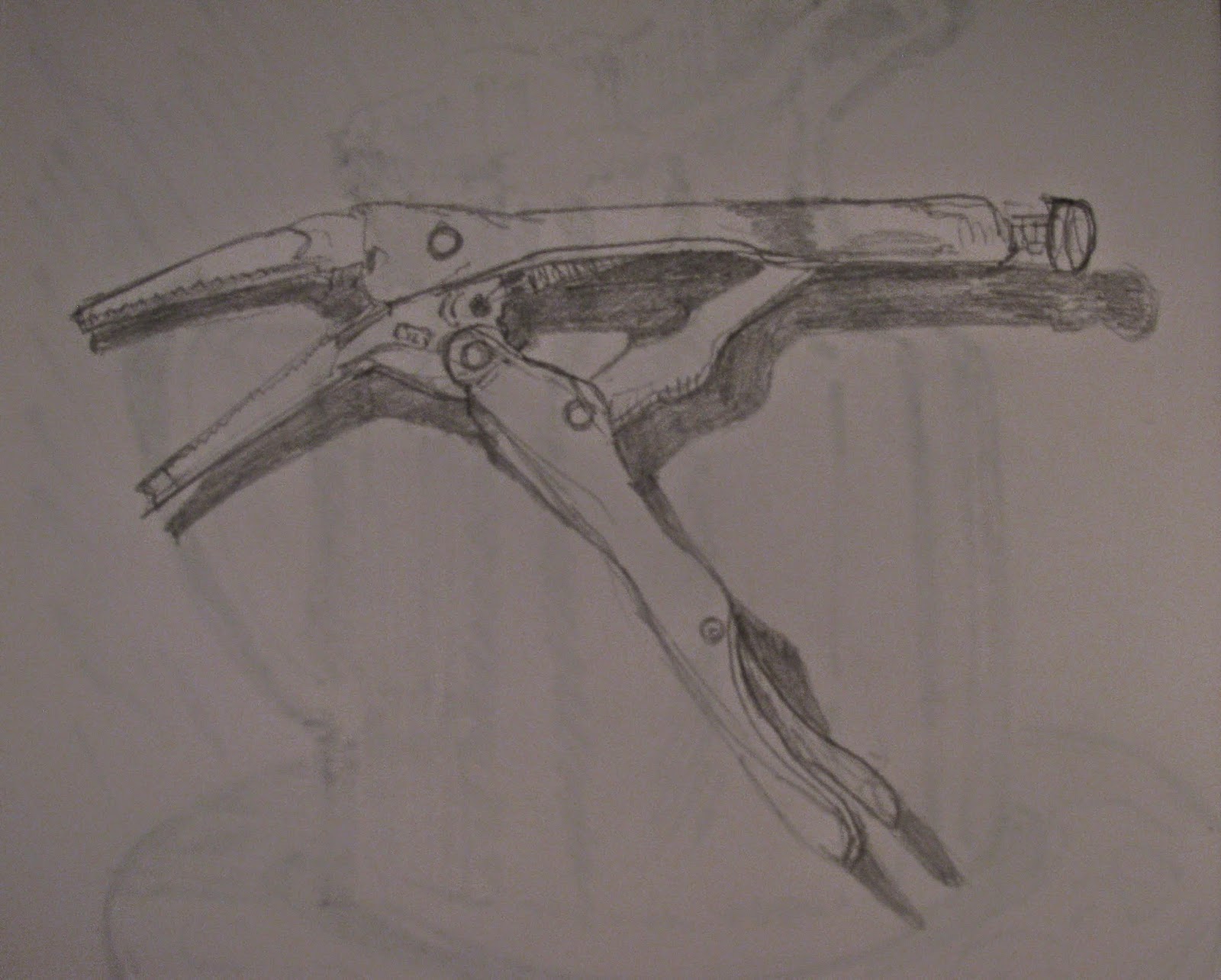
Even more therapeutic were the following day's sketchy "morph drawings". I'd read about this fun project in a drawing book--: Draw something "real." Then morph its shape into something else. Here's the vise grip in three quick reincarnations as a crow, a circus performer, and a dog sled:
I was cheating a bit...being so stressed and all...because you're supposed to morph the original drawing in stages, as I'd done some years before, starting with my sewing scissors:
....which, in a few steps, morphed into a hummingbird:
A year or so later, I happened to re-read the instructions and saw I'd also cheated a bit with "Scissors into Hummingbird". You're supposed to draw the changes step-by-step to show specifically how the shapes would have to change -- as if you were engineering the project in some kind of alternate universe.
Okay. So my third attempt was to morph our pepper mill into a pair of glasses. Here's the starting point:
Then, Steps 1-3, as shown below: Move the centre screw to the edge; flatten the screw and the handle grip and reorient the turning mechanism to face down; collapse the bottom of the mill into flat discs.
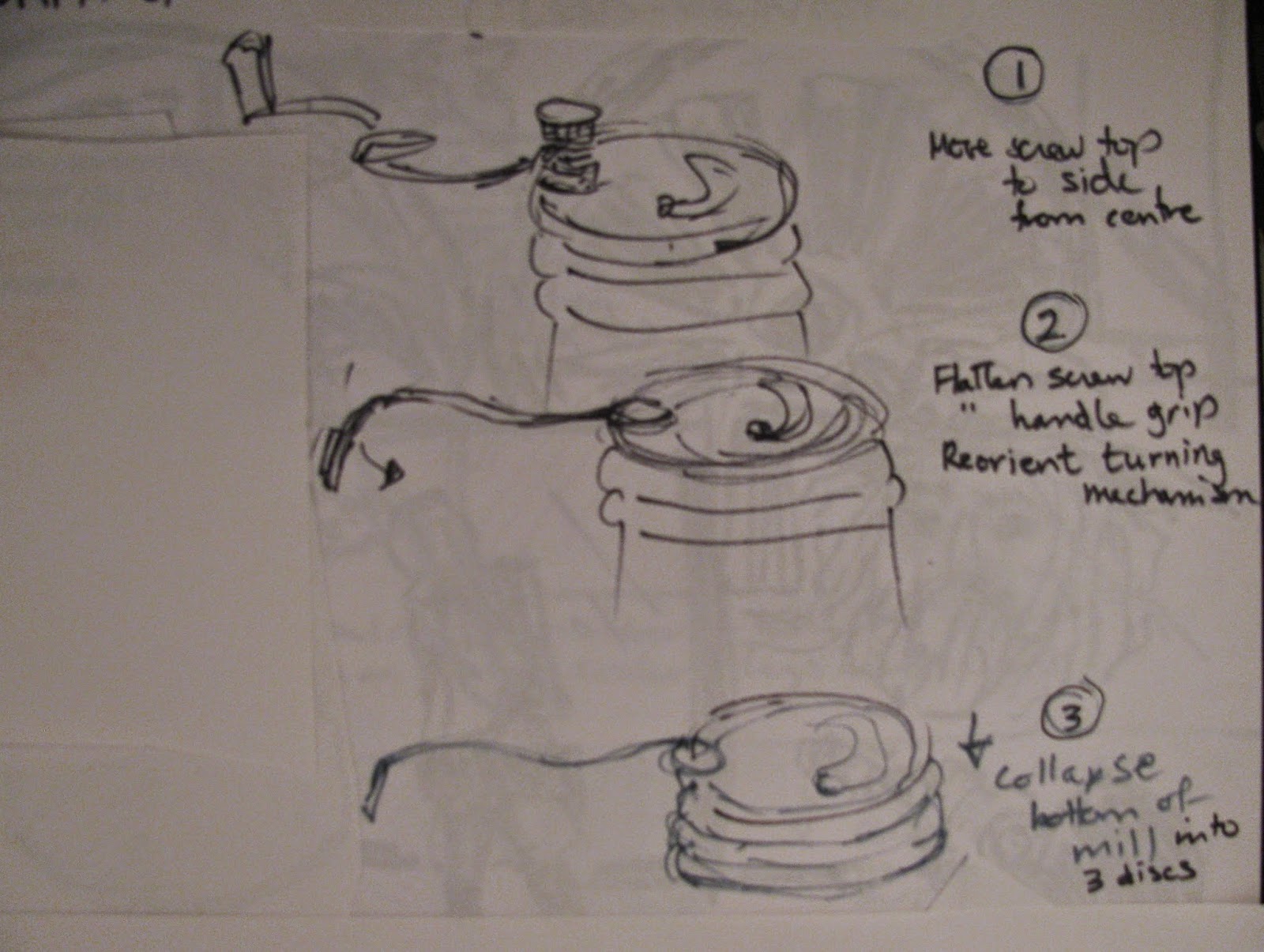
Next, in Steps 4-6, collapse the discs further into three sections, shrink the middle disc, and open the three discs in a flat plane as shown here:
Then, in Steps 7-9, push the left disc open and pull up the inner circle of the right disc; elongate the lifted "circle" to match the left side; and finally...ta tum!...add prescription lenses.
Why, it's a Lens Grinder!
Did you find this stress-relieving or stress-inducing? Maybe you wondered if "vise" was spelled correctly? www.askoxford.com confirmed my choice for "S" -- at least for my 'murican readers. Or maybe it was stressful to contemplate the point of this whole morph exercise. I think it has to do with (1) Visualizing shapes and their interaction; and (2) Having fun doodling with a pencil.
In any case, for an ultimate stress reliever, let's see what this handy implement might morph into:--
Friday, July 4, 2014
I've been framed
Among the possessions I have from my mother is a lovely wall mirror with carved wooden frame. It seemed always to have been part of our home, and it wasn't until I was a teenager that I thought to ask about its origins. My mother had bought it at an antique sale when we'd lived in northern New York state in the early 1950s. "I bought it for the frame," she explained. "It had some non-descript painting that I threw out, and then I had a mirror cut to fit it."
Non-descript painting? Oh, how I wished I'd seen it! "Oh, it was just a dreary countryside," she said. Recently I've read that even our obscure part of New York state attracted a share of aristocrats fleeing the French Revolution -- until they learned just how cold the winters could be and high-tailed it elsewhere! Might one of them have brought along and then left behind............?
Oh, seriously. Let's forget the possibilities of lost Rembrandts and Old-Masters-Found-in-a-Barn and just enjoy the frame, as my mother did:
After all, it isn't the first time a frame has been worth more than its contents. The very same thing has happened to me.
Just a year ago, I wrote about the fun I had creating an iridescent bubble-themed card for a work-buddy who was then following me into retirement. My card honoured the special place she has in my workplace memories for the time she cheerfully set things aright when I'd created a veritable flood of bubbles by using the wrong detergent in the dishwasher.
Some time in the year we shared an office, she'd mentioned that her Significant Other was a bit of a packrat (placing him high in my estimation) and, among other things, had a basement full of picture frames of every possible description. So it was not entirely incomprehensible to open her recent email attachment and find my modest 4"x12" card now flawlessly installed in its own glossy wooden frame:
Pretty cool, eh? -- even if friend and her S.O. can't quite agree where to hang it. (I'm with her -- definitely belongs right over her dishwasher!)
Next to my mother's mirror, my own best frame is the one I covered with elegant wasp paper, in all its grey-gold-silver marbled glory. From time to time, I consider what I might paint that could possibly be good enough to be placed in this beautiful frame.
Tuesday, June 17, 2014
A tight squeeze in the middle
It was a tight squeeze, but I've just finished the second painting -- the mid-section -- of the proposed triptych (a 3-part series, intended to work as a whole) I described in Inspired by the blue and white girls. That earlier post introduced the first (left-hand) panel, "Fishing With the Blue and White Girls" shown here:
With the second panel, I've learned some big lessons -- including what an innocent I was at the outset. The first lesson, one that kept my brain cells whirring for almost two weeks, was that I needed to find a way to break up the horizontal line of the table's back edge. Did I not foresee that I was going to have to deal with this line (and the blank space above it) travelling along to the right, across two more paintings? Obvious answer: No.
Okay. I'd planned to call this second one "Celebrating with the Blue and White Girls" so with the gorgeous Corsican hellebores blooming in our front yard, I decided to break up the space above the table line with (1) a big bouquet, and (2) a basket of party favours.
Early into the layout, I stumbled on the next big lesson, which might sound a bit like Math Anxiety Redux:
(A) 1 + 1 + 1 = 3 paintings = 1 triptych
(B) 2 + 1 = 3 paintings = 1 triptych
(C) 3 paintings = 1 triptych
(D) 1 long sheet of paper divided by 3 = 1 triptych
Statement D says it all. The best way to develop this triptych would have been to start with a giant piece of paper, lay out the whole 3-part sequence, then cut the sheet into thirds, and begin to paint. Alas, no such room in the small basement studio, and I soon realized it was going to be a neat trick to make a unified transition from the right side of "Fishing" to the left side of "Celebrating."
In any case, here's the final version of my latest (copyright 2014) -- you can view its evolutionary challenges here.
And just think: I'll be able to practice what I learned when I move on to the final right-hand panel and aim again for a seamless transition.
An unexpected pleasure of doing this series, though, is that another Blue and White Girl has surfaced among my friends. Well, why should I be surprised that my wonderful friends, unknown to each other, would meet, find common interests, and appreciate each other via my little corner of cyberspace?
Bouquets to all of you! (Luckily, I took this photo on Day 2 of my still life set-up, after seeing that the hellebores had unexpectedly straightened up and flipped themselves to the left overnight -- after I'd laid in the basics. On Day 3, they had completely drooped over, and I had to refer to the photo more than once.).
Friday, May 30, 2014
The Sculpture Garden at The Yellow House
This month we celebrated two years since taking possession of The Yellow House. Almost faded from memory now is the gruelling 5-block move from our old place, an epic journey that went on into mid-July. Reflecting from time to time on where we've come from and where we've landed, one or the other of us will say, "Well, it's the best we could have done under the circumstances."
As this spring has shown, there are both old and new pleasures to cheer us on. There are still some surprises coming up in the garden we inherited here. And most of the plants we brought along have put down roots and are thriving, with one exceeding all expectations. Years ago, we brought to Vancouver from our cabin property a small clump of Rosa nutkana, the wild rose of British Columbia. In our old yard of "mixed sun and shade," it produced just a few blossoms. Here, against the sunny western fence of our small front yard, it's tripled in size and has been laden with scented blooms since mid-May.
Another remnant of Cloudburst (the name we gave our cabin, situated below Cloudburst Mountain) has come into its own, a half-finished sculpture called "A Bird in the Hand." It has a story, of course -- the story of my failed attempt to become a sculptor.
Our cabin property was amply supplied with huge cedar trees and lots of windfall, and I thought the giant logs had the makings of some statuesque figures. Coincidentally, as I began to make my plans, we fell into conversation with a logger from the next-door property, and I mentioned that I was planning to carve sculptures. "From what?" he asked. "Yellow cedar," I answered -- modestly proud that I knew the wood of choice for coastal First Nations' traditional carvings. "Where'd you find THAT?" he asked. "All over the place; we've got lots of it," I answered.
Rolling of eyes followed -- as he explained that although the wood might be yellowish, the trees surrounding us were RED cedar...not suitable for carving...and that yellow cedar grows farther north along the coast or higher up in the mountains. What's more -- though he was hardly the type we'd consider a soulmate -- he invited us to his cabin to see his own chainsaw carvings (which were not bad at all) and gave me a one-and-a-half foot high chunk of authentic yellow cedar.
With more realistic plans than I'd had originally, I made a small hand-sized clay maquette (model) as a guide to a larger cedar version to be called "A Bird in the Hand."
Throughout one summer, with chisels and mallet, I worked and worked and worked on that yellow cedar. It was hard, literally hard, and before long I was having trouble with the old shoulder injury I'd acquired years before from an Ontario canoe trip undertaken without adequate conditioning. Before long, I had packed it in.
The barely realized sculpture came home to Vancouver with us to live in a corner of the basement, where I almost abandoned it two years ago. But no-- why not let bird and cedar back into the open air, here at the Yellow House Garden, and let the weather take over where I had left off?
"A Bird in the Hand" has survived two winters now, with a sinuous clematis vine as its backdrop. It looks rather striking when rain darkens its wood or when the afternoon sun casts a shadow from the bird shape onto the curve of the right thumb. It's not a bad companion to nature's own sculptures -- first, the driftwood piece from a Howe Sound kayaking trip:
And second, a truly elegant "wing" of driftwood from the waste wood pile (can you believe it?!) at Kitsilano Beach:--
The Yellow House Garden also features dozens of cherished stones, some of them interestingly sculptural like the title photo above and this one, with mouth wide open:
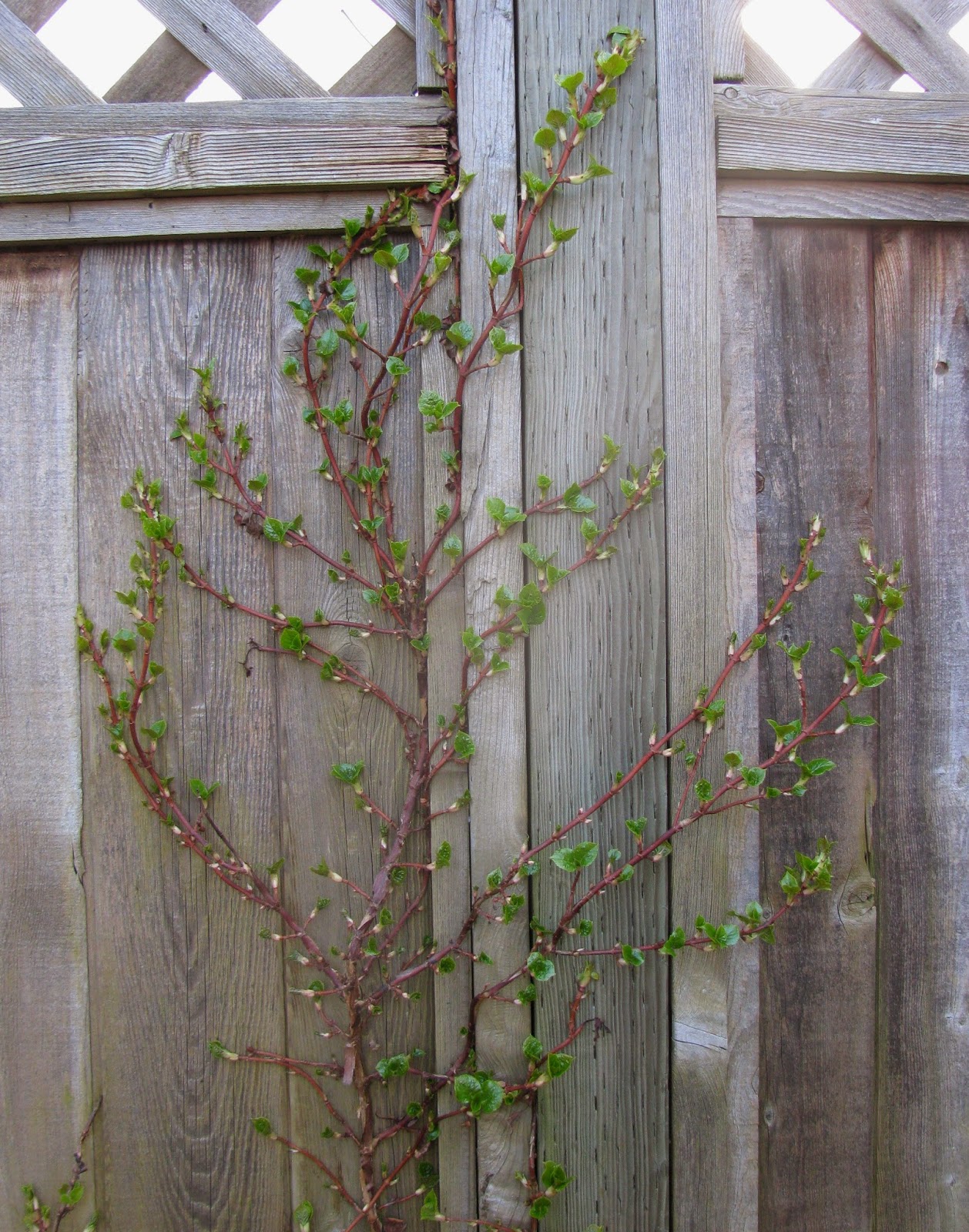
I was tempted to try sculpting once again with the amply-branched small tree in the back yard (Attention, Friend L: Is this a California lilac?). But topiary with this species turned out to be a mistake. Last fall I trimmed it into five globular shapes, imagining that its spring flowers would shoot off fireworks in all directions -- but the new leaf growth charged rampantly ahead of the flowers, turning it once again into A Small Tree With a Lot of Branches.
No additional sculptures are contemplated. After all, looking down into our front garden, we find that jungles have their own perfect charm.
Tuesday, May 6, 2014
Back to the bestiary -- it gets worse and then it gets better
I barely wince now when I go to the library and walk through the courtyard's unsavoury animal sculptures intended as "public art". For this, I can thank all my friends who read my earlier blog on the subject, courageously viewed the menagerie, and shared my gut response with comments like these:
- "I would never take my grandchildren to this library!"
- "If WE think these are scary, what impression do they make on a toddler or young child? This stuff belongs in a gallery or show, to be seen by choice. ...It doesn't belong in a library."
- "Shame on whoever did this."
- "Ooh...these ARE creepy."
With all this moral support, I was well fortified by late autumn 2013 when I arrived at the library one morning to find that the wisteria around the courtyard entrance had lost all its leaves revealing........oh, no! Two more distasteful sculptures that were previously (mercifully) hidden in the foliage.
There's an east-side Creepy Thing:
...and a west-side Creepy Thing:
What ARE these grotesqueries?? At first, I thought they were dugongs or manatees, or whatever marine animals are supposed to have inspired sailors' tales of mermaids. (Ha! Tell that to Hans Christian Andersen.) But on second (painful) glance, these creatures seem to have fur and claws, not scales and fins. Let's not speculate any further.
I've tried to be fair to this sculptor. Maybe his off-base series follows a little-known tradition in public art -- an idea suggested to me by a fascinating book I read recently. THE PROUD POSSESSORS, by Aline B. Saarinen (wife of the famous architect), recounts the experiences of famous (and not so) American arts philanthropists and recaps the beginnings of famous art collections in the US. She writes:
When the Philadelphian William P. Willstach made so substantial a fortune from selling saddlery hardware that in 1858, at the age of 48, he found himself in a position to retire, it seemed completely natural to spend the rest of his life collecting fashionable contemporary art to go into his fashionable contemporary house. If art in the home carried intimations of the cultural elevation of the owner, with equal logic ,art in the city would make Philadelphia "the Athens of America." This was the stated goal of the gentlemen who, in 1871, organized the Fairmount Park Art Association, the first group in America dedicated to adorning public parks and places with statuary. Their up-to-date taste led them to a Dying Lioness, Hudson Bay Wolves, and slightly constipated-looking marble figure called "Il Penseroso." (- The Proud Possessors, Aline B. Saarinen)
Dying lioness? Hmmm, sounds rather like our local sculptor's anorexic feline.
Ugh. So let's leave all this and travel eastward about ten blocks where.........meanwhile, in another part of the forest, an unsung, unpaid, truly philanthropic artisan has installed an unofficial but delightful work of art:
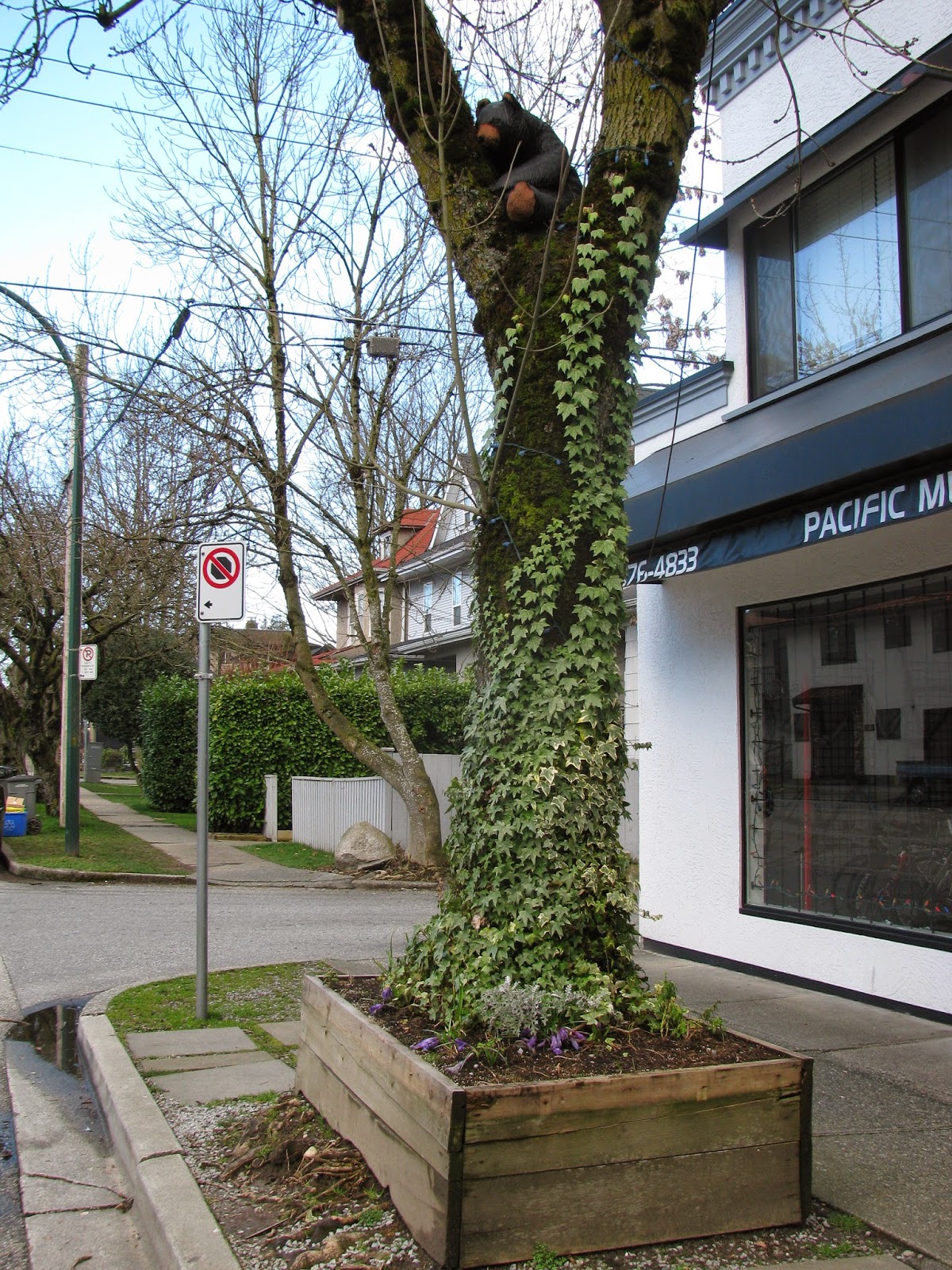
If those green scales suggest an alligator, it can only be a very harmless alligator enjoying the pleasure of hanging out with the most engaging bear in east Vancouver. The local public along this modest side street applauds this one!
Tuesday, April 22, 2014
Let the games...continue
Through the seemingly endless rains of March, I let loose again with my lively game of The Colourful Past Series. The goals of the game have been described before with two of my paintings "Small Front Windows (Colourful Past #1)" .....
... and "Three Neighbours on Quebec Street (Colourful Past #2)":
The objective is to plunge adventurously into colour, to Do Something with my fascination with the details of Vancouver's old architecture, and to work in a more experimental style -- sometimes having a fun splash with texture tools like those pictured at the top.
By now, I've "collected" in my sketchbook dozens of small residential windows, with their almost endless variations as to overall shape, size, shape and numbers of leaded mini-panes, borders, colours, themes...and on and on. For Colourful Past #3, I decided to group samples of three different shapes -- octagon, diamond, and square -- and arrange them in a design that suggests the decorative bands on old buildings, an architectural element called "beading" as shown here:
Then, with the combination of windows and beading, I couldn't resist titling this piece, "Glass Bead Game," (copyright 2014) ,with a solemn nod to Hermann Hesse -- whose own Glass Bead Game was considerably more cerebral.
There are no competitors in my own game. No scores are kept. The tournament season is determined by when the spirit moves me. When does the game end? ...when it ceases to be fun. For now, here's the third in The Colourful Past Series, with its progression shown here.
Tuesday, April 8, 2014
The essential season
Isn't it time? Isn't it time for winter to finally end and for spring to come into being? So many people have had a tough time of it this year -- even here on the wet coast, where we can scarcely complain when distant friends have endured one "historic snowstorm" after another. At The Yellow House, even frosty porch steps or a 2" snowfall present problems, and in the usually mild islands of the Strait of Georgia, my friend L and her husband have had a gruelling time -- uprooting from one cherished home and facing big bumps in the road (now beginning to smoothe) on the way to the next.
My earliest springs -- into young adulthood -- were spent in the magic realm of Eastern and Midwestern deciduous trees where, when spring finally pops after a frigid snowy winter, it POPS. It's the stuff that poems are made of, and it happens that my two earliest favorite poets (both New Englanders) each have their own take on the season -- each in a different key.
Robert Frost's perfect mini-poem (one of those stored in my memory) reflects on the transitory:
Nature's first green is gold,
her hardest hue to hold.
Her early leaf's a flower,
but only so an hour.
Then leaf subsides to leaf.
So Eden sank to grief.
So dawn goes down to day.
Nothing gold can stay.
(-Robert Frost, "Nothing Gold Can Stay")
e e cummings' poem celebrates the ecstatic. Still in my memory bank decades after I discovered the poem, its first stanza would recur to me often when spring finally popped among the deciduous cottonwoods and red alders at our cabin property:
i thank You God for most this amazing
day: for the leaping greenly spirits of trees
and a blue true dream of sky; and for everything
which is natural which is infinite which is yes
(- e e cummings, "I Thank You God for most this amazing day")
I came late in life to the perfect poet Pablo Neruda. Regrettably -- and with apologies to my dear friends A and K who both, in different worlds, know and love Spanish -- I can read Neruda only in English. I first discovered him many years ago when I read Jon Kabat-Zinn's book FULL CATASTROPHE LIVING (worth a read!) which closed with a poem that begins:
Now let us count to twelve,
and we will all keep still.
For once on the face of the earth,
let's not speak in any language.
Let's stop for a moment
and not wave our arms so much.
(-Pablo Neruda, "Keeping Still")
Ever (or almost always) respectful of copyright, I've just nibbled
here at these poems. But the great paean to spring, Neruda's
"Deslumbra el dia" or "Dazzle of Day" must be consumed whole:
Enough now of the wet eyes of winter!
Not another single tear.
Hour by hour now, green is beginning,
the essential season,
leaf by leaf,
until in spring's name, we are summoned
to take part in joy.
How wonderful its eternal all-ness.
New air, the promise of flower,
the full moon leaving
its calling card in the foliage,
men and women trailing back from the beach,
with a wet basket of shifting silver.
Like love, like a medal,
I take in,
take in
south, north, violins,
dogs,
lemons, clay,
newly liberated air.
I take in machines smelling of mystery,
my storm-coloured shopping,
everything I need:
orange blossom, string,
grapes like topaz,
the smell of waves.
I gather up,
endlessly,
painlessly,
I breathe.
I dry my clothes in the wind,
and my open heart.
The sky falls and falls.
From my glass,
I drink pure joy.
(-Pablo Neruda, "Dazzle of Day")
I've done some reading about Neruda, and he strikes me as a great humanist. He came from a modest family in the Araucania region on Chile's northerly coast, a region even wetter than Vancouver -- thus "the wet eyes of winter." His literary gifts eventually took him to sophisticated intellectual and consular circles in Europe and then full circle home to Chile, as a trusted colleague of Salvador Allende.
The story is told that when Neruda campaigned for elected office in the most deprived area of the country, the harsh deserts of the north, the miners poured out of the earth to meet his train, chanting his poems and calling, "Neruda! Neruda!" I learned also that this complex and sensitive man gathered an immense seashell collection -- and this, along with the lemons that appear often in his poems, inspired my 2002 painting, "Appreciation - For Pablo Neruda." (This is one of those Early Works that tells me that I am making some progress)
Right now, we look out our front window to see nest-building crows snapping long twigs from the neighbouring trees. In and out of the massive clematis vine on our front porch, the pretty little house finches are bringing smaller bits of construction material to renovate two old nests and, we're sure, build some new ones.
So many good things are happening now in the lives of friends. Glasses raised? Let's drink that glass of pure joy! It IS time.
Subscribe to:
Posts (Atom)