Tuesday, June 22, 2010

A Window on the Twilight Zone


I once had a boss who could perfectly (and I mean perfectly) reproduce the theme music from The Twilight Zone. I can hear it now...

Something so astonishing has happened in my small world that it deserves an unplanned post. If you read my previous account (and you'll need to, for this to make sense), you're familiar with "Winter Window" -- the painting that just didn't come together. On June 15, I'd made the final decision to trash it. On June 16, I wrote and posted the sad story. On June 17, I was rummaging in a corner of my studio and turned over a panel that had its face to the wall. What to my wondering eyes should appear but a preliminary layout, transposed over a 10-year-old unsuccessful painting, of....an earlier try at "Winter Window" that I'd completely forgotten I once did. No kidding!

Click to enlarge and you'll see the grand plan.

Looking closely, I recognize in the drawing the paperwhite narcissi that I'd forced for blooms early in 2008 -- the year that the stability of our family routine was disrupted. I can remember now, sitting on the floor to get a close-up view at geranium level (vs. my recent failed attempt to imagine an even closer view). I'd obviously gone this far with the layout and then put it aside.

Already, though, it's much more promising than Failed Version 2010. The window panes are off-centre, and the spaces are more broken and interesting with leaf shapes -- I just might give this another try! Maybe I could work in a cactus, which currently occupies the window sill. Maybe those yellows (from the failed underlayer) could be kept for another recent addition to the window garden, a half dozen yellow kalanchoes rampantly returning to their wild trailing state. Maybe I could capture the vague tree forms outside the window. Uh-oh. This is sounding dangerously like getting carried away with cool ideas. I think there was a lesson about this I promised myself to remember...


*LATE-BREAKING* - This just received at the Twilight Zone post. To prove that many things are possible, my supportive and inspiring friend the photographer Judy Andrus Toporcer has used her wizardry to "paint" the photo source for Failed Version. Click on the image to enlarge it and take a look!


Tuesday, June 15, 2010

Things That Grow in the Dark -- or Don't


I've often laughed at a habit of mine -- the tendency I have to check
into the studio between working sessions to see what's happened since
the last time I was there. I'll finish a morning session and then
some hours later be unable to resist opening the door, looking to see
how the morning's painting is going...as if it would be any different
from when I left it.

I've recently realized that this is no laughing matter. In fact,
what's there when I open the door is a sure indicator of whether
things are going well or not. When things are on track, something
does happen between visits. Just as novelists talk about their
characters taking on a life of their own, there's a sense in which a
painting does, too. Whether or not I've consciously mulled things
over, time has passed and I've moved along to a new space. When I
revisit the work-in-progress, new possibilities present themselves,
solutions to problems seem possible, next steps are clarified. It's a
stretch to call this a "dialogue" with the painting, but it's a good
feeling when we're cookin' along together.

Earlier this year, I decided to capture the view toward my studio
window, an idea that's intrigued me every winter, when houseplants and
wintering-over geraniums are clustered together, leaning into the
scarce light. "Winter Window," it would be called, and this year I'd
do it instead of just thinking about it. The scene before me, as shown
in the photo, was my guide.

As I began, I imagined myself down at geranium-level, looking up
through the leaves. I had the plants and the window as models, but
the viewpoint was entirely imaginary. For the first week or so, it
was quite stimulating, but gradually I began to realize that I had no
impulse to check on it during the day. I knew nothing was happening
behind closed doors; somehow, it wasn't giving back.

When JT asked how I was doing and I heard myself say, "Oh, I'm
grinding along on this dumb painting," I knew it was pointless to
spend more time on it. The top part was too empty, and the bottom
part too full -- and no tentative salvage operations made a
difference.


I recalled the words of one of my mentors: Sometimes you can learn
more from a work that fails than from one that succeeds. I recalled
another painting on which I'd pulled the plug -- and the lesson I'd
learned then (two years ago) but forgotten. Some artists could bring
off my idea of "being down among the geraniums" -- but for me, working
only from an idea -- from "imagination" -- is risky business. I need
to start with a strong structural underpinning, a solid pictorial base
-- a lesson I'll try to remember.

So: Goodbye, Winter Window. Maybe another time, in a different way.
For now, it's been turned upside-down and received some preliminary
marks for an entirely different painting that will go over it.


You can view its short failed life -- and ponder how it might be reincarnated here.

Sunday, May 30, 2010

Botanical Roots - Nature or Nurture?

Recently I met a new (to me) Kelly, and across an age gap of perhaps
35 years, we enthusiastically exchanged views about our name (she's
"Kellie" and glad she's not "Kelli"). It made me think how natural
are the human impulses to both want to belong and want to
differentiate ourselves.


There's no one I know in my family who's like me, who would have
relished making the field sketch which recently morphed into
"Taurus/Rosa nutkana." Or is there?


On my father's side, traces of his immigrant family are lost three
generations back in the mists of rural Ireland -- though surprisingly
this strain produced some fine engineers, with a gene that must have
passed me by. My mother's history offers more fertile ground for
investigation, with a clan that goes back to 18th century South
Carolina. One side is distinctly rural, based at a centuries-old red
earth cotton farm which finally went bankrupt just before the Great
Depression -- but not before "my daddy's farm," as my mother called
it, gave her the first impressionable ten years of her life. The other
side of the family was always urban Charlestonian -- small business
owners, some would-be musicians, several crackerjack administrators,
and a few notable eccentrics.


And it's here, at the convergence of urban and eccentric, that I looked way back and connected with "someone who I'm like" -- my many-times-great-grandfather, John Linnaeus Edward Whitridge Shecut(1770-1836).

JLEW, as my great-aunt's archives abbreviate, was a doctor, inventor, small entrepreneur, novelist, co-founder of the Charleston Philosophical Society, and the first person to catalog the flora of the American Carolinas in Flora Carolinaeensis, a book that can be found on Amazon.com, along with his very bad novel inspired by The Last of the Mohicans. His botanical studies, including the one shown here, are housed in the Charleston Public Library.


My mother's arts were almost exclusively social, and she claimed to see only one colour -- her favourite, green. Yet she would exclaim about sights like the pattern of sunlight on a tree branch or the way new buds unfolded; things sometimes reminiscent of her early years, like the grape arbour on "my daddy's farm."

It's tempting to see a family history in what captures the eye like this assortment of leaves that I enjoyed packing onto one page -- but what's the thread, nature or nurture?

Wednesday, May 12, 2010

Artists Are From Venus

According to astrological indicators, "artist" is one of the favoured occupations for those born under the signs ruled by Venus -- two signs, Taurus and Libra. Not a bad line-up for the Taurus crowd:-- Redon, Turner, deKooning, Delacroix, Inness, Church, Rossetti, Frank Stella, Jasper Johns, Gainsborough, Rossetti, Mary Cassatt, Rousseau, Dűrer!

And here in the middle of Taurus' reign (April 22-May 22) is the latest in my series Astrological Plants of the Squamish Valley -- "Taurus/Wild Rose."


In the first flush of beginning a new painting in this series, (and I have another two under way now), I always forget how long each of them takes. There are lots of preliminary layers to build up, lots of fiddling around with templates for the lettering, and many minute-by-minute decisions about what to place where and what colour to use, all within my overall plan for the graphic motifs for the signs, elements, and alchemical correspondences.

As I work away, I ruminate on things like: How many wild rose varieties are there? (Alberta's official wild rose is evidently a different variety than our BC rose of the Nootka). Wasn't the Western Garter Snake the perfect correlation for the earth signs? Why don't I re-read Mary Renault's novels (popular best-sellers in the 1970's-80's -- was it really so long ago??) that first introduced me to the labyrinth at Knossos and the significance of bulls and snakes to the
Mother Goddess? Ruminate step-by-step with me, if you like.

Tuesday, April 27, 2010

Thanks a million!


You don't have to read the biographies of too many artists to find dark and dubious doings in their personal gardens of Eden. Frieda Kahlo and Diego Rivera. Alfred Stieglitz and Georgia O'Keeffe. Picasso and Mistresses A, B, C, D, Etc.

But there are exceptions, the sculptor Henry Moore among them. Looking back on his long career and recalling his wife's encouragement from their earliest days together, when he was an unknown artist with a vision of creating huge sculptures, he paid her a touching tribute -- so simply expressed, but no doubt of the greatest importance to him: She even helped me move the stones.

What would I say in tribute to my guy's lifelong (it seems that way after 40 years) encouragement? He bought my first sketchbook. He brought home the notice by which I found my first painting course. He gave me my drawing table and built all the rest of my studio furniture -- bookcase, mounting boards, compartmentalized table tray to my own specifications, huge flat drawers to store artists' paper. He took me to Paris to buy my Julian easel. And more. He even helped me gather The Giant Plants.

When we used to drive to Upper Squamish every weekend, I gradually came to notice along the highway the occasional patch of humungous plants that resembled Queen Anne's Lace -- very large Queen Anne's Lace, 10-12 feet high, flowerheads almost three feet across, surging upwards from dense thickets of 4-foot long leaves. As the summer ripened, the flowers gave way to giant seedheads...and I had to draw them! Once I shared my compulsion, my wish was halfway granted. Always too pressed for time to stop on our way out and back, we had to make a special trip, requiring one vacation afternoon...and a lot of trust. The plants' location nearest our house was just north of the Second Narrows Bridge, in a triangular patch of land surrounded by the highway, the cloverleaf access lane, and a busy Marine Drive.

John sized up the options, found the one place he could feasibly drop me off and pick me up, zoomed to the shoulder and said, "Now!" Armed with garden clippers (which proved barely adequate to the task), I jumped out and scooted through a gap in the cloverleaf traffic while he headed off, confident that some way or another, before too much time passed, he'd be able to double-back and pick me up.

I was able to clip the plants' 3-inch stalks only because they were hollow tubes, dried and brittle with the season. I grabbed three of them and made it back across the highway to my pick-up point, shedding seeds all the way, radiantly happy with these wonderful finds and with the man who made it all possible, shown here (incognito) holding the largest:


In the end, the largest drawing I made just wasn't large enough (but still so satisfying to work on) and I realized that nothing less than a 10-foot canvas would do this subject justice.


I've since learned that The Giant Plant is Heracleum mantegazzianum
(which sounds like another name for "humungous"), banally called "Hogweed" and considered a noxious weed that's said to cause skin rashes. In our own garden, it has produced a millions -- well, tens of thousands -- of seedlings since the year we collected it and this year, again, we'll let just one of these come to fruition. The seedlings grow rampantly and the ones I didn't weed when they were penny-sized now have roots like carrots and have to be dug out with a shovel. It's a task that nonetheless makes me smile as I remember the gift and the giver. Thanks a million, JT.

Tuesday, April 13, 2010

A Cat in the Studio


Looking through some old sketchbooks, I found a quote I'd copied by the artist Giorgio de Chirico (1888-1978):


We must hold enormous faith in ourselves: it is essential that the revelation we receive, the conception of an image which embraces a certain thing, which has no sense in itself, which has no subject, which means absolutely nothing from the logical point of view...should speak so strongly to us...that we feel compelled to paint.


I remember being surprised that de Chirico had written such an impassioned statement. I'd thought of him as a cool customer, whose obscure symbolic paintings have never much appealed to me. In fact, when I looked for some examples, I was surprised to see the colour in them. The ones I'd first seen of his were all black-white-grey.

But then I remembered an anecdote told (I think) by Janet Flanner, who was The New Yorker magazine's Paris correspondent from 1925 to 1975 and whose collected articles and notebooks cover a delightful range of things 20th century and European. It seems that a young journalist couple of her acquaintance was travelling in Italy in the 1950s, when de Chirico was in his prime. They happened upon the village where they knew he was staying and dared to knock at the door and ask if they might interview him. Graciously, he agreed and the two young people entered the studio, bringing with them their Siamese cat who couldn't be left in the car.

It would make a good story to say that the cat's reaction to de Chirico's art led to the scene that followed, but more likely it was the dislocation and the unfamiliar surroundings. In any case, the cat took one look around, leaped from its owner's arms and roared around the room, tearing through drawings, upsetting finished and unfinished paintings, spilling a good bit of paint onto masterworks in the making. At last, the panicked couple was able to catch and calm the cat -- and survey the damage. Of course, they were overcome with embarrassment and mild terror at the artist's probable reaction. Remarkably, de Chirico's concern was entirely for the cat. "The most important thing of all," he gently said to them, "is that no living being should be afraid." Now there's a man who's not at all a black-white-grey kind of guy.

As for our own two cats, Nikolai and Sasha, don't picture them lounging comfortably in my studio as Nik is shown in the drawing above. They are greatly intrigued by the door that's always closed to them, and that's the way it will stay. Two other cats reside there permanently, both of them gifts, both of them deserving a special environment, both of them (especially the fabric one) needing a place to hang out -- that's safe from cats!


Tuesday, March 30, 2010

Accidental Artist


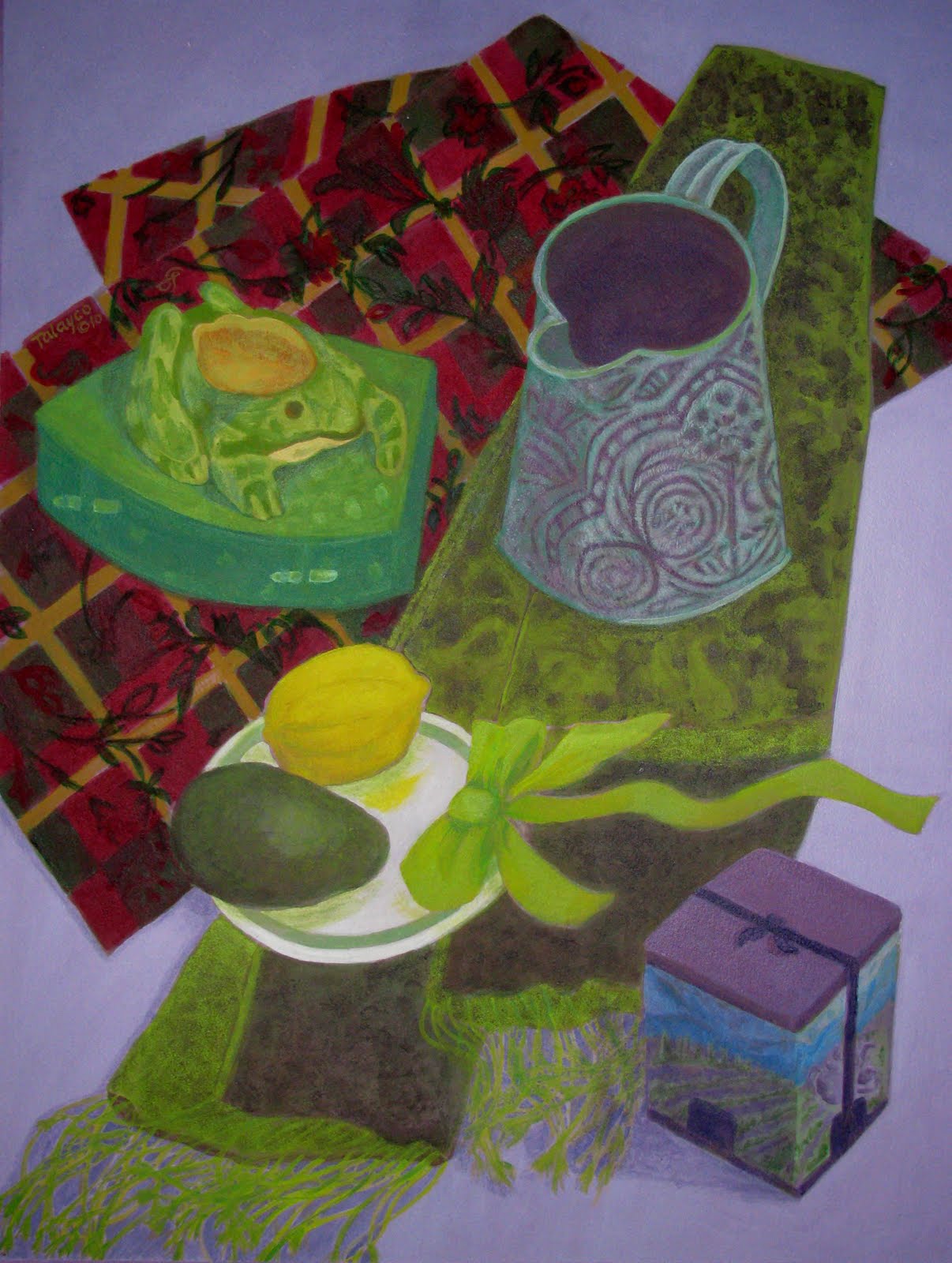
"All artists have accidents, and the better the artist, the better the accident." Did I read this somewhere? Did someone actually say it? Or did I invent it as I lurched from one accident, mistake or oversight to another in the production of my Feb-March painting, "The Improbable Pond"?

My first accident was to pursue it at all, once I'd assembled the set-up. Viewed with caution, it seemed even at that stage to present some problems. But then I remembered the words of one of my esteemed role models, Mary Beth McKenzie. She and my other favorite, Harriet Shorr, are women in their 70's now, enduringly successful NYC-based artists, who in their student days bucked the art school trend in abstraction and have continued to paint in a representational manner (where things look like the things they are). I return again and again to their books and their thoughts about the process of art and about being an artist. Mary Beth writes (in A PAINTERLY APPROACH):

Growth for an artist is generally slow and unconscious. Real progress takes place over a long period of time....Unless you approach painting with a highly experimental attitude and are willing to take risks with your work, your progress will be extremely slow. It's important to continually challenge yourself, to set up problems for yourself in order to develop your technique and to experiment with new ideas. Vary your approach: try different mediums, different sized canvases, unusual points of view, more ambitious compositions. Always try to extend your reach. In this way, your work will continue to change and develop naturally. You must evolve as an artist, and this is really a lifelong process.

With her counsel in mind, I took a deep breath and leaped into "The Improbable Pond." I think I've been moderately successful in bringing it all together although the outcome is different from what I'd originally expected I would do with it. The sequence of its development is charted (can I say "by popular demand"?) at this Picasa link. Go ahead. Take the plunge.