Monday, May 31, 2021

This is not a linear process


To-do lists and project plans have always been essential components of my modus operandi.  The satisfaction of check-check-checking and the feeling that I'm making progress keep me moving on to my next act.  Some of these strategies work in my Homegrown Art School – renamed since early COVID days, my Artist-in-Residence program.   Yup, I can lay out a big plan but when it comes to putting paint to canvas, things sometimes go awry. 


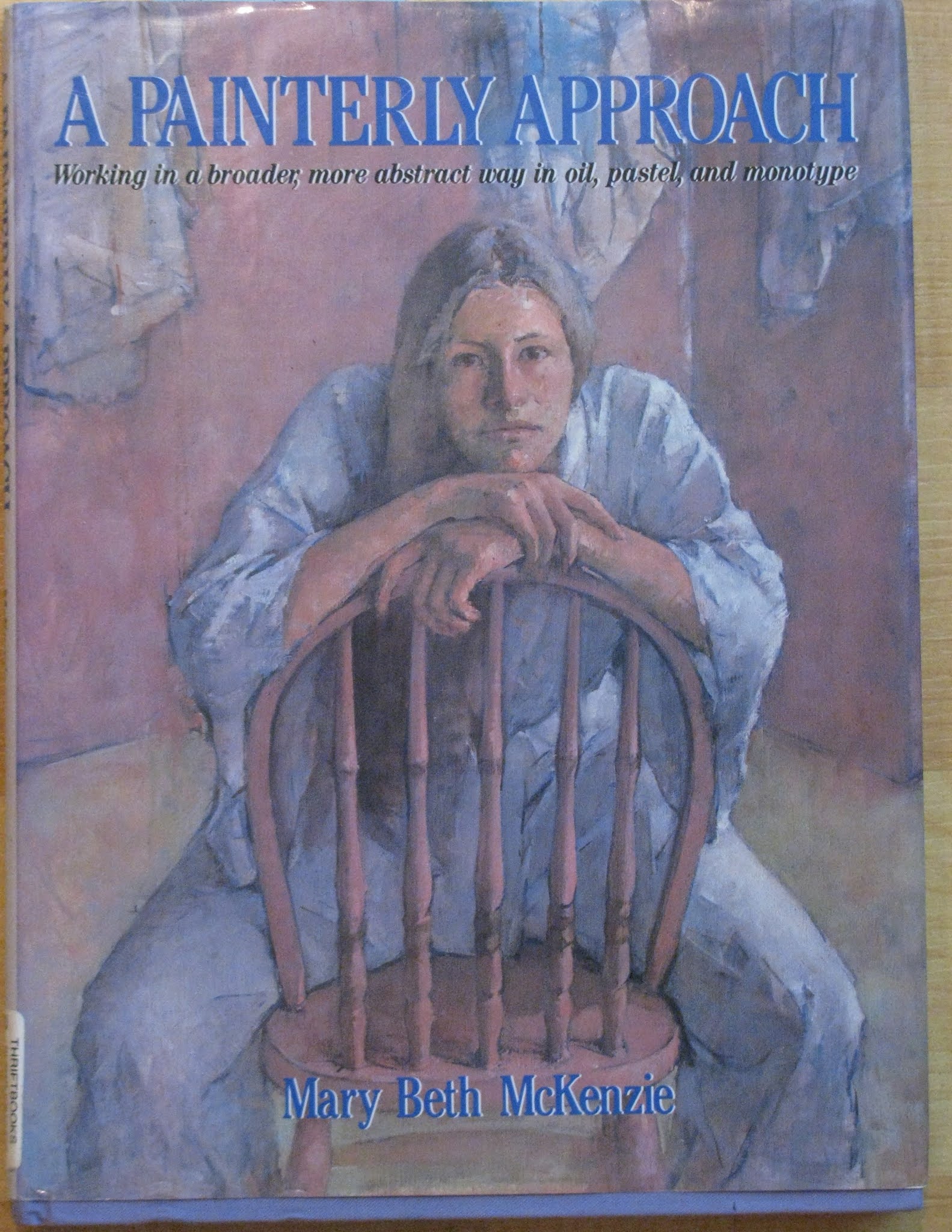
But that never stops me.  I am making progress, really I am, in my "Jury is Out" series (recapped last time) and my aim to work in the style of long-time favourite artist-teacher Mary Beth McKenzie.


I tried various sketched poses and eventually decided on a sitting pose and did some painted studies of a face that might be useful.  Working from a scaled-up magazine shot -- conveniently the reverse of the pose I'd decided on -- I  laid out the basic composition.


In books and videos, I'd been observing different artists' practices in beginning a painting.  In this review, I noticed again a quote from Mary Beth that had struck me years ago:-- 

"While an initial concept is important, you must allow a painting to take its own course.  It will grow in stages, and each stage, and your reaction to it, influences the next.  A painting has its own existence and reality, and you have to follow its needs, making changes freely.  Often these changes take you in another direction, opening up new possibilities that are sometimes more interesting than your original idea.  You have to allow a painting to evolve."

I'd planned to use certain colours, including a dark blue-black for the female's hair, and began to build these up gradually as I "kept the whole thing going at once" (- an almost but not quite universal artist's dictum). 


By this point, I was learning some interesting things about working with close tonal values (avoiding strong contrasts in darks and lights) – and decided I could learn even more if, to some extent, I emulated the light colours in the cover painting of the McBible.


I kept going in this direction but began to think I'd have been better off to try to "copy" that cover painting – and I became more and more hesitant to press onward.  So with a few lessons learned, I laid a few more layers and decided to call it quits with  "The Jury is Out (Mary Beth)" copyright 2021.  (Maybe I'll be like Matisse and sneak into the museum months after the painting is purchased and hung to put some more strokes on the canvas!  Haha.)


Still – there was one more thing I wanted to try, a technique referred to by my Hero Artist.  (We don't say "heroine" any more, I guess).   This is the use of a palette knife, either to lay out a broad swath of paint or, with the knife's narrow edge, to "cut" a very fine line of paint.  And I have plenty of barely used palette knives!


For my experiment, I selected one lucky candidate from the Cardboard Club – that cozy collection of faces I've produced from time to time to use up excess paint.


Then I swathed and sliced with abandon – thanking my lucky stars that I hadn't tried this technique at a late stage of "Jury."


Wow.  This now resembles one of those frostbitten arctic explorers who, having lost their bearings,  has just made it back to civilization through an unexpected blizzard.  It's time to close the book on this lesson, isn't it?


Saturday, May 15, 2021

If at first you don't succeed


I did try again.  And again and again.  And then I ran away from home for a day to clear my head at VanDusen Garden, where I always spend a little time with my friend Dr. Menzies in this tranquil corner, a good place to mull things over.


Our story so far:  I've assigned myself the project of deliberately working in styles that progress from the flat, linear to the more painterly – and then see what comes of it in terms of my own approach.  Until I've completed a few of these experiments, the jury is out – that's the name of my series which imagines a group of art students waiting to learn if their submissions have been accepted.  So far:  Alex and Nando. 


For the third student's submission, I'd planned a spinoff on my long-time favourite artist-teacher, Mary Beth McKenzie.


When I first discovered this book that's been so meaningful to me, she was a slim, dark-eyed 41-year-old artist, just making her mark in New York City.  I was a year older, also dark-eyed, and otherwise in the Wannabee category.  Here's a tour around a fairly recent McKenzie exhibit where you'll see artist-coincidentally-as-senior-citizen, still creating her wonderful larger-than-life paintings.  (Just a hint:  You might want to mute the curator who seems to say the same thing four times over.)


I'd been spinning my wheels for two weeks, sketching various set-ups for a Mary Beth Wannabee Painting, when I took myself off to the Garden.  I came home refreshed, again looked through my life drawing sketches, and selected a pose from a 2019 in-person session:


Then I chose a face from a recent on-line life session.


Coincidentally, I happened on a similar pose in an old magazine and used that to scale up to my intended 18" x 24" canvas size. 


Then I got cold feet and decided I'd better do a preliminary study of the face – which was so intriguing to me, I wanted to spend time with it anyway. 


If this looks easy, it wasn't.  So I decided to take a page from my mentor Mary Beth who advised that there was a lot to learn at the beginning stage of a painting and to avoid the compulsion to produce a finished product.  "Make many starts," she said.  So I started another.


I continued to work on the two in tandem, using different approaches with form and colour.


When I reached a certain point with Face One, I realized another of Mary Beth's wise counsels.  This face was so dark, it looked like an old ad for Coppertone Suntan Lotion before we all became aware of sunblock.


I'd finally understood the point of her advice to "Put down the most important colour first – that's the guide to which you will key all the colours that follow."   So….I added the background colour to both of them.


That showed me the extent to which I needed to adjust both faces.  It also helped me see some structural errors, particularly in Face One.  This is why acrylic painters love white paint!


I could work back and forth on both paintings for another few weeks, but let's not belabour this.  They're studies, after all.


Or should I try a third face?  No, I'll leave that to VanDusen Garden.


Friday, April 30, 2021

I haven't struck gold yet


Inspired by the imagination and commitment of D, a young "creative" and ardent enthusiast of diggers and words, I've been paying close attention to construction sites.  (D's grandmother, in her witty accounts, tells me that at age 3, he's a seasoned site supervisor on every dig in their North Shore vicinity.)  


As I hope for a little more than the mud and clay of the old Tea Swamp not far from my place (photo above and also here) I'm reminded of the words of artist-author Donald McIntyre:


"Painting is ultimately a bit like mining.  You explore and explore; then it dries up and you keep on like an idiot, hoping that something else will come along…Every now and then, you do a painting which is the start of something different in your life."


My own recent diggings are guided by my plan to answer a key question I've posed: -- Do my paintings work best in a linear style or a painterly style, or my own combination of both? (This link by the way is a wonderful brief synopsis of what the heck I'm talking about.)  My aim:  To do a series of paintings modelled on painters I admire who work in various mixes of linear/painterly styles -- and eventually draw some conclusions about my own style.  


You might have caught my first try, based on the flat linear style of painter Alex Katz – "The Jury is Out (Alex)".


For the second in the series, I reconnected with a painter whose works I *love*  -- Ferdinand Hodler.  I'd discovered this early 20th c. Swiss artist a few years ago when I emulated his style with a painting which I based on a photograph of Richard Avedon.


This time, I viewed a lot of Hodler paintings on line, like these.  His "Portrait of Gertrude Muller" led me to a working hypothesis.


Many of his figure paintings are very linear and dynamically coloured, against a rather flat and plain background – one step beyond Alex Katz in terms of presenting a 3-dimensional impression on a 2-dimensional surface.  I did some preliminary planning and got started.


I smiled at my early stage, based on a sitting figure I photographed ...somewhere.


About halfway along, I realized I'd made a big mistake.  The eyes were just too low on the head.


There's a general guideline that helps with placement of features – and it's a halfway point itself.  Yes, of course, human faces vary -- but most show the middle of the eyes at about half the height of the head.


Groan.  There was only one thing to do. 


When the paint dried, I tried again and came closer.


As I worked towards the finish, I considered the title for this second piece in my "Jury is Out" series.  I've imagined art students waiting to learn the fate of their submitted portfolios, with their first names the same as the artists I'm imitating.  But here's the thing:-- I don't like the name Ferdinand.  I don't like the nicknames Fred, Freddie, Fredo.


But wait!  Here's a little known nickname for Ferdinand:-- "Nando."  Really!  But will he be confused with Nandi, the young prodigy?  What the heck – the guy in my painting looks a little preoccupied and needs a goofy nickname to cheer himself up.  Here he is in "The Jury is Out – Nando" (copyright 2021). 


I'm not entirely happy with this.  I could have done something much more exuberant along Hodler's lines -- like his gorgeous painting, "The Joyous Woman."


So as to whether you've seen the last of Hodler on this blog, I wouldn't place money on it.  (1911 Swiss 50-franc note with Hodler's "The Woodcutter")


Thursday, April 15, 2021

The season to begin anew


The structure is solid but there hasn't been much action.  Now, though, in just the past two weeks, "green is beginning" – in the words of Pablo Neruda in one of my favourite of his poems.


Almost simultaneously, there's been a heartening development in my personal art world.  The studio where I'd been doing life drawing until March 2020 re-opened in Zoom format after its pandemic-imposed shutdown.  It didn't take me long to set up at home for the first session.


A year ago, I felt I was really beginning to catch on.  My quick poses (1-, 2-, 5-minute) were pretty informative, and I was quite pleased with my drawings like these from 15- and 30-minute poses.


Now – well, I'm downright rusty…just barely making it with some sketchy short poses...


…making lots of false starts with the medium-length poses…


…and getting downright fed up with my fumblings through the longer poses.


Nonetheless – I'm happy to be back at it, and coincidentally as I begin anew, I've picked up a fascinating bit of complementary lore.  I can't even remember how I came across this brief article on a mid-20th century Canadian woman (and her collatorators and successors) who, as a medical illustrator, changed the look of anatomy texts for medical education. 


Quick! – to the catalog of the Vancouver Public Library, which almost never disappoints me.  There I found several editions of what became a classic Canadian text, "Grant's Anatomy."  I requested the oldest edition they had – 1991 – before the widespread use of computer-assisted design, thank goodness.


Don't ask me why but somehow the subtle colours and hand-lettering remind me of Maurice Sendak.


It happens that I have many marvelous anatomy books of my own, most of them birthday gifts from the mid-1980s (!!) when I was first becoming enthralled with the human figure. 


They're written by artist-teachers for the purpose of art education and contain often stunning illustrations – skeletons, bones, muscles and, very usefully, "surface anatomy," the landmarks we see when we observe the figure, clothed or unclothed.  (Quick cut to this week's "OOPs" moment in the Canadian House of Commons).


The following are from the books of Louise Gordon and Joseph Sheppard.  (Gosh – these heroes of mine from the 1980s are lookin' kind of old and grey these days).


If I had learned everything in these books by now……..  Well, I haven't, but I know enough to get crackin' again.  Along the way, I can enjoy browsing through "Grant's Anatomy" that, for medical students and professionals, dives deeper than artists need to know about nerves and veins and inner connections of muscles and such.


A new constant in my busy calendar of Zoom events will be twice-monthly sessions at the drawing studio.  My brow might be furrowed as I work (from the forehead muscle that's actually called the "corrugator"), but I *love* the environment – three camera angles to choose from, including the overhead "skycam" that's totally fun and something that's impossible in the normal in-person sessions:


 And if I don't soon get back to my 2020 level of confidence, I'll do backflips trying!  (- from artist/teacher John Raynes)