Friday, June 29, 2018

Some questions to be asked about Klimtangle


Right off the bat, who is the artist whose work most lends itself to a large Zentangle colouring book? (But first, a swerve off-topic:  Why wasn't I savvy enough at age 7 to "monetize" those childhood black-and-white outline doodles that I then coloured in?  I guess it took even more savvy grown-ups like the couple described in this link).

Did you guess?  Gustav Klimt, of course, with his abundant mesmerizing patterns.  Everyone knows Klimt, I think.  Whether or not you do, this 2-minute video on his famous so-called "Woman in Gold" ("Portrait of Adele Bloch-Bauer") is a brief overview of the painting, the subject, the eccentric artist, and the 21st-century court case that arose from its having been confiscated by the Nazis.

When I saw Klimt on the curriculum of my on-line art course, I knew I had the perfect subject in a figure I'd happened upon months before in Google Images -- the 19th-/early 20th century stage and silent film actress Edith Wynne Matthison. 

And I knew I'd better get an early start!  As I worked back and forth between Wynne Matthison and Klimt, a new question arose every session.   This was not as simple as colouring a Zentangle design!

For a start, what are Klimt's typical patterns?  Does he combine different geometrical shapes?


 Answer:  There's nothing "typical" about how he bends and combines shapes in endless variations -- and somehow it all looks coherent.

Q:   How does he use colour?  Are backgrounds solid or patterned?


 A:  A little bit of this, a little bit of that -- sometimes shades of a single colour, sometimes colour opposites, sometimes a little breather of solid colour.  It's all dynamite.

Q:   To what extent do his patterns suggest direction and 3-dimensionality?


 A:  Sometimes they do --very subtly; sometimes the whole expanse of pattern is just flat.

Q:  How did he make such perfect geometrical shapes, especially the swirls?


 A:  I don't know, and I gave up trying.

Q:  Does scale matter?


 A:   You bet.  It HAS to have been easier to apply patterns to a 54"-square piece like the "Woman in Gold" than to work with a tiny paintbrush on an 11" x 17" surface like mine.
  
It was alternately exhilarating and mind-numbing to cast Edith Wynne Matthison as a Klimt heroine, and here's her curtain call.  (Developmental sequence shown here, worked over an old quick sketch of a dancer in action).


 On one of the exhilarating mornings, I went out in the garden after my studio session and was struck by how the Sweet William and pansies looked JUST like a Klimt painting!  I was so excited that I staged the little setting shown in the title photo -- and then remembered when I came inside that Klimt had been there before me, with his own paintings of flowers and gardens. 

Final question:  What does it take to persevere in painting these meticulous patterns?  Well, I guess you have to be a Klimtomaniac.  (Applause and laughter from the audience)

And if you're not there yet, you might be after viewing how one contemporary museum is presenting Klimt as an "immersive experience."  (Click on the white dots in the first frame to move through the exhibit)


Saturday, June 16, 2018

Time for a draw-down


I'm always interested in what I can learn from others.  Almost everyone has things to share, but it's those with a creative passion who particularly attract my attention.  This week  it struck me that it's time for what my friend A, the semi-professional chef and baker, would call a "draw-down."  (The "semi-" means she doesn't get paid except in 5-star admiration).

When A does a draw-down, it means she's cleaning out her fridge or freezer of stuff that she might even have forgotten about.  And then she whips it all into a "simple" lunch or dinner that's wholly original and, even through cyberspace, enticing and unforgettable.

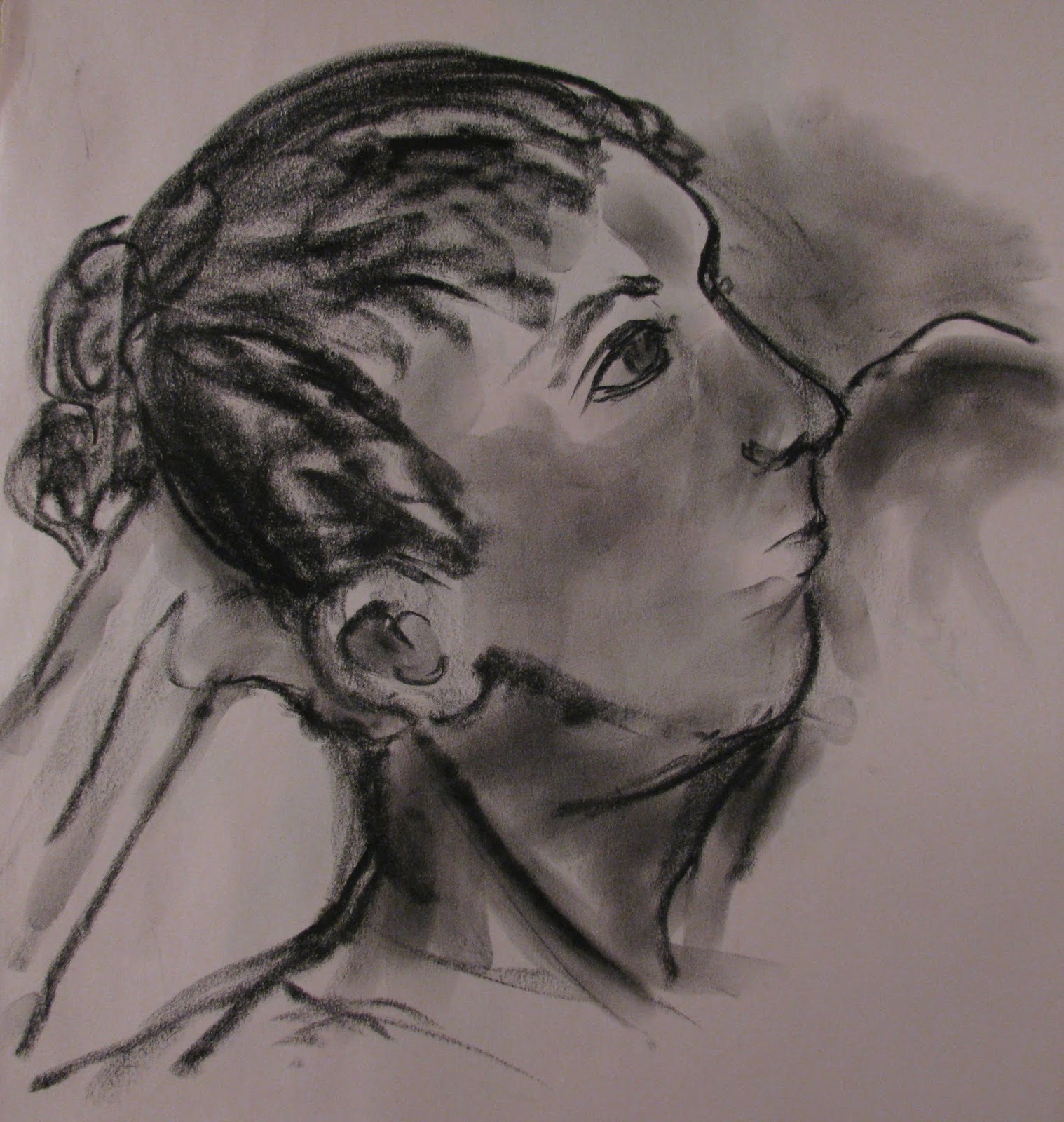
Well, all those adjectives aside, I've had photo images sitting around for a month now from my last drawing session at Basic Inquiry.  Time for a draw-down!

Some 1-minute warm-up poses:--


 A couple of 5-minute poses:--
 

 Moving on to 10 minutes:--


  And 15 minutes:--


 And two 30-minute poses from the final stage of the session:--


With summertime doings shaping up, I've drifted from my goal of doing these life sessions at least every other week, but no matter.   Taking some lessons from the big guys, I mostly follow Pissarro's counsel:--
   "One should draw every day, even if it is only an apple.  One can so easily lose the knack."
  The artists I most admire are as thrilling to me for their drawings as for their paintings.  And Degas, right at the top of my list, has this to say:--
"Drawing is the artist's most direct and spontaneous expression, a species of writing: it reveals, better than does painting, his true personality." 
Hmmmm.  Lest we get too psychoanalytical, consider also the observation of Stan Hardy of Laurel and Hardy fame:--
 "You can lead a horse to water, but a pencil has to be led."

Wednesday, May 30, 2018

Spectrum: From the intense to the gently humourous


Time for a big catch-up on the artist-of-the-week on-line course.   First, a quick review.  You know my methods, Watson.  -- or do you?  I've been lurking around the edges of this course, adhering to only one of its rules:  There ARE no rules, and you can do whatever you want or nothing at all.
  
So:  I take note of the artist-of-the-week, trying to work at least a week in advance.  Then I go to my art books and/or make a mesmerizing Google Images search, and then I decide what to do to best suit my personal goals.

But what to do when the week presented Van Gogh?  Like so many other artists-or-not,  I feel almost a personal connection with him from the time decades ago that I read his biography and his letters to his brother.  The words "awe" and "reverence" are not too strong for my feelings of regard and attachment.   I couldn't imagine either copying a painting (which in other cases I might do) or working in his style.  Then, as I looked through a wonderful book of Van Gogh portraits, I decided to select four self-portraits and reproduce only "Vincent's Eyes" -- or, singular, that one magnificent eye that stares back at me from my bulletin board and energizes my whole studio.


The next week I became better acquainted with Kees van Dongen -- a name I'd heard as an artist in Matisse's early circle.  He painted many big-eyed colourful female portraits, but I was most taken with his "Portrait of Madame Jasmy" in black-white-grey.


In the Image Search, I spotted a photo of van Dongen in his studio, holding an easel, and decided to recreate this in the manner of Madame -- borrowing some colour from other of his works.


Next up:  A female artist whose name I knew -- unfortunately, as so many people do, as "the sister of.........A More Famous Male Artist."   Or, and this applied, too:  "Mistress of a More Famous Artist."

She's Gwen John, sister of Augustus John, with whom I had a slight familiarity, and also the sometime mistress of the great sculptor (and womanizer) Rodin.   As I cruised through images of her rather restrained, rather Victorian portraits, I stopped in my tracks at this dynamite portrait of her sister Winifred. 

This one I had to try copying!   The work-in-progress sequence is rather interesting -- as I tried using an acrylic paste medium to enable a texture like the one in John's oil painting.   Here's my final "Portrait of Winifred John - an emulation."


 At this point you might be wondering where in the spectrum we'll encounter the "gently humourous."  The first sample comes by way of my introduction to a fascinating artist I'd never heard of -- a South African painter named Irma Stern (1894-1966).   The Afro-American instructor who created the week's lesson credited Stern with humanizing and dignifying African and Asian subjects in a very atypical way for that era in South Africa.

Stern is a fabulous colourist who merits more of my study -- but I was enthralled with her fairly muted "Portrait of the Baillie Children."


Hmmmmm.  What to make of this?  Lightbulb flash!  I'd take them forward in time about 15 years.  Here's my "And Then They Grew Up."


I *love* this punky twosome who still give me a morning laugh in the studio.  Oh, I do enjoy my own sense of humour.........as shown next, when we reached the artist Pierre Bonnard.

Decades back, on one of our few trips to France, we saw a fabulous exhibit of Les Nabis, the group of artists which includes Bonnard.  His colours,  particularly "in real life," are ravishing -- and I'm a great fan.  And what's more -- something I'd known for a long time -- Bonnard was one of those artists who adored cats.   When this one hopped up in the Image Search, I was struck by its title:  "The Demanding Cat." 


My course of action was clear.  There was nothing for it but to grab the white cat's colour for my own almost-snowy hair and substitute a streamlined tabby to represent a special little cat-boy who was full of affection and his own irresistible assertiveness.  Here we are, together enjoying our own sense of humour:  "Self-portrait with The Commander-Demander."
  

We've come full circle with this post's spectrum -- but there will be lots more ahead.  After all, it seems in some people, the human eye can distinguish a million or more colours.  


Monday, May 14, 2018

What are we gonna do?!


After a disoriented April, I got back to the drawing studio on May Day.  M'aidez, indeed!  Everyone was all set to go, all chairs were filled in the circle around the model stand, but -- no model.  This had never happened (to me) before.

Okay.  No worries.  The model phoned to say she was stuck in traffic, and the imperturbable studio monitor appealed to a member of the group -- another of the regular models, who is also an artist, who was attending the session to do drawing herself.  She agreed to do the warm-up by modelling for the 1- and 2-minute poses, but "draped" as we say (keeping her clothes on).

I think this young woman was one of the first models I had when I began this routine just a year ago -- and she's FAB.  Here are a couple of her 1-minute poses:


And several two-minute poses:


It was positively exhilarating.  And then the scheduled model arrived -- a very beautiful young woman with a perfect body.  Under other circumstances, it would have been satisfying to try to do justice to this perfection -- but after the first model's challenging twists, turns, shifts in balance....  Well, as I confirmed at the break with a regular compatriot who I often sit near:  the energy just seemed to evaporate from the room.

For the most part, I chose to focus on sections of her figure rather than on an entire serene pose.  Some 5-minute poses:


A couple of 10-minute poses:


And a playing-with-crayons (me) 30-minute pose:

 Not bad for an overall session, considering that implementing Plan B resulted in an A Plus performance.  When I thanked both models afterwards, the dynamic one reminded me that the models' monthly schedule is posted on the website.  AND it just so happens that she's on the May 15th roster.  YA-HOO!   I'll be there.


Monday, April 30, 2018

Youth and age - the timeless theme


There's a BC wildflower called Youth-on-Age, so named for its characteristic growth pattern.  The ones  blooming in my garden now derive from a tiny plant judiciously collected from a vast growth at the base of UBC's Point Grey cliffs -- forty years ago this month!  As my enduring and unequalled identification guide explains it:
"...examine the leaves in the late summer and you will see that the reason for the odd name is that small leaves are growing from the base of the old leaf blades.  As the old leaves wither they slowly drop to the ground, giving the new leaves a chance to root."
                  - C. P. Lyons, Trees, Shrubs and Flowers to Know in British Columbia
 A sort of phoenix plant, you might conclude.

In mid-March when it scarcely seemed likely we'd see ANY abundant spring growth this year (so cold! so rainy!), the timeless theme was on my mind as I developed a "Youth and Age" diptych for Degas Week in my on-line course.  (True confessions:  I started a week early and spent two weeks in total).

Degas, one of my all-time favourites, began painting self-portraits at an early age -- always with eyes like deep pools which apparently characterized the Degas clan.  I chose to emulate this one for the simplicity of its tones:


 By happy accident,  my internet image search turned up a "Portrait of the Painter Degas" by Maurice Denis.  He's another early 20th century artist whose name I knew -- but with whom I had no resonance.  Now I do!  I fell in love with his austerely toned picture of an elderly Degas.


I worked on the two in parallel under the heading "Youth and Age"...


...with a somewhat successful outcome.  (You can view the brief sequence of development here).

Here's my version of Degas' "Self-portrait in a Soft Hat":


My version of Denis' portrait of Degas:


Let's think of the new spring plants that emerged from young leaves growing at the base of the old ones -- 


-- how life keeps putting down new growth; how the old nourishes the young; how after decades -- even across centuries, even across cultures -- art students are still inspired by the thrilling vitality conveyed in a masterwork of art.


Saturday, April 14, 2018

Brand new gallery wing: The docent’s tour


I'm still lurking around the edges of my on-line art course, doing my own thing to the tune of artist-of-the-week.  Now it's time for a catch-up so I thought I'd line you up with a docent's tour.

You know the drill.   You tend to hear things you already knew, things you might or might not have known, and surprising things you'd never have guessed.  Ready?  Cell phones turned off,  please.

Let's start BIG -- with Rembrandt. 

You knew:  Any gallery worth its salt must have a Rembrandt!
You might or might not know:  Rembrandt was a prolific painter of self-portraits and left a virtual painted autobiography spanning youth to old age.
You might be surprised to learn:  Your docent fell in love with Rembrandt's drawings decades ago, long before she warmed up to his paintings.

For Rembrandt week, I chose to do a simple very-black-and-white copy of his pencilled self-portrait as a young man.


You knew:  In any gallery, you're sure to encounter artists you've never heard of.
You might or might not know:  Tanner was the first Afro-American artist to achieve international acclaim -- which he was able to develop after moving to France.
You might be surprised to learn:  His wife was a Swedish soprano, Jessie Ollsson, and I chose his beautiful "Portrait of the Artist's Wife" to  emulate.


You knew:  There's a female artist who is forever painting mothers and their children.  You're sure to see her work on Mother's Day cards.
You might or might not know:  Mary Cassatt was a great friend of the artist Degas and shared his interest in experimental techniques with pastel.
You might be surprised to learn:   Your docent thought she'd discovered a close family connection to Cassatt and Degas, as described here.  (Okay, so maybe it wasn't so close after all.)

I decided to work in pastel and modify a typical Cassatt theme/pose -- borrowing a friend's husband and granddaughters for "Grandpa and the Girls."  (and obscuring them from being "borrowed" by Facebook!)


You knew:  There was a sole female among the original Impressionists but she's often overlooked.
You might or might not know:  She was married to Eugène Manet, the brother of the famous painter.  Their daughter Julie wrote a charming and insightful book, "Growing Up with the Impressionists."
You might be surprised to learn:  Morisot was greatly esteemed by her Impressionist colleagues, Renoir and Degas in particular, but otherwise had to fight the good fight of 19th century females for professional recognition.

I chose her "Jeune Fille au Manteau Vert" as my model for a quick, loose sketch of a local felt artist in her shop.


You knew:  The waterlily guy!
You might or might not know:  The great love of his life, his first wife Camille, died young of tuberculosis before he'd even settled in what became the famous hamlet of Giverny.
You might be surprised to learn:  Stephanie Cowell's "Claude and Camille:  A Novel of Monet" is sooo not worth it.

I emulated Monet's "Portrait of Camille," using my memory of one of my young neighbours for a somewhat updated version.   But why does she look so worried?  It's incredible how subtle the features can be.  I fiddled with eyes and eyebrows for days and finally left her to worry about what people would think.


You knew:  His first name is the same as my cat's.
You might or might not know:  He could draw like a dream and paint like a madman.
You might be surprised to learn:  Born and educated in Russia, he came to the States in his early 40s and eventually became part of the Taos Art Colony.

I was enchanted by the energy and splash of his "Portrait of the Artist's Father":


I decided to let loose and re-do an uninspiring portrait I'd attempted months ago of an elegant aging woman I saw in the lobby of a medical building.   She's now taken on a new life as "Wise Woman" -- and it's kind of fun to look at the progression of her facelift here.


This gallery is still under construction.  We'll dip into the paint pots from time to time with a progress report.