Monday, July 31, 2017

Stepping up to the plate again


 After my thrilling May session at Vancouver's Basic Inquiry Studio, it was another month before I went again -- even though my original plan was to make this a weekly practice.

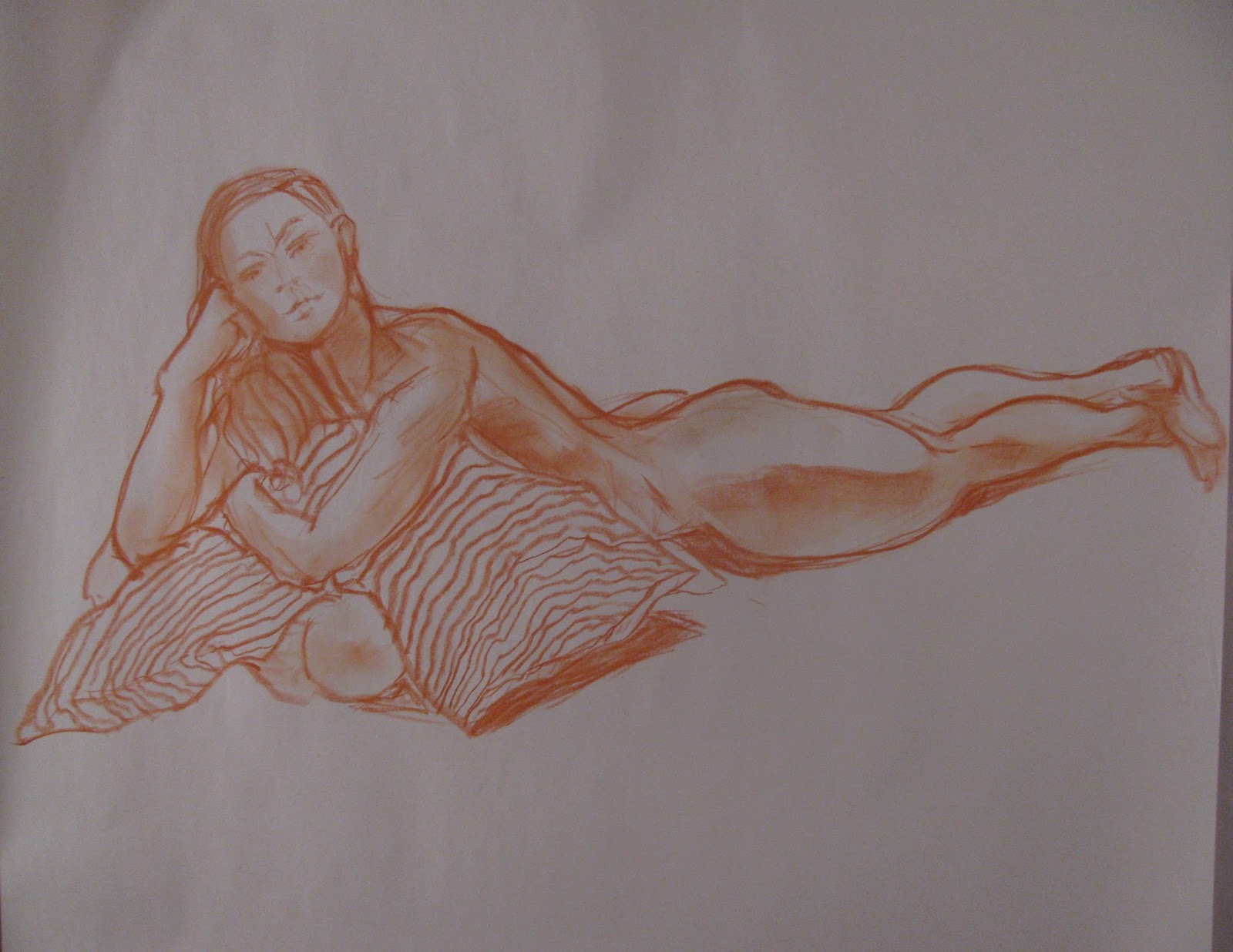
My second session in early July was just as affirming -- terrific model, excellent moderator, great studio layout.  Without the angst of my initial visit, I moved with a little more confidence through the timed poses.  Some samples:

One-minute poses:

Five-minute poses:


Ten-minute pose:

 One of the final 30-minute poses:


 I was fairly satisfied but also exhausted at the session's end.  And sitting on the artist's donkey for three hours left me with a very uncomfortable behind -- it couldn't have been more so if I'd been sitting on one of the original bag-type bases of the schoolkids' baseball games of my childhood. (this link offers a fascinating more-than-you-ever-wanted-to-know history of baseball's bases!)

Thinking it over, I decided it was more realistic to aim for a session every other week.  And next time I'd take a seat cushion!  What's more,  I realized I could pre-plan what I wanted to focus on in each session's poses of different durations.  There are tons of ways to approach life drawing, and different drawing books, teachers, and my own inclinations have suggested different exercises.

Both the seat cushion and the "agenda" contributed to a fruitful and less tiring experience when I went again in mid-July.  The model was an amply built woman who, like the two previous models, was amazing.

Some samples:

One-minute poses, alternating straight and curved lines:


 Ten-minute poses, starting with a focus on "the main line that sets the pose" (not visible in the outcome, but the essential first step of my process):


 Fifteen-minute poses, placed in positions that yield interesting "spaces between" (rather tricky since you don't know what pose the model will adopt next):


And the two final 30-minute poses in which I've just tried to keep it all together.


 In my personal post-session evaluation, I had one more brilliant realization:--  It's summer, and summer won't last forever.  So I might or might not settle in to an alternate week schedule until the good weather begins to fade.  But I'm IN now.  I'm a member.  I have my member-discount tickets.  And I'll be back!


Monday, July 17, 2017

Best of class vs. Tried and true


A frequently quoted maxim in doing art is to use the best materials you can afford.  I suspect that's sound counsel for any craft or trade. Would my expert quilt-making friend use a fabric that didn't feel right? Would my friend the semi-professional chef/baker use a flour that didn't have the right oompf when mixed with liquid? And notice that determining what's "right" is an elusive art in itself.

Lately I've been working on my recently purchased Arches fine arts paper, the most expensive paper I've ever bought. Whether it will suit me as well as my long-time favourite Crescent brand, another more than respectable choice, remains to be seen.

As I get used to the slightly new feel, I've considered another maxim:-- Rely on the tried and true.  I'm willing to bet that the two skilled friends I've just mentioned each have a favourite tool for special purposes -- the first needle that's reached for when a hem needs sewing, the "only" knife that can really be relied on to chop onions.

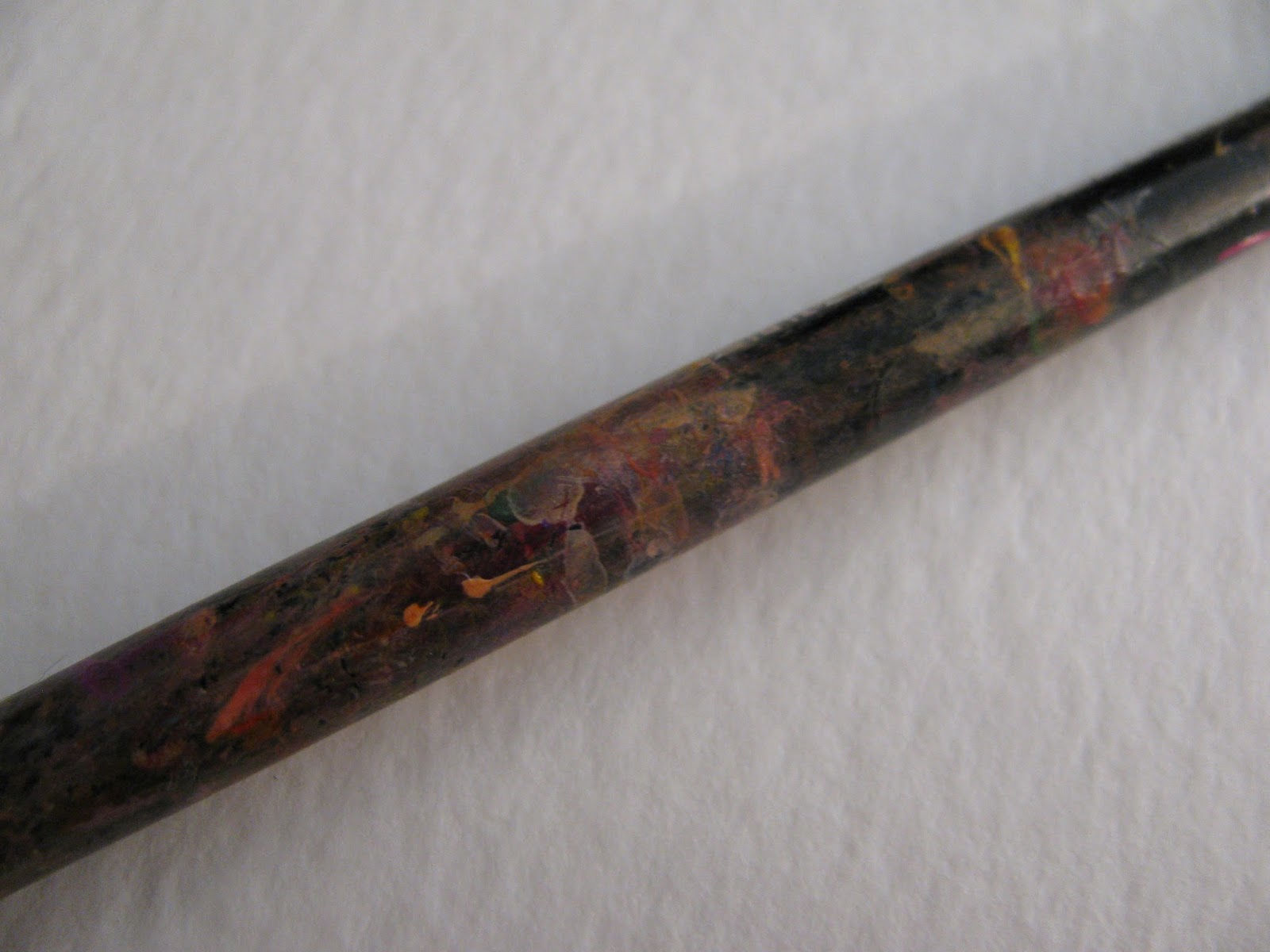
So consider this 44-year old brush, the survivor of a 3-brush set that I bought when I first began to paint:


Even in its youth (and mine), it was neither my favourite nor my most frequently used brush. But when I have a large swath of paint to put down quickly, this is the brush for me. I know exactly  what thickness of paint it handles best, exactly how much paint it will hold, and exactly how it will behave on various surfaces.

And look at these two favourites, used in almost every painting I've ever done -- almost as old and showing their age.


I keep thinking it's time to replace them, but there's a problem. Although I religiously wash the brushes themselves after each use, the brush handles have acquired rather beautiful marbled patinas of paint splashes, and the brand name is obscured.


No matter. I have about 25 other brushes of various sizes. And I can't imagine living without these two until they're really unusable.

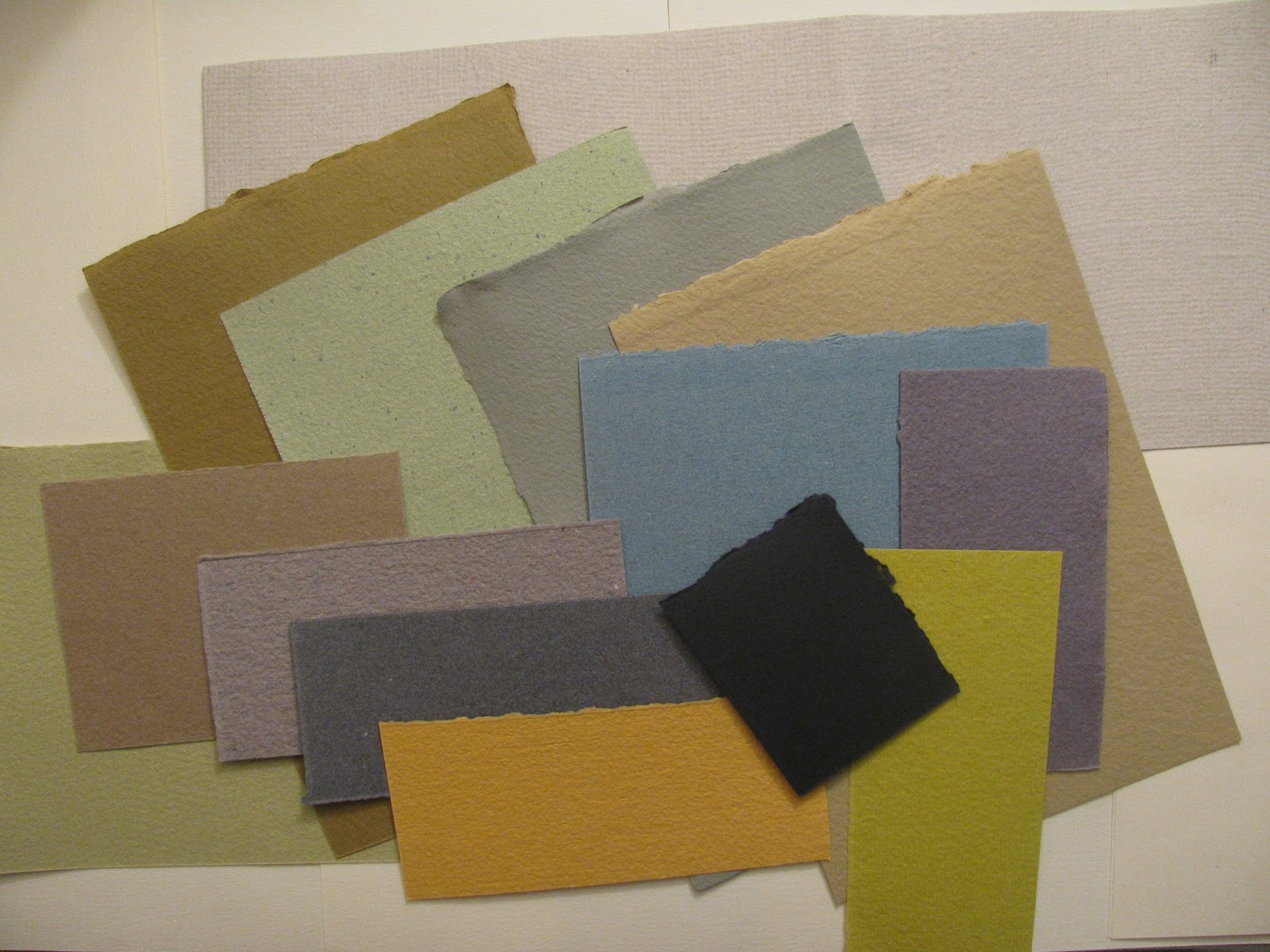
And while we're talking about tools and materials, let's consider another maxim: -- Experimenting with new material can generate a whole world of creative ideas.  For example, I was recently browsing in a specialty paper shop and noticed a name I'd come across in catalogs:-- Papeterie St-Armand, Canada's own fine arts paper mill in Quebec.


How could I resist buying their generous sampler pack with dozens of smallish papers in different colours, weights, textures? Here's a spread with just one each of the treasures I found when I opened the package at home.


I could almost have gobbled up the delicious deckles on this one. (An uneven deckled edge is the hallmark of traditionally made paper -- and unfortunately, it's often necessarily sacrificed in the final art piece)


Even the white St-Armand, with its intentional random texture, is enchanting.


Now what to do with this lovely stuff? Maybe my Chinese calligraphy-type brushes will come to the fore. Or pen-and-ink? How about a linocut? Or a collage? I'll be playing with these papers from time to time as the spirit moves me. And I'll let you know what hatches.


Friday, June 30, 2017

Get out the sunscreen!


Wishfully waiting for summer about a month and a half ago, I began the seventh in my "Flash Mob" paintings by presenting my familiar lounging swimmers under wraps.


It was a good opportunity to play with fabric folds and also to splash around on my new-bought **pristine** artist's paper from Arches, the French mill that makes some of the best.


Maybe it all went a little too smoothly -- because working over an old painting provides a useful resistance, both texturally and tonally. Working against that can slow you down but also give necessary pauses in which to consider and reconsider.

And so somehow, I let a troublesome figure establish herself.


The female figure on the far right was so intriguing in my original sketchbook -- the position of her feet, the twist in her spine as she looked back over her shoulder.


But from the first transposition from original quick sketch to paper-doll study, her head just didn't work.


It was too big. It was too small. (You can view the inflationary/deflationary cycle here)  Finally I said, "Let's wrap this up" -- and went with what I had.

Here's "It's a Wrap" (copyright 2017)


Sometimes, you've just gotta throw in the towel -- or wrap it around your shoulders -- pull yourself away to the sidelines, and mull over how you might make the cut next time.


Friday, June 16, 2017

Call up the troops


Just a few years ago in reading about the Impressionists, I learned about one of their predecessors, Ernest Meissonier. His paintings don't appeal to me (nor did they to our Impressionist heroes), but I was struck by how he planned his complex, populated scenes like his "Battle of Friedland" shown here. He actually commissioned the construction of hundreds of small-scale 3D horses and riders, organized them into a "composition," and painted from the model, as it were.

It certainly makes sense. Even as I experiment with compositions for my Flash Mob series, with at most nine figures involved, it can get tedious to make a dozen preliminary pencil sketches.


Last summer, when I first started doing multi-figure paintings, I found that the quickest way to try out different compositions was to make paper cut-outs that could be easily moved around.


As I drew and cut out these little figures, I was reminded of my mother's story of her paper-dolls. As a committed tomboy in the early 1950s (and ever afterwards), I'd been somewhat mystified by the debut of the briefly famous paper-doll Betsy McCall.  The celebrated offspring of the then-classy McCall's women's magazine, she was a sturdy little paper-girl just my age.


Each month, she'd arrive with a whole new wardrobe -- tidy perfect dresses that were similar but very superior to the kind of dresses my friends and I wore to school. These, and the spotless shoes and socks -- and the fact that she was out in public in her underwear?!? -- I found appalling rather than appealing.

"Oh, I loved my paper-dolls!" my mother said. In her day, little girls didn't assemble pre-packaged Betsys, but gleaned the magazines for an appealing figure, cut it out, mounted it on cardboard -- and then made up stories for the figures to enact. Right. Typical kids' stuff like the scenarios I developed with my panda and teddy bears.

"And my favourite paper-doll," she said, "was named Elizabeth Barrett Browning -- because it was the most beautiful name I'd ever heard."

Remembering all this -- Betsy, my mom, and Elizabeth B -- I spent one amusing studio session last summer making tabbed outfits for a couple of my figures.


The jester particularly became the presiding genie as I worked on my first figure painting, "Catching the Rays."


The paper-doll approach has turned out to be useful with the two most recent paintings I've been working on. And if I'd saved my original group and put them with my current gang, I'd have more than enough of a crowd to stare down the galloping horses and invite everyone to a big beach party.

You've probably found this to be a very silly post. So let's give the last word to Elizabeth Barrett Browning, who wrote: "Silence is the best response to fools."


Wednesday, May 31, 2017

"It resonates"


Does this title image look like it's resonating? Hard to say. As I work along on my Flash Mob series, it's sometimes a challenge to match a visual image to a dubious colloquial expression -- which was part of the Flash Mob's impetus from the first in the series, "Lean In."

Nonetheless, here we go with the preliminary sketch plan:


When I started this, I hadn't yet acquired my delicious new stash of Arches fine arts paper. (Give this site a moment to kick in, and it's lots of fun). So once again I worked over an old painting--


Laying in the figures on such dark paint went pretty well, with the use of white pastel crayon:


With my art classes (and homework!) over for a while, things moved along fairly quickly in my studio mornings.


However, nearing the home stretch, I had to face the fact that the top figure's arms were just *TOO LONG* -- a mistake I should have dealt with two weeks before.


You can view the whole sequence here, and here's the final view of "It Resonates" - #6 in the Flash Mob Series (copyright 2017):--


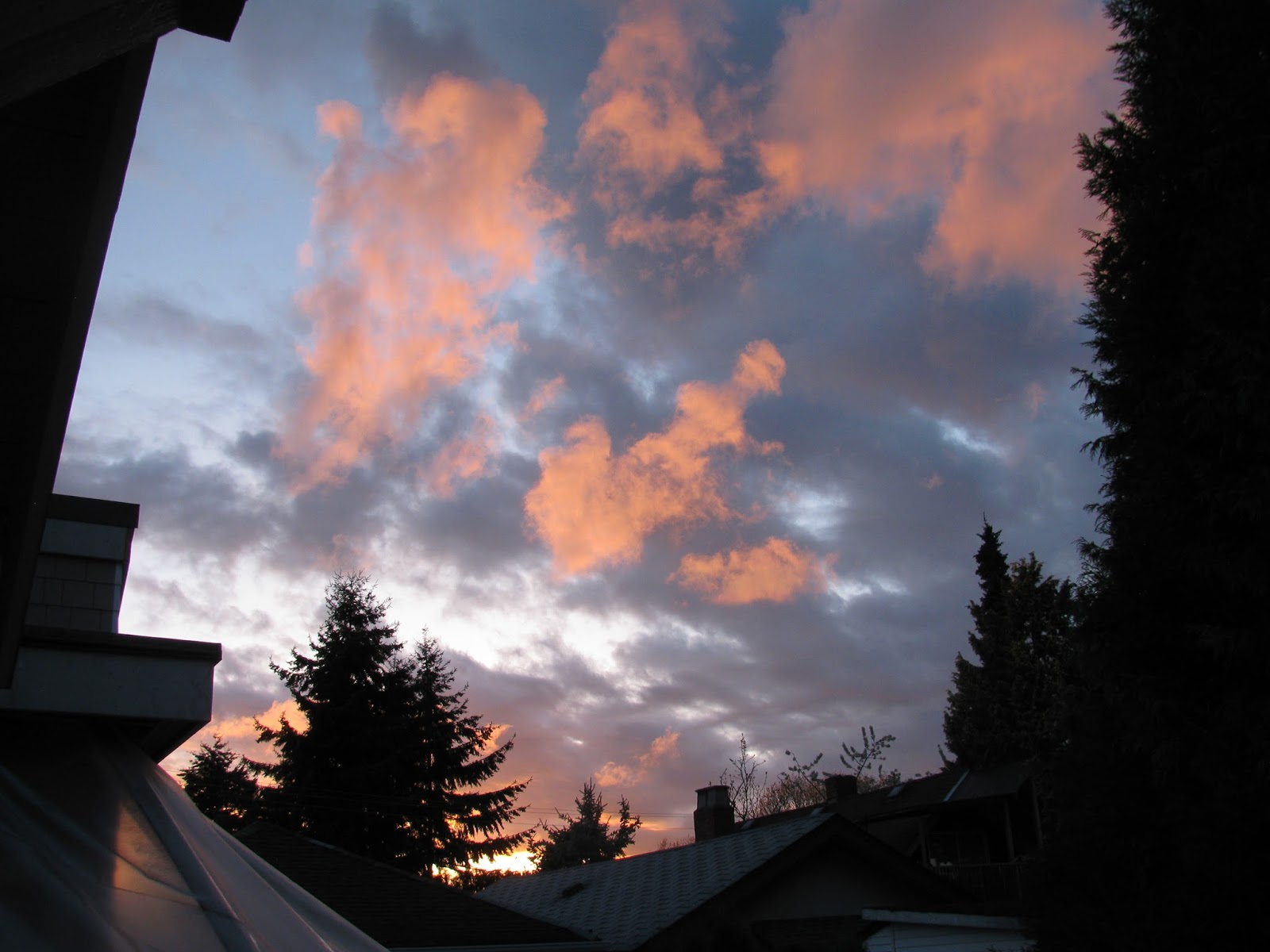
Well, short of an earthquake in action, what IS a visual equivalent of "resonate"? Let's try this -- it's at least an excuse to share a beautiful April sunset from my back porch.


Monday, May 15, 2017

Right at home


One of the gifts of The Yellow House (where, surprisingly, I've lived for five years now) are these magnificent multi-coloured parrot tulips -- I call them my "Harlequins." Our first spring here, two of them improbably poked up through the dense growth of the front yard hellebores, and it was love at first sight.


Last fall, I found similar bulbs on sale, swooped them up, and gave them more room to thrive this year. Working on my knees in the garden, savouring what's in bloom and dreaming of what some day might follow, is one of those things that makes me feel perfectly at home -- right here, in my own skin; in the zone; where I'm meant to be.

I had the same quiet thrill when I at last checked out Basic Inquiry Studio, a Vancouver non-profit drawing group that offers many different types of drawing sessions with live models. You can check out Basic Inquiry here  and watch a brief video describing what life drawing is like from the model's point of view.

For my trial run, I chose the session with the typical art school routine, warming up with one- and two-minute poses, then progressing to five-minute, 15-minute and half-hour poses. As the 3-hour session unfolded, I was metaphorically walking on air. Here's a sampler (you can view the whole batch in sequence here) with a one-minute pose first:--


Now five minutes each:--


Fifteen minutes each:--


By the way, the point of all this is not necessarily to have something to show for it -- it's the ongoing practice just like a musician's doing scales, or "laying track" as Julia Cameron of "The Artist's Way" would call it. I had just been explaining this to a friend when I came across this link referencing my revered virtual teacher Kimon Nicolaides (1891-1938; yup, from before I was born) with a similar idea.

Here's the first half-hour pose:--


Second half-hour pose:--


And with some time to spare on that one, I did a quick Matissean wrap-up:--


And here's the final half-hour pose. There should be a thought-bubble above her head that says, "Yup. REALLY like doing this. I'll be back."