Friday, April 8, 2016

What goes around...


Have you been holding your breath? Treading water? ...as you've waited to learn the next developments with my Aquatic Sketchbooks and the old/young Czech guy who sketched dancers in movement?

Get ready! It's a dramatic episode.


A brochure for this year's International Dance Festival caught my eye at the library. I always watch for these, not because I'm an aficionado of dance, but because they always have terrific photographs of dancers. Flipping through the program, looking for useful poses to study for anatomy drawings, I happened to spot something that was there Just For Me!! -- A notice that during the Festival, there would be a modest art exhibit and -- thrillingly -- ten days of free noon-hour Life Drawing Sessions at the Festival's home base, the Roundhouse Community Centre. (For old building and train enthusiasts, the original Roundhouse was the western terminus of the Canadian Pacific Railway where ...the trains that went around, came around....)

I was just in time -- the sessions started in two days, and I saw that I could squeeze at least three sessions into my calendar. No treading water for me -- I was floating on air as I surfed into the Roundhouse that Friday and settled my big sketchpad and materials at a table, after catching a glimpse of the art exhibit's showpiece.


I'd been away from life drawing for 20+ years and was so excited, I could barely calm myself. But then I channelled my revered teacher Kimon Nicolaides and his counsels: "It is more important that your studies capture this comprehension of movement, of gesture, than that they contain any other single thing."

And lately, as I re-read a chapter of his famous book, I found the following marvellous invocation. (This paragraph is the kind of thing that makes the eyes of contemporary art students glaze over -- or so I conclude from on-line Comments such as those posted here. The only intelligent comment-maker is the one from Kelowna, BC!)


Try for the present to think of the gesture as a thing in its own
right, distinct from the form which your eye sees...This thing we call
gesture is as separate from the substance through which it acts as the
wind is from the tree that it bends. Do not study at first the shape
of an arm or even the direction of it...Become aware of the gesture,
which is a thing in itself without substance.
- Kimon Nicolaides, THE NATURAL WAY TO DRAW

And now: On with the show! The set-up was terrific, and the first day's model was great -- a woman of about 60 who I later learned has worked professionally as a clown. I gradually found a working rhythm and managed some of the great poses she did in her stripy tights and scarf, tank top and loose jacket.


She even stood on her head and also held a rather long pose with her tongue stuck out! I wondered if she'd travelled to Tibet where I understand this is how one says "Hello."


At the session's end, I left one of my sketches for the "Interactive Wall" (bottom of the centre column) and floated out ...


-- rather pleased to have been considered a Tribal Elder by a young Chinese engineering student who asked me what medium I was using "that is not so dirty as charcoal." (Answer: Conté crayon)

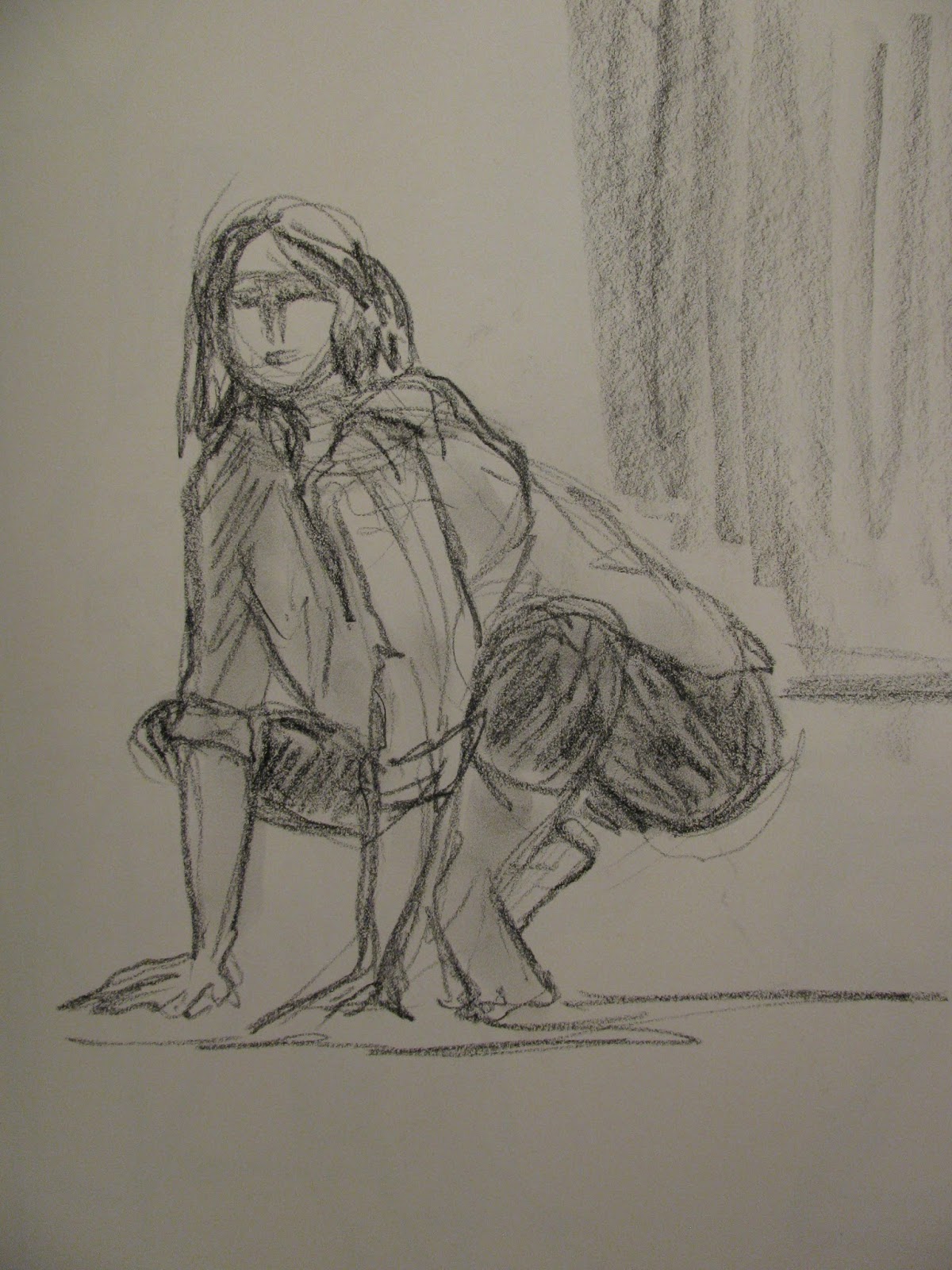
The next week I was back, equally excited but not as in synch as I'd felt the first time. The young model's boxy shirt was obstructive.


Not to blame the model, I remembered that sometimes you're in the flow and sometimes you aren't. Once I'd warmed up, I caught a couple of her interesting poses.


My third and last session was both thrilling and challenging. The male model did terrific poses in the familiar art class sequence of several 1-minute poses, then 2-minute poses, then 5-minute poses, and a final 10-minute pose. You need to have your wits about you -- and I didn't always.

Are you ready? Here are the five 1-minute poses:


Here, on two sheets, are the five 2-minute poses:


Now, on two sheets, the five 5-minute poses:


And...ta tum...the final 10-minute pose. I *really* wanted to finish with my best -- and I did:


Back home, I sat at the sun-splashed table in the front window and caught an amazing reflection of golden hearts from my cherished cat mug (that holds coloured markers!) onto the program announcement. Call it "The Way to My Heart."


Wednesday, March 23, 2016

Making a splash


By now, my faithful readers know of my great interest in the human figure -- an interest that goes back decades (yikes!) to my days of taking life drawing classes in the early 1980s. By then, I'd already discovered my bible -- a book titled THE NATURAL WAY TO DRAW by Kimon Nicolaides, an instructor at New York City's revered Art Students' League through the late 1920s and 30s.

Nicolaides "invented" many of the drawing exercises that are still taught and practiced -- "gesture drawing," "contour drawing" and so on, but it is his whole approach that is amazing and demanding. He doesn't teach "techniques" and he certainly doesn't believe in "the right way" to do something. He counsels again and again....to look....to see...to feel....and, most of all, to work attentively every day.

He describes his exercises quite concisely and then assigns repeated practice sessions that take 15-20 hours. Over the years, I've returned to him again and again. And always, over the decades, I've tried to consistently practice "The Daily Composition." This is a small quick gestural study from memory of a place/people/activity seen during the day. His assignment: "Do not be concerned about 'doing it right.' There is no right or wrong. Just do it. Do it every day for a year. The serious student will do it every day for the rest of his or her life."

This Winter-Spring (that's a season, right?) some serendipitous events came along to jumpstart my interest again. First, a reprinted painting by Vancouver artist Thomas Anfield caught my eye, and as I pinned it to my bulletin board next to a Cezanne landscape I was blown away.


Then, a book I'd looked at several years ago became available again from the library.


As I flipped through it, I was struck by the resemblance of his frequent beach scenes...


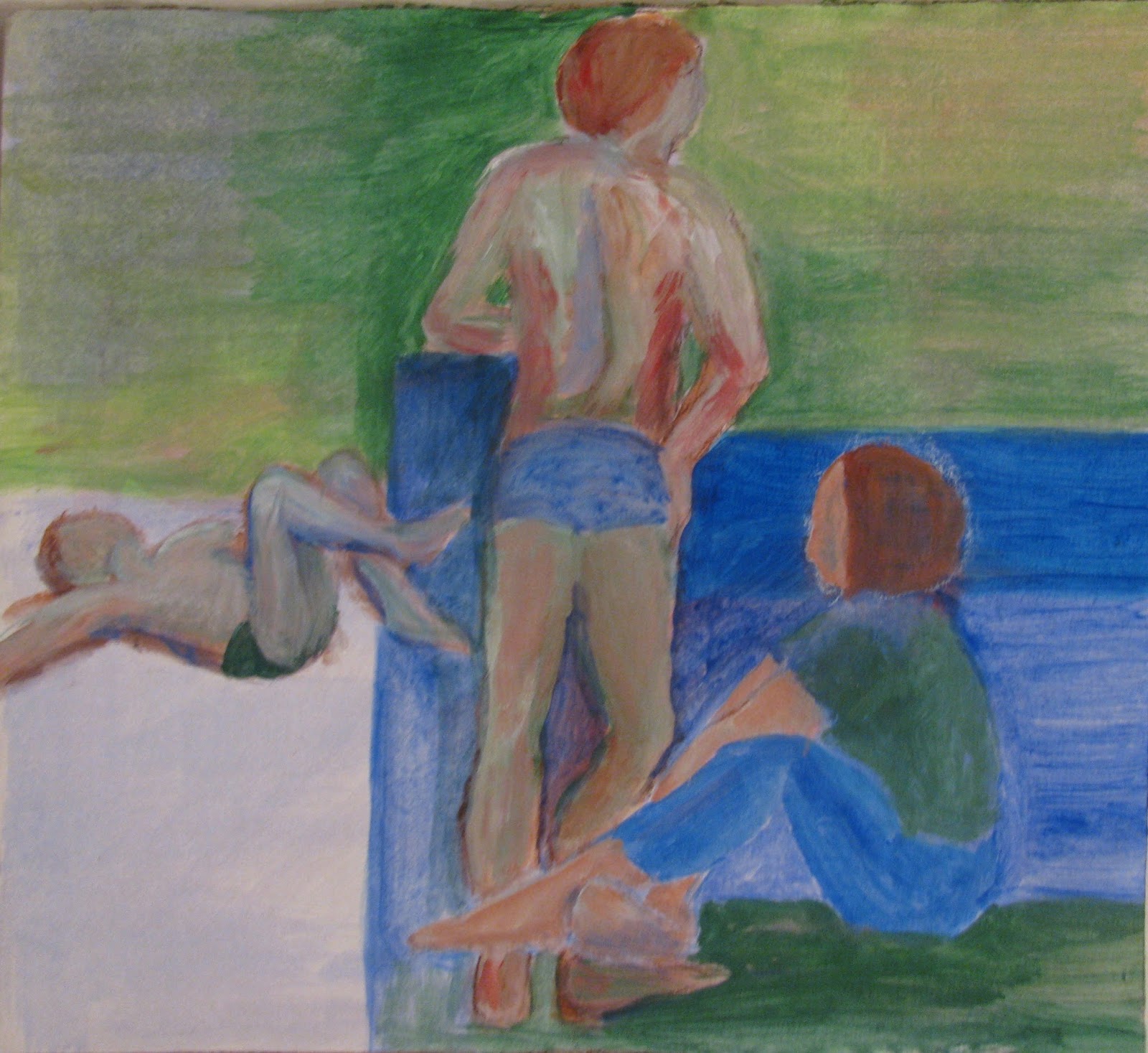
...to my own old "Aquatic Sketchbooks." For almost 20 years, we swam three times a week -- summers at the outdoor Kits Pool; cool weather at the indoor Aquatic Centre. I'd take along a small sketchbook, and I filled dozens of these with quick gesture drawings of swimmers and beach loungers.

Already determined to weed out my old sketchbooks, I decided to weed and paint at the same time -- with a series of small studies a la "The Soma Suite".  Combining small sketches from different pages, I produced six small painted panels. Here's the outcome:--

A sketch contributing to "Wait and See":

The painted study:


One of the sketches for "Too Cold to Swim":


The painted study:


The preliminary to "Sunspot":--


The painted study:


Sketch preliminary to "Low Tide."


The painted study:


...and where are my preliminary sketches for "Warm-Up"? I don't know, but here's the paint job:--


Finally, a contributing sketch to "Poolside with the Strata Council."


And the painted version. (Strata, get it?)


When I sketched long ago at the Aquatic Centre, an older guy (now I would call him a younger guy!) who worked at the pool came over and asked to see what I was doing. When I showed him my sketchbook he said, "Ahh...I thought so." He explained that years before, in his native Czechoslovakia, he had worked for a ballet company. Cameras and film were not readily available then, and he was employed to sketch the dancers in movement as they developed their program.

I remembered this as I read about artist Thomas Anfield, who also creates dance performances. And circling around this concept of dance and visual arts is a remarkable synchronicity that recently unfolded for me. Stay tuned for more on that next time.

Meanwhile, if you find gesture drawings intriguing, you can view more of them here.  And who knows? You might even get a postcard in the mail with a swimmer, a lounger, a stretcher, a sketcher...or even a dog!


Thursday, February 25, 2016

It’s a hoax! ....Or is it?


I've read so many books on art theft and art forgery that someone might question my motives. But you can learn a lot about art and art history from this angle. I actually did a tiny forgery myself once. No, not "The Coffee X-Change".

My forgery was done about ten years ago as an assignment from one of my painting books. I had so much fun with it, I couldn't leave it behind when we moved to The Yellow House in 2012. The objective of the lesson called "A Colour Forgery" was to learn how to mix tube colours to get just the colour you want. The method: Cut out "colour chips" from magazines, glue them to a firm support in a design of your making, and then try to equate the magazine colours with your own paint mixes


Sound easy? It ain't. My final outcome is shown in the title image above -- the two panels (colour chips and painted "forgery") of my Matisse-inspired design. Some colour matches were fairly successful:


Others, less so:


When I unpacked these small panels recently, I considered continuing where I'd left off but decided to rest on my laurels, such as they were.

About this time a second-hand book and a friend's Facebook posting came my way, almost simultaneously. This was quite a coincidence because one doesn't have to go far into the field of art forgery, without thinking of Vermeer.
 

Of course, everyone knows Vermeer. He's an icon, for heaven's sake (to use that teeth-gritting word).
 
Because little is known about his 17th century life and because he made only 36 paintings, he and his work became the natural prey of the infamous art forger Hans Van Meegeren.


The story of Van Meegeren's trial is fascinating -- because he didn't exactly forge a painting -- he created new paintings that "forged" Vermeer's style.

But back to Vermeer.


One of the mysteries surrounding his work is whether or not his sublimely realistic paintings might have been created with the help of an optical device called a camera obscura.

-- or maybe even the simpler camera lucida. Personally, my eyes glaze over at these technicalities, but I'm intrigued by someone like Les Cookson, whose obsession is to hand-craft the beautiful boxes that are camera lucidas. (or is that cameras lucida?)

But Les Cookson's obsession is nothing compared to Tim Jenison's. The Jenison project was brought to my attention by my clever friend The Wizened Eye.  Truly -- whether or not you've wended your way this far, through any of the previous links, you *have* to view this one -- it's otherwise indescribable.

http://boingboing.net/2014/06/10/vermeers-paintings-might-be.html

My friend The Wizened Eye not only has an eye for the exquisite in her own works. She also has a somewhat devious mind, and she pointed out that the Tim documentary was produced by the famous magicians Penn and Teller. The question that naturally follows -- Is the Tim thing itself a hoax? -- has been exhaustively addressed by another writer.
https://medium.com/@joshgans/10-reasons-to-doubt-tims-vermeer-c183bb3ce7a2#.puo83j1tc

The jury is still out on that one. But when you pull together the threads of art, money, and personality quirks, strange patterns can emerge.


And on show right now at Vancouver's Oakridge Mall (remember? Where art and high fashion meet) is a sale of twelve "3-D reproductions" of Van Gogh paintings, sanctioned by Vincent's great-great-great-nephew.

And there's an on-going real-life lawsuit around the Caravaggio painting sold by Sotheby's as a forgery, er, copy -- which has since been declared (by some) to be a real Caravaggio.

Ah, what a tangled web we weave, when first we practice to deceive...


Sunday, January 31, 2016

What would Degas do?


About this time last year, I was starting to think of a commemorative painting for my 70th birthday in May 2015. Inspired by my long-time enchantment with Degas and his painting "The Collector of Prints," I finished on deadline my own version, a self-portrait called "Seventies Sunrise."


I learned so much from that experience and since then, the spirit of Degas has looked over my shoulder as I've worked in the studio. I've done many small studies of his compositions, like the one above, and I'm endlessly fascinated by the way he often plays big shapes against a background grid. When I was working on "Not Far From SoMa," my small panel of figures against the grid of a streetscape, I whimsically asked myself, "What would Degas do?"


Ha ha, I thought. He'd be right at home at Starbuck's. And the thought then came to me to do another riff on Degas with a painting of figures in a 21st century coffee shop. I flipped through my biggest and best Degas book and came upon his familiar painting, "The Cotton Exchange." 


Perfect! That high ceiling is just like those in the coffee places in some of downtown Vancouver's heritage buildings. I made a quick painted study as I mulled over the possibilities.


The contrast of darks and lights in his painting is striking, and I realized that I had to find plausible substitutes for the mass (and snippets) of cotton. I also realized that the worst mistake I could make would be to try to "duplicate" the figures exactly. After all, it's not just guys in suits who drink coffee. Instead, I invited as the clientele my friends and neighbours along my block -- assembled together in a trendy place called "The Coffee X-Change."

The mass of tabletop cotton became a tablecloth.


The serious figure in the foreground became retired teacher J, checking his I-phone and guarding someone's light-coloured pack and windbreaker.


Looking on fondly from the sidelines is his indulgent partner E, hoping they'll soon get back outside to Sally, their dog.


Spreading the tablecloth is thoughtful J, cheered on with coffee served by her partner E. I decided they were throwing a celebration for the seniors on the block --that's my pal G arriving in the background, and I'm next to her, unseen in back of the window frames.


Nearby, checking their I-phone are J and S -- she of the enviable turquoise hair! -- and in the background B, who's testing the limits of the X-Change's hospitality as he pulls his pug dog along with him.


Sprawled at centre stage is another S, the dad of the block's second pug dog.

 
 -- and just arriving are A and ....still another S, the two of them gracious gardeners and bakers.


Finally, far right, putting cream in their coffee (offstage) are young parents K and M -- with their engaging 1-year-old son M out of sight on the floor behind them.


And all of this happened on top of an old 2011 painting called "A Balancing Act."


Be sure to watch the progress of "The Coffee X-Change" here to see how the giant radishes are eventually stomped out. And please enjoy your beverage of choice as you view the grand finale:--