Wednesday, May 23, 2012
courAGE!
With my birthday this week, I'm halfway between 65 and 70 -- an interesting time to recall my reactions when, in my early thirties, I discovered the magnificent drawings of 20th century artist/activist Kathe Kollwitz.
In addition to her powerful works on behalf of the dispossessed, she drew self-portraits throughout her life. The early ones show a frank fresh-faced girl with deep intense eyes. The later ones, like the one above, show -- well, the inevitable sagging chin line and wrinkles. I can remember (so long ago!) thinking, "Wow. That took a lot of courage."
I haven't as consistent a personal record to look back on, but inevitably I've made many self-portraits in my time. (After all, one reason artists do self-portraits is to make use of a convenient model who's not likely to complain, "But you made my nose too long."). In learning to draw, I made this one in my early thirties.
Another surviving self-portrait recalls my early forties:
And this one, also from my forties, was intended as the study for a painting that never materialized:
Surely I must have done a self-portrait some time in my fifties, but nothing surfaced in my studio clean-up. In my sixties, though, I've painted two self-portraits. This one, "At 60 in Favorite Shirt" has been described by a friend as "a bit grim."
And so the next year, I painted one that's a bit more mellow, in which I reflect on and reflect my own "Gemini Split."
Is there another self-portrait, drawn or painted, in my future? No doubt -- since the temptation is always there. But in my mid-sixties, would I really have Kollwitz's gumption? In looking at one of my best "classical realist" drawings (shown below) -- also from my thirties -- I've had the idea that maybe I'll draw this same pose again and let my forearm and hand show the changes of three decades. All it will take is a little courage.
Wednesday, May 9, 2012
Tree People
Most of the pleasures of the home we'll be leaving soon have had more to do with the outdoors than with the antiquated interior -- witness the ancient pear and plum trees in our backyard. From the very first sight, I've been enchanted by the interrelationship of these two trees and the particular shapes and thrusts of their branches.
They were even my models for a long-ago assignment to create an imaginary exhibition poster. (This imaginary exhibit was so enticing to my feline fans that they clawed the poster off the wall!)
At some point, the fascination was articulated for me in the writings of Renoir, who has proven to be one of my important teachers. He wrote: "When you have learned to draw a tree, you will be able to draw the human figure." Suddenly, I realized that somehow the form of these trees echoed the drawings I most love, Michelangelo's "studies for the Libyan sibyll." Notice here the curve of the spine, the movement of the arms, and the gesture of the left hand (also pictured in a unique study, just below-left of the torso):
-- compared to our plum tree:
We bought our old house in 1985, long before Teardown Mania hit Vancouver's real estate market. Even then, we were the only potential buyers who wanted to live in rather than to demolish it. The pear and the plum trees gave us years of fruit for wines and jams, along with the daily enchantment of their beauty and their attraction to birds and insects. In turn, we were able to give them a 25-year renewed lease on life -- and are perhaps still their debtors.
Wednesday, April 25, 2012
The greatness of mountains
In our 35 years in B.C., we've met the occasional odd native who is indifferent to the wonder of mountains (or eagles, or seals). Odd, indeed. For us, it was love at first sight when we drove west by van, and the great wall of the Rockies suddenly came into view from a hundred or more miles away.
In our first five years here, we hiked every weekend and became closely acquainted with many mountains. Inevitably, mountains were early subjects when I began to paint -- in the beginning, "imaginary" mountains evoked from the Upside-Down File, such as "Ravenstorm" (circa 1990).
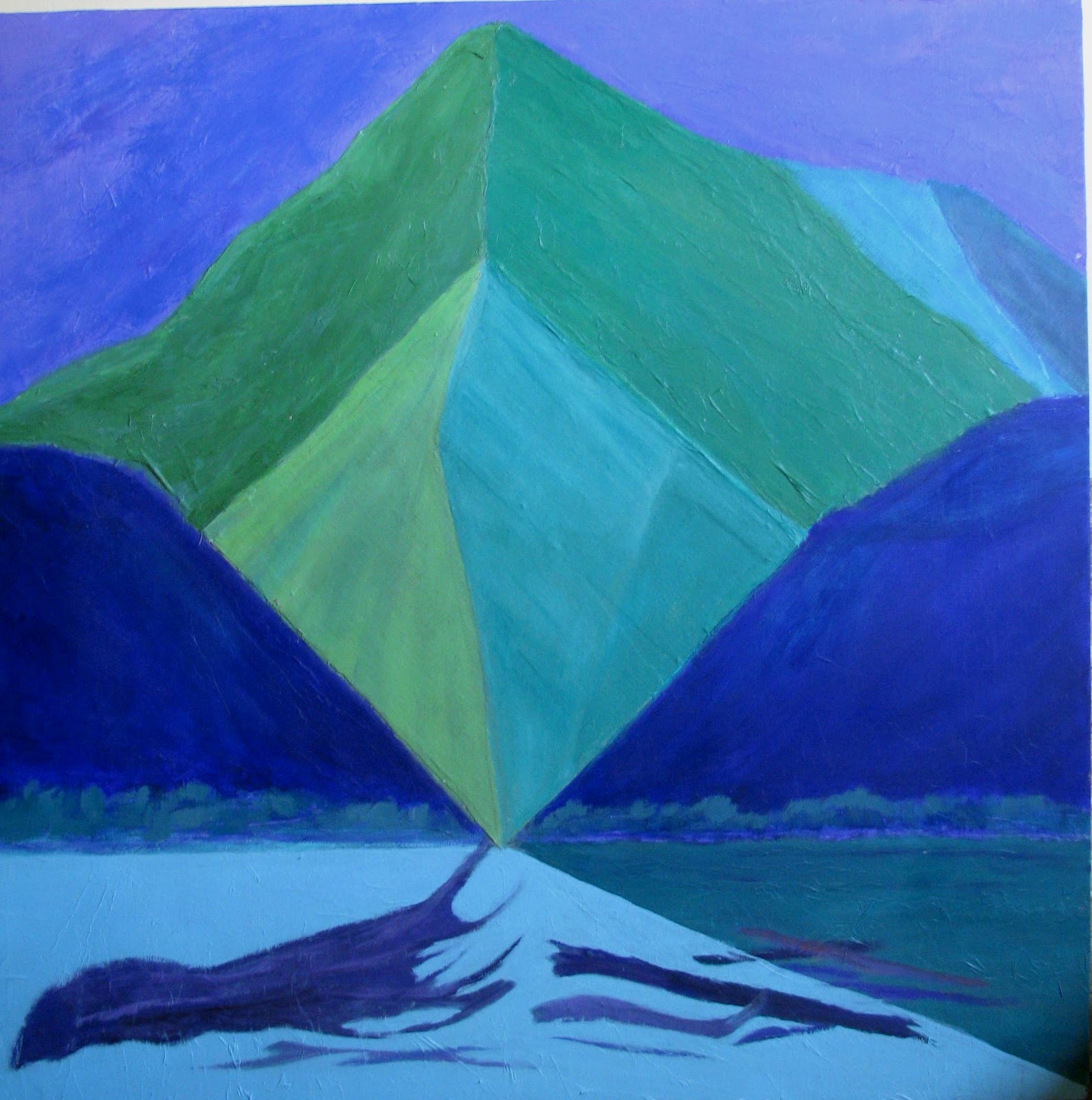
Eventually, we bought a kayak and spent every weekend on the water, coming to know among other things, the drama of mountains meeting shorelines, as in "Above Furry Creek" (1991).
It happens that my mountain paintings were all done on pressed wood panels with applied texture and collage elements. JT cradled them for me, applying wood braces to the back side to prevent warping. "Above Furry Creek" was the largest panel I worked on at 5' x 5' -- and a fast-moving furry creature has been enlisted here to show its scale.
Working on this painting, I became fascinated with how the diagonals and triangles of actual mountain-scapes resemble endless variations on the Eye of God motif.
Eventually, we found our cabin property and became immersed in the natural life of the Upper Squamish Valley, living almost half-time year-round for 20 years beneath the mountains of the Tantalus Range. "Mt. Pelion" (shown here) looked down on us from the north.
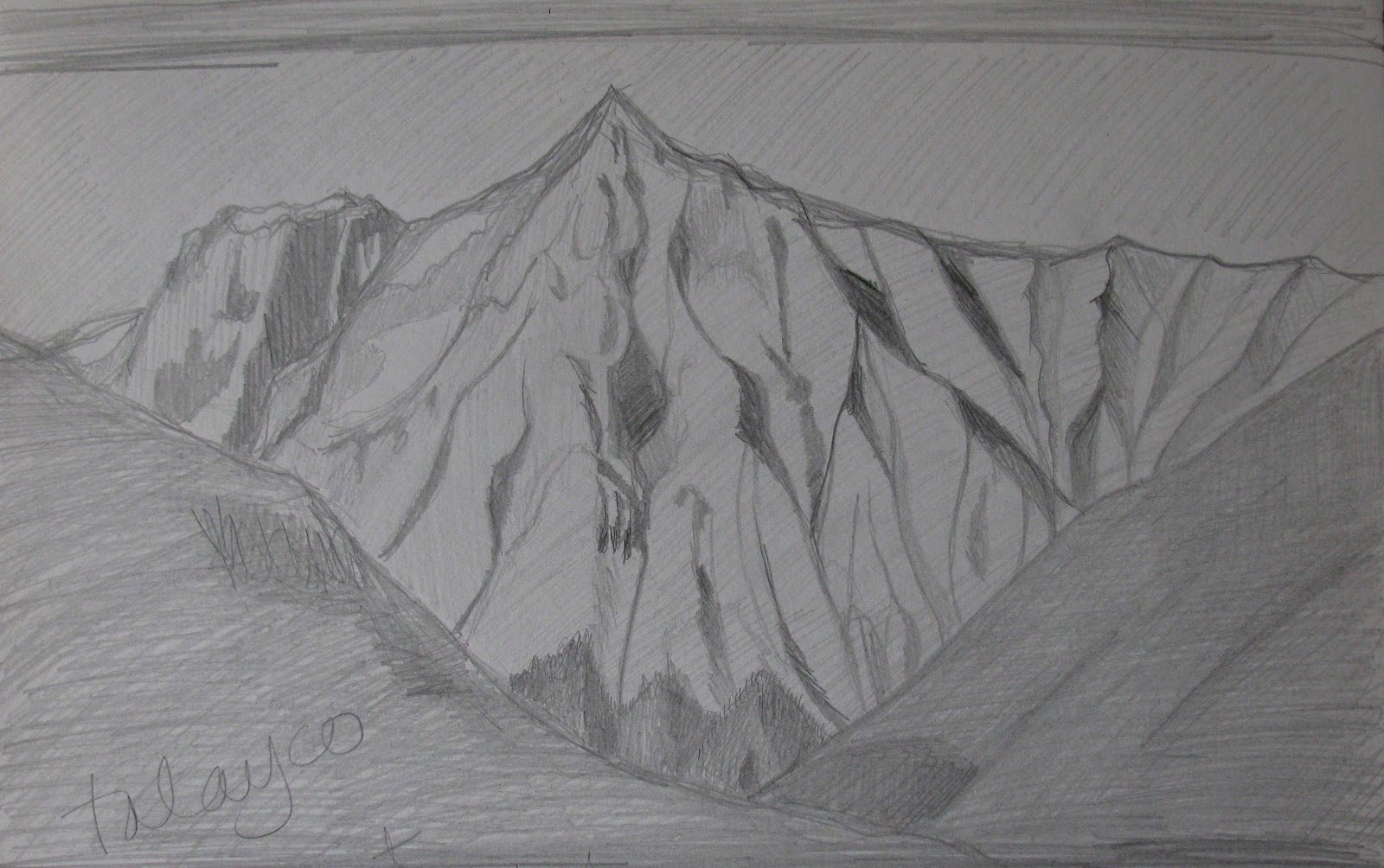
In my ongoing 2012 studio overhaul, I found among my sketchbooks many records of my Mountain Period, among them my first pencil study for "Above Furry Creek."
...then a small (5" x 5") colour study, collaged from colour chips clipped from magazines.
...then -- most worth finding again -- a quotation from Lama Anagarika Govinda's The Way of the White Clouds that seems to resonate with the Eye of God theme -- and with our own intense response to mountains.
To see the greatness of a mountain, one must keep one's distance; to
understand its form, one must move around it; to experience its moods,
one must see it at sunrise and sunset, at noon and at midnight, in sun
and in rain, in snow and in storm, in summer and in winter and in all
the other seasons. He who can see the mountain like this comes near
to the life of the mountain, a life that is as intense and varied as
that of a human being. Mountains grow and decay, they breathe and
pulsate with life. They attract and collect invisible energies from
their surroundings: the forces of air, of the water, of electricity
and magnetism; they create winds, clouds, thunderstorms, rains,
waterfalls and rivers. They fill their surroundings with active life
and give shelter and food to innumerable beings. Such is the
greatness of mighty mountains.
Tuesday, April 3, 2012
Excavations: The artist's early abstract period
The first is "Warmfront" (copyright 1986) in which I contrasted warm and cool colours for the effect of something warm and fluid breaking into something cool and geometric.
The second is "The Inspiration of Wings" (copyright 1986):
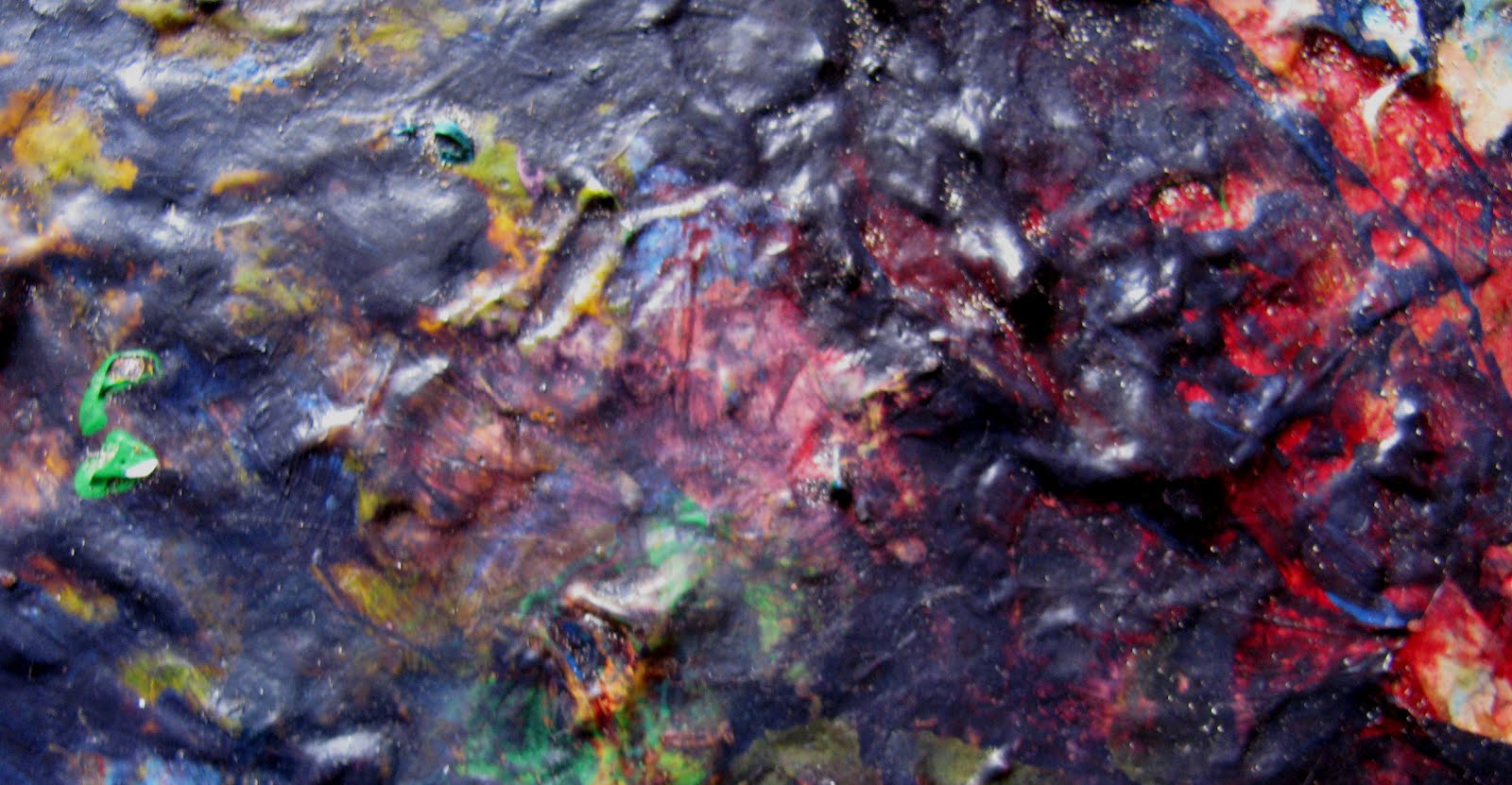
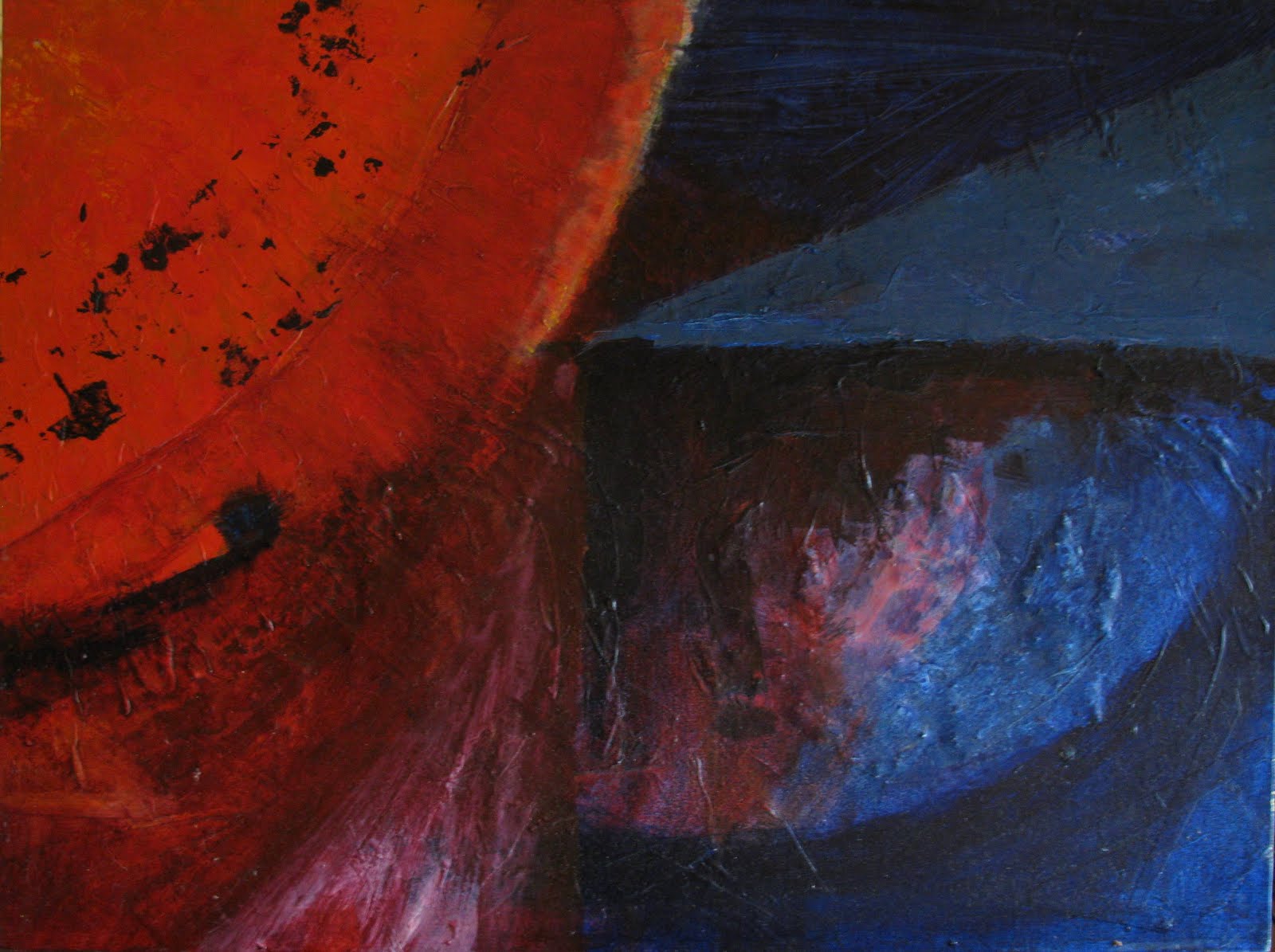
...and Exhibit B:
The colours and movements are rather exciting. In fact, as I look carefully, I think Exhibit A and Exhibit B just might make better paintings than "Warmfront" and "The Inspiration of Wings." And these two Exhibits are sections of my dried palette in its most recent state!
Tuesday, March 20, 2012
The Upside Down File and Leonardo
The trick is to ignore the subject of the photo, blur your eyes, and look for a lively spread of dark and light tones that establishes strong directions -- a composition that could make an interesting painting if you plugged in colours and your own content. Close encounters between football players can be surprisingly useful, but even talking heads or crowd scenes can work.
When I find a good sample (and sometimes it comes with viewing sideways), I might keep it on file or do a quick sketchbook study. The objective, when you paint, is not to reproduce the newspaper image exactly but simply to get down the gist of it as a starting point.
In my Betts-Wannabe phase, it was only natural that I turned to my Upside Down File for my long-ago series of paintings (never realized) called "Howe Sound Creeks." In those days (long before the Sea to Sky Highway was "improved" for the 2010 Olympics), we commuted every weekend to our cabin north of Squamish and came to know every season of the mountains along that roadside and the creeks that pour down them.
This clipping looked like a promising start for my first painting:
Here's the resulting painting. I had fun working on it but can't say I was wildly satisfied with the outcome, finding it too rigid and formalized:
However, this first try was serendipitous. At that time, I was using the flat side of styrofoam egg cartons as palettes, and I noticed that my final mix of colour on the palette made for a very exciting mini-painting on the creeks theme:
I decided to use this as the study for a second painting:
Hmmm....not half as good as the accidental egg carton version! So it was about this time that I decided to return to the Howe Sound Creeks Series another day.
And what does this have to do with Leonardo, anyway? Well, I think my clever mentor Edward Betts offered his students a convenient modern adaptation of an exercise that Leonardo proposed to his own students in his Treatise on Painting.
"I will not forget to insert into these rules, a new theoretical invention for knowledge's sake which, although it seems of little import and amusing, is nonetheless of great utility in bringing out the creativity in some of these inventions. This is the case if you cast your glance on any walls dirty with such stains or walls made up of rock formations of different types. If you have to invent some scenes, you will be able to discover them there in diverse forms, in diverse landscapes, adorned with mountains, rivers, rocks, trees, extensive plains, valleys, and hills. You can even see different battle scenes and movements made up of unusual figures, faces with strange expressions, and myriad things which you can transform into a complete and proper form constituting part of similar walls and rocks…. Don't underestimate this idea of mine, which calls to mind that it would not be too much of an effort to pause sometimes to look into these stains on walls, the ashes from the fire, the clouds, the mud, or other similar places. If these are well contemplated, you will find fantastic inventions that awaken the genius of the painter to new inventions..."
Tuesday, March 6, 2012
End of Winter?
When this splotch of golden yellow appears in the garden (this year, along with an unseasonable late February snow) I know that we're truly on the verge of making it through another winter -- because these crocuses and I have a pact that goes back to 2005.
At that time, I had an early-spring realization that along with "getting older" (not to be confused with actually Getting Old), I was also getting more sensitive to the potential downs of winter's darkness. I resolved that the only antidote was to meet winter head on and plan something to look forward to, along about mid-January. Once I had decided this, things began to fall into place for an anticipated painting I'd already titled, "Depths of Winter."
First, at work, a matte black flower pot showed up next to the garbage can. (Packrat alert! Packrat alert!). "I know!" I thought. "This year I'll force some bulbs for that pot -- bright yellow, maybe." As I envisioned the dark/bright contrasts my painting would have, I spotted a dark blackish teapot in a thrift shop window. On a summer walk in VanDusen Gardens, I picked up some dark and dramatic Himalayan pine cones, and autumn brought the delivery of my crocus bulbs. As I planted them for "forcing" (I now prefer my invented term "inviting"), I began to set up my still life against an old black patterned skirt. When the bulbs flowered in my studio in mid-January, the almost-finished painting was waiting for them -- and here it is.
"Depths of Winter" (copyright 2006) is still one of my personal favorites. I learned so much, dealing with the shadows and the tones of yellow, and it always brings back to me the emotions of that time. The garden catalog cautioned that "invited" bulbs might not prevail when planted outdoors after their first indoor flowering, but these golden yellow beacons have unfailingly come back every late winter. We've almost made it through!
Tuesday, February 21, 2012
Frequently Asked Questions
When I went searching for my pen-and-ink drawing with the bit of wasp nest resting on a desiccated magnolia leaf, I came up with a small stack of 6" x 8" pen-and-inks I'd done twenty years ago. At that time, I was very engaged in drawing and had become fascinated with the patterns in JT's bandanas played against the shapes and designs of shells, seedpods and dried flowers.He perceived this inquiry into "production time" as a very low-brow response to the painting process. (Imagine the tourist in tropical shirt and baseball cap, tapping Leonardo on the shoulder and asking him the same question. "...and by the way, don't you know her smile's kinda crooked?")
So this author/artist had mulled things over and devised his own satisfactory answer to this Frequently Asked Question. The dialogue now goes like this:
Question from uninvited commentator: "Hey, man, how long did it take you to do this painting?"
Superior artist, after pregnant pause: "My whole life. It has taken me my whole life to get to this point."
Well. That should put a stop to any further intrusive questions.
Personally, I think the deadly FAQ is a natural enough one, especially coming from someone who doesn't paint and is wondering what it might involve. Documenting the development of my own paintings, I've found it revealing to learn that for a typical still life, I average 15- 20 hours on each one, preliminary sketch to sign-off (not including "all my life to get to this point.")
There are lots of ways to look at time. Rainer Maria Rilke suggested this viewpoint for artists.
Being an artist means: not numbering and counting, but ripening like a tree,
which doesn't force its sap and stands confidently in the storms of spring, not
afraid that summer may not come. It does come. But it comes only to those who
are patient, who are there as if eternity lay before them, so unconcernedly
silent and vast. I learn it every day of my life, learn it with pain I am
grateful for: patience is everything.