Tuesday, February 7, 2012

Colour -- and the gifts of grandmothers

A few months back, while I was mixing paint for "September Stripes," a whole world of colour suddenly flooded back to me -- in the afghan I had as a child. What followed from this flash was an interesting few days of recovered memory colliding with colour theory and warm thoughts on the unintended riches of certain family legacies.

My remembered afghan was authentic in three ways:-- It was made in the traditional "granny afghan" design of multi-coloured squares bordered in black. Its yarn, in the thrifty spirit of mid-1940s wartime, came from either salvaged worn-out sweaters or scant leftovers from newly knit ones. And it was crocheted especially for me by my grandmother who was called "Granny."

Granny, who lived with us for many years, seemed flawless to me -- as each of her grandchildren in their individualities, was to her. How was it possible then, I would wonder as a 5-, 6- and 7-year-old, that she had made a Big Mistake with some of these colours? In fact, as much as I tried, I could never wholly accept a single square as ideal -- only two or three rows together at most. It was only later that I realized the construction of the squares depended entirely on the amount of yarn available.

Whenever I would snuggle under my afghan (which I could distinguish in an instant from my brother's -- something no one else could do), I'd carefully put on top the two squares with my favourite colour combinations. One of these contained the rich and pale yellows of "September Stripes". The other had a three-row sequence of blue-toned pastels.


I was astonished how clearly these colours came back to me. Once I'd remembered my favorites, others came through over the course of a few days -- arriving in small parcels, like the balls of varied sizes in my grandmother's workbag. There were the ones I didn't like at all:-- a very dark brown with a deep dull maroon, a chestnut brown with a dull olive green, and a sickening pale pink with a half-hearted tan. As a child, I'd mentally move a colour or two to another square, trying to make them work, but these ones were mostly beyond redemption.


Last to arrive from my memory bank were the almost-rans, the colour combinations that intrigued me: an emerald green with a wan beige; an intense orange with an intense turquoise; a 3-row set of rich cherry red, dull blue-green, and a green-tinged off-white. I'd look at these again and again, making mental adjustments that might bring them into the "like" category (what if this orange were paler, this green softer?).


As you see, I resolved to try to reproduce the remembered colours in paint. In the hours I worked, it occurred to me that almost every one of these samples, good or bad, could form the basis for a lesson in artists' colour theory -- something for which my grandmother would have had no use. Except for her grandchildren's afghans, she crocheted exclusively in white, making intricate doilies for the arms and backs of upholstered chairs (definitely old-fashioned by the early 1950s!)


Nonetheless, it seems I owe to her my great love for colour and a fair bit of sensitivity in its use. And along with this meditation on colour, I had another rich thought:-- that some of the legacies children receive are obvious, and some are less so and sometimes more important.

Among my friends now are grandmothers, great-aunts and aunties who are blasting away almost non-stop on behalf of their cherished little and not-so-little ones:-- knitting, crocheting, quilting, sewing, cooking, felting, baking, story-telling, singing, play-acting, writing, scrap-booking, photographing, recording, event planning...with creations that include hats, blankets, sweaters, toys, stuffed animals, costumes, favorite foods, tall tales, family histories, surprise (or not so) parties, uniquely designed cakes, never-stale cookies...the full meal deal. (My mouth waters just thinking of a nourishing bowl of Mrs. Gnome's Track Soup, with sides of yams and sticky rice, topped off with a whole plate of Grandma's Rainbow Cookies!)

And I've wondered, as I painted the colours that Granny bequeathed me, just what legacies from grandmothers, great-aunts, and aunties will be remembered 40-50-60 years from now by Aedan, Aiden, Alanna (please!), Alexa, Alyssa, Andrea, Chantel, Christian, Corbin, Fred's and Bruce's kids, Gavin, Jaymie, Juniper, Logan, Matthew, Merritt, Nyah, Ocean. Time will tell.

Tuesday, January 24, 2012

"Everything about the wasp except why"

A few months ago, I re-read a favorite book, A Species of Eternity by Joseph Kastner. It's an engaging history of the adventures of the explorer-botanist-naturalists of pre-colonial and colonial America and touches on how their discoveries were viewed in Europe. I came across something I'd never noticed before: In the 1700s, Parisians would pay more than the price of a pearl necklace for the nest of a North American paper wasp!

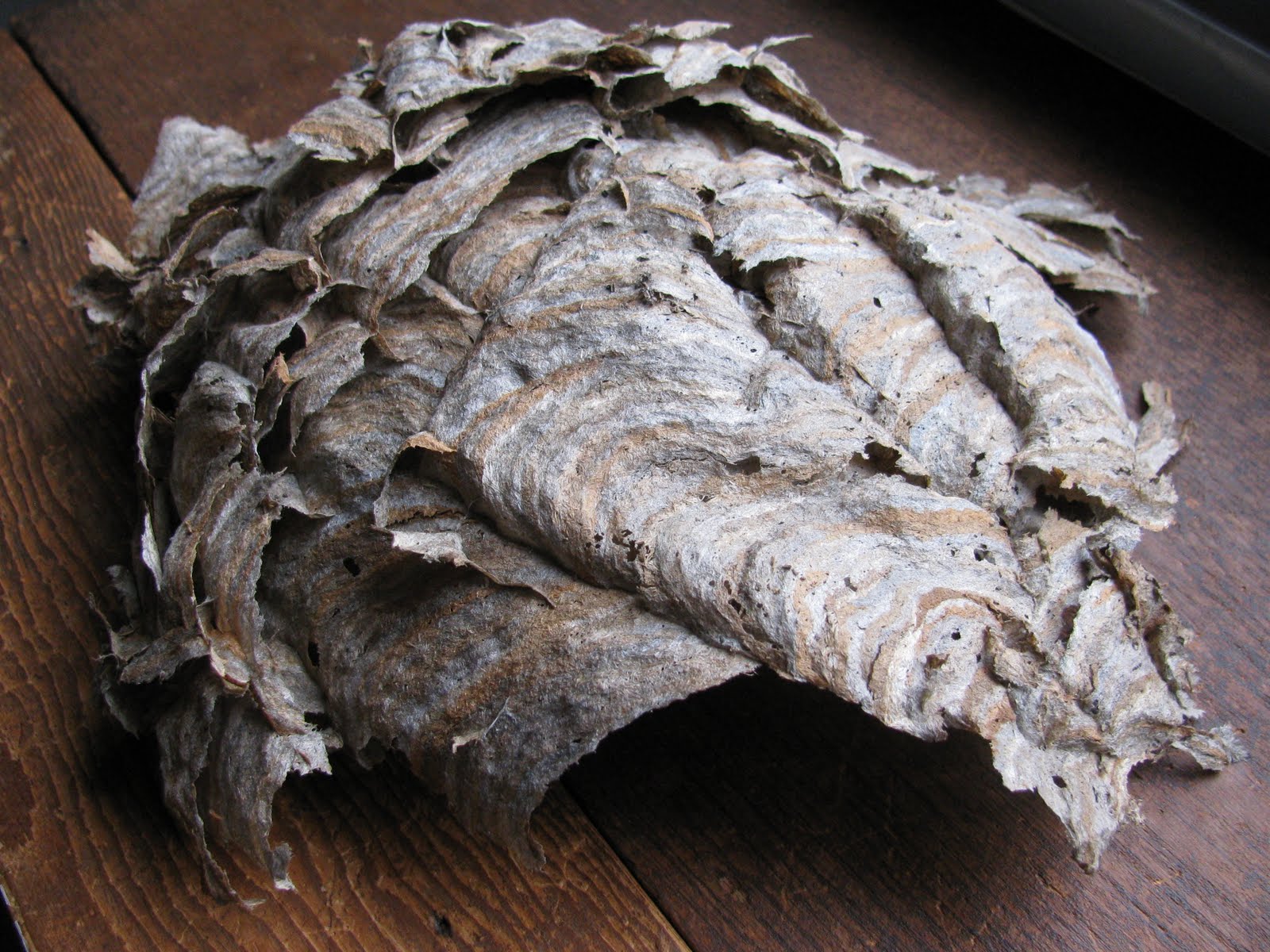
Well, I'm with Paris all the way on this one -- and JT knew the way to my heart when about ten years ago, he brought home an end-of-season partly dismantled wasp nest. If you've never seen the inside of one of these elongated globes, a revelation awaits you. The architecture is astonishing -- a series of five 6-sided egg casings (rather like slices of beehive) are stacked in descending size, with a "button" at the top.


The hive structure is encased by layer upon layer of wasp-recycled paper:-- newsprint transformed into rippling patterns of grays, dull yellows, light blues, and actually metallic-sheened silvers and golds. How do they do it?


What art could improve on this wonder? -- and yet, I was compelled to do something with it. I got out my coloured pencils and did a large drawing, just enjoying the experience of interacting with all its intricacies, all the ripples in its paper.


And not a moment too soon!! About a month later, now into the depths of winter, I walked into the studio one morning and found about three dozen groggy wasp youngsters staggering along the walls. ("Where are the trees and grass Mom told us about?") In family fashion, I captured as many alive as I could and put them and the entire hive outside. But I saved the outer wrapping and the little button (the cells of which had been empty all along) and later incorporated the latter into a pen-and-ink drawing called "Abandoned" -- which featured all kinds of empty nests, as it were.


Recently, I've been doing a big studio clean-up and still couldn't bear to throw out the wasp paper (or the button). My eyes happened on a second-hand picture frame I'd been given, the kind that has a linen mat which in this case was soiled and scratched. I realized now was the time to give it a new lease on life -- collaged with wasp paper!


The outcome is truly fabulous -- and I'll have to contemplate what kind of future painting I might make that would be worthy of it. Meanwhile, I again had the thrill of hanging out with the wonders of wasp-dom -- for one thing, how the layers of paper are "felted" together to create passageways for incoming/outgoing wasp workers.


I recalled again a line from Dylan Thomas' A Child's Christmas in Wales. Among the "useful presents" under the tree (distinct inferiors to the useless/fun presents), he lists: "...the books that told me everything about the wasp, except why."

Tuesday, January 10, 2012

"Mismatched"...oh, so very mismatched

At my final job, the preparations for a major office renovation involved all hands on deck to de-clutter closets and store rooms -- a dream activity for artist-packrats and a task for which I quickly volunteered. Intercepting a dumpster-destined box of never-used and outdated "company mugs", I found treasure: one of the untouched mugs had shattered into a fascinating variety of shards. I *HAD* to do something with it -- the varied sizes and shapes of the pieces, the white of the cracked edges against the black ceramic.

I re-wrapped and saved the pieces carefully, and for a couple years my mind played with what to do with them. In late 2011, I happened upon an old cotton shirt:-- black, white, and gold plaid. Ta TUM! I'd place the mug shards against the folds of the shirt!!


I began a study in pencil that quickly showed me that this was going to be One of Those Bright Ideas, the kind that never pan out. Just too fiddly.


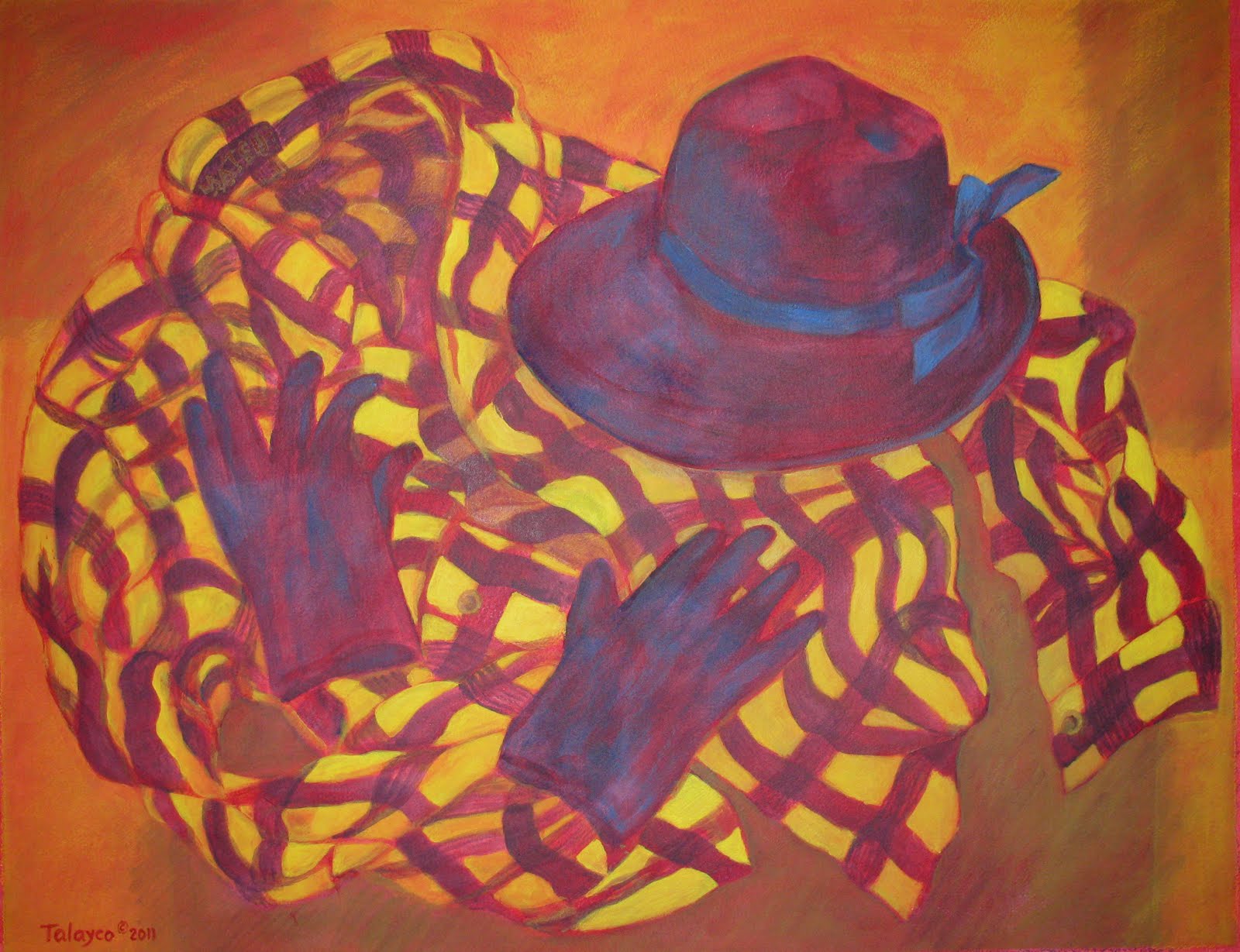
Well, what to do? I'd become enthralled with the way the plaid design warped and zigzagged through the fabric folds. But I could see that I needed something bigger than the mug pieces to play against it. My glance happened on my old wool felt hat that hangs inside the studio door.

I've saved this hat for poor nostalgia. It was the height of elegance in the late 1960s, worn with my first "grown-up" suit, both gifts from my mother when I graduated from university. A decade later, it had lost both lustre and relevance but it came along to BC with us, where it had a 5-year reincarnation as a cool weather hiking hat. Now the memory of the 3/4 length gloves I'd once worn with the suit brought to mind...a currently elegant/relevant and very beautiful pair of leather gloves that a dear friend brought me from Italy. Exit mug shards. Enter black hat and gloves.


In the final painting, I think I managed to pull off what I had in mind. You can see the plaid design evolve and watch for the first appearance of cuff buttons here.The painting's title reflects the mismatch with my original intentions, the mismatch in eras and tone of the various pieces of clothing, the mismatch of the plaid design as it snakes around the old hat and the beautiful gloves. Here's "Mismatched," copyright 2011.


Thank you, VF mug, for taking a detour on your way out the door to inspire my funkiest painting yet. And thank you, VF friends, for keeping in touch and cheering me on. May you always choose the right accessories and may you correctly button your plaid shirts so that you are never...mismatched.

Tuesday, December 13, 2011

Cucurbits 2011 - A creative convergence

"Mysteriosa reptans" is the (pseudo) botanical name I gave to the mysterious vining plants that emerged spontaneously in our garden in July, no doubt volunteered from our home-brewed compost. By September, the four plants had produced two small pumpkins, two small acorn squashes, and three striped squashes of the "Heart of Gold" variety.

If you read my previous post, you'll know about my seasonal fascination with the Cucurbit family (squash, pumpkin, melon) as the basis for a painting. This year, there was a remarkable convergence on this theme. As I set myself the challenge of painting our garden cucurbits, another garden was spontaneously generating in Manhattan.


First, my painting:-- I set myself the challenge to create an interesting composition with seven objects very similar in shape and size (one usually chooses more variation). The outcome is "September Stripes," copyright 2011. (You can watch those stripes develop here.


Meanwhile, on the East Coast, my lifelong friend A was manipulating her long vines of knitting yarn to create some witty cucurbits and Indian corn (I must try that next year!) for No.1 Grandson's Halloween and for her own Thanksgiving table.


On close inspection, these are no ordinary veggies -- they're clearly heritage varieties!

There are many smiles for me in this convergence -- a smile as I brought my painting together, smiles when I received A's stories and photos, and then...as the season progressed, a big smile as I put our garden squashes to their final use (saving their seeds for next year). As I pulled the first batch out of the oven, a line came back to me from Dylan Thomas' A Child's Christmas in Wales (relating to little boys pretending to smoke and then polishing off their candy cigarettes): "Then, with a smirk, we et them."

Tuesday, November 8, 2011

Cucurbits Fascination: A retrospective exhibit


The elderly Chinese couple down the street always grows mysterious vining plants on makeshift trellises in their front garden. I watch for the fruits, which look like a cross between a small green pear and a spiny chestnut. When I asked its name, the man gently cupped his hands and said, "We call it egg-in-hand." (Maybe it's white and soft beneath those spines?) Coincidentally, I later saw some of these "eggs" for sale as decorative objects, with a sign labelling them "cucurbits."

Now I've learned that there's a whole botanical family Cucurbitaceae, which includes, in addition to melons and cucumbers, the squashes and gourds that draw me like a magnet every autumn. While I planned by Fall 2011 painting, I hauled out all the cucurbit paintings I've done over the years. Here we go:

Starting with four small paintings in 2003, you'd think I'd have overdosed. I bought an amazing squash and a whole mass of beautiful gourds and did first a small study:


Next, a blue/green painting with what was then an enthralling theme to me -- the shapes of cardboard packing inserts - "Harvest - Three Gourds."


Then a Serious Painting -- "Melon Jug and Carnival Squash" -- playing the colour and texture of the squash against my mother's old ceramic pitcher.


Still unable to let go of the cucurbits, I placed three gourds under strong light and captured the shadows in a small study.


On to 2004, when a single plain gourd played a modest role in "Packing Form and Candlestick."

But I wasn't finished with that year's bounty and, getting out my coloured pencils, I constructed "Harvest Quilt."


In 2004, another of my family keepsakes -- my grandmother's cookie jar -- found unlikely cucurbit companions in "Echoes - Cookie Jar Tapestry."


How is it possible that I didn't succumb in the years 2005-2006? My next cucurbit painting, "Autumn Glow," was started in fall 2007, finished in winter 2008.


Similarly, in early winter 2009, I finished two paintings that were conceived in fall 2008. "The Wishful Bird" featured a thrift store find that kept me company -- wishfully -- while I waited for JT to come home from the hospital.


Then, a marvelous turban squash took centre stage in "That Time of Year" documented in one of my early blog posts.


Finally, in my 65th autumn, I did what's still (I think) my best-yet painting, "A Brown Study at 65."

The 2011 cucurbit? Just finished last week, to be unveiled with the next posting. It's mouthwatering.

Tuesday, October 11, 2011

Horizontally challenged

My words to JT signalled that summer was over, and I was relishing the start of fall painting season: "If you notice there's just one mandarin orange on the grocery bill, it's because I need a small orange object."

All summer, I'd been mentally planning my kick-off painting. It started when a clean-up project unearthed a very old cherished patterned skirt. On this background, I imagined various objects of the same colours as the skirt -- with the trick being to play off flat patterns with 3-D objects.

As the last two years' work will show, I most commonly choose a vertical set-up for my still lifes. To tone down the busyness of the many coloured shapes, I decided on a horizontal layout since horizontals tend towards calmness and stability.

Almost as soon as I assembled things, a small bell sounded in my consciousness. The summer camp dinner bell? No...a little reminder of the lesson I learned recently in attempting a light-hearted trompe l'oeil . The kind of precision required to bring off my pattern/object plan would just not be my thing. Nonetheless, I decided to press on with the fabric and objects -- and found that my first study loudly said, "BORING."

Resolving to work a little more loosely, I rearranged the fabric and shifted my viewpoint.

A quick line study confirmed something a little more lively.


The outcome is "Reaching Out" (copyright 2011) -- with many shapes and angles reaching out beyond my original concept. (I know, I know: I give the impression of being calm and stable myself, but in truth, I like to see a little more action). The final version is below, and you can view its evolution here.


Acknowledgments: The lovely little pottery bowl in the foreground was created by my friend D, who is in no way responsible for how it looks here!

Tuesday, September 20, 2011

Last postcard from summer camp

One advantage of attending stay-at-home summer camp was the ease of pursuing adventures just around the corner. On my customary two-block walk to the bus stop, I pass almost a dozen examples of old east-side houses -- modest and less than lovingly cared for, in many cases -- and I'm fascinated by their architectural oddities. I've counted about half a dozen styles of old roofing material, and I constantly wonder about the odd little square windows placed randomly, it seems, where access to the view outside appears unlikely. They can't all be on staircase landings (like the one in our house).

For months, I've been taken with a shabby house down the hill from the bus stop, its roof and part of one side just visible in the space between two closer buildings. Something struck me about the proportions of the dormer roof to the main roof, the funny placement of the dormer windows, and the rather perfect little chimney. I made some sketches from memory and wondered what would happen if I tried painting this slice-of-house in a very simple style. I spent my last session at summer camp giving it a try:

Well, Grandma Moses would be proud. (Or maybe she wouldn't.) I admit it looks verrrry Summer Camp. Still, I think something more engaging might be done with the simple geometries and funky details of these old houses.


There's a bittersweet footnote to my adventure. I arrived at the bus stop one day to see with astonishment....no, the house hadn't become a "tear-down" (in Vancouver parlance). It's being renovated!! Spiffy grey horizontal roofing tiles have replaced the weather-worn diamond pattern -- the latter "one of the best roofing systems ever made," according to the man who repaired the raccoon excavation in our own old roof. New windows have been installed and the framing repainted (though there's not much they can do with the odd way the window frame goes right to the edge of the dormer). Surely an all-over paint job is coming next. The old house that captured my eye is no more -- in its present rejuvenated state, it would never have attracted my interest.